
VIENNA — I am writing this from the Hotel Imperial lobby at 2:47 AM, surrounded by the wreckage of what I can only describe as the most expensive lesson in trusting algorithms I have ever received. The WiFi is still down. It has been down since Tuesday. Friedrich, the concierge, just walked past with a look that said I told you so without actually saying anything, which is impressive because we have never discussed prediction markets and I am fairly certain he thinks I am in Vienna for a conference about dental equipment.
I am not here for dental equipment. I am here because Eurovision is now a commodity, and I discovered this fact at 11:02 this morning, and my entire journalistic career collapsed into a single, crystalline moment of poor decision-making.
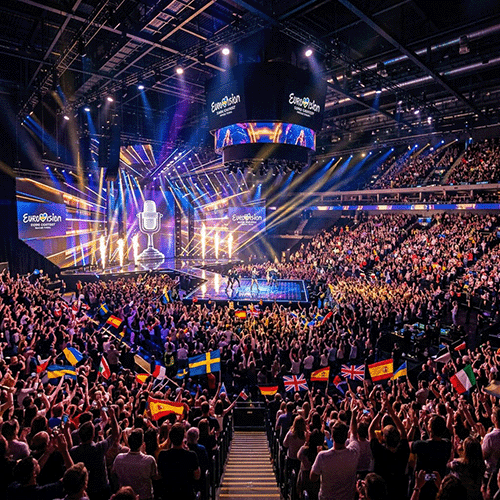 But I'm getting ahead of myself. Welcome to the Grand Final dispatch. If you read my semi-final piece, you know I arrived in Vienna with one press credential, zero Austrian, and an aggressive interest in the local pastry situation. I have now had eight Sachertortes. This is not a boast. This is a medical update. The hotel doctor has been notified. He recommended I "consider moderation." I considered it. I had another Sachertorte.
The finale was tonight at the Wiener Stadthalle, a venue that holds 16,000 people and, based on current crowd energy, roughly 12,000 of them are wearing sequins. The remaining 4,000 appear to be Scandinavian and are wearing the specific expression of people who have done this before and know where the good bathrooms are.
I found out about Kalshi at 11am, via a DM from my editor that read: Snipes. Eurovision is now a prediction market. Find an angle. Don't eat anything else.
I immediately ate a pretzel and opened Kalshi.
For the uninitiated — and before this morning, I was proudly among you — Kalshi is a US-regulated prediction market where you can bet on the outcome of world events. Elections. Economic indicators. Grammy awards. And, as of this cycle, apparently, which country's contribution to the collective European experience will be judged most worthy by a combination of national juries and televote, both of which function exactly like fantasy football but with more eyeliner.
At 11am, the board looked like this: Finland leading at nearly 47 percent implied probability, Australia in second, Bulgaria in third.
Bulgaria. Third.
I need you to remember that number. Bulgaria. Third. On the prediction market. The market, which is supposed to be smart, which is supposed to aggregate information, which is supposed to know things — the market had Bulgaria in third place.
I need to be very clear about something. Finland was being represented tonight by Linda Lampenius and Pete Parkkonen, performing a song called "Liekinheitin," which translates to "Flamethrower." I watched their semi-final performance from a press area that smelled like hairspray and collective anxiety, and I can confirm: it was extraordinary. It was also slightly terrifying. There is a moment where the stage lights go completely red and Pete does something with his arms that I can only describe as load-bearing charisma. I wrote in my notes: "flamethrower is literal. check fire code."
Linda Lampenius is also, I learned after approximately four seconds of research, a famous Finnish violinist, which means this is not a novelty act — this is someone who decided that four decades of classical training had led her, inexorably and correctly, to this stage, in this city, doing this. I cannot relate to that level of professional certainty. My own path to this press credential involved a canceled travel piece about Coachella, a missed flight, and a series of increasingly desperate emails.
Australia — Delta Goodrem, performing "Eclipse" — was sitting at second on the board, which is the kind of sentence that would have gotten you escorted from a Eurovision party in 2003. Australia is in Eurovision. Australia has been in Eurovision since 2015. I have now accepted this. Delta Goodrem is, and I mean this with complete sincerity, deeply talented and her performance tonight did make at least one professional music journalist cry and then deny it on the record. That journalist was me. I am not proud.
Bulgaria. Third. DARA, "Bangaranga." I had heard it in the semi-final. I had watched the Bulgarian delegation in the green room, drinking something that looked like energy drink but was, I was told, a traditional Bulgarian herbal infusion that "aids focus." The delegation members were all wearing matching tracksuits. I found this unsettling in a way I could not articulate. They looked like a team. They looked like people who knew something.
The market did not think they knew something. The market had them in third.
At approximately noon, in the basement corridor that functions as the de facto press lounge (two folding tables, one espresso machine that requires three attempts minimum, a motivational poster in German that I'm told says "You Are Here"), I met Marcus.
Marcus had flown from Chicago specifically for the prediction markets.
He was wearing incredibly good shoes — Loro Piana, brown suede, casual in the way that $1,400 shoes are casual — and a lanyard that said MEDIA in letters large enough to be read from space. He had obtained this credential, he explained, through a process he described only as "LinkedIn."
"I'm not here for the songs," Marcus told me, accepting an espresso with both hands and the reverence of someone receiving a sacred object. "I'm here because the live crowd data moves the market in real-time and I want to be inside the building when the votes come in."
"Are you a journalist?" I asked.
"I'm a quantitative sentiment analyst with a content vertical."
I wrote that down. I'm still not sure what it means.
Marcus had a spreadsheet — printed, physical, on paper, I want you to picture this — tracking jury composition, diaspora vote patterns, and what he called "the sequin coefficient," which is a measurement he developed himself "correlating costume elaborateness with jury score variance." His Finland column had seventeen entries. His Bulgaria column had a note that just said WILDCARD in red ink and three question marks.
"Bulgaria's a wildcard," he said, tapping the column with a pen that probably cost more than my monthly rent. "The televote is unpredictable. The diaspora is concentrated. The song is..." He paused. "The song is a variable I haven't fully modeled."
"Have you bet?" I asked.
"Finland at forty-seven percent implied probability," he said. "It's the blue-chip play. Finland has the jury appeal. Finland has the staging. Finland has Linda Lampenius. Do you know who Linda Lampenius is?"
"I do now," I said.
"She's a violinist," he said, as if this explained everything. It did not explain everything.
I told Marcus I was considering a position. I told him I had a feeling about Bulgaria. This was a lie. I did not have a feeling about Bulgaria. I had a feeling about the Bulgarian delegation's tracksuits, which is not the same thing and is not, I am told, a sound investment strategy.
"Don't bet on feelings," Marcus said, finishing his espresso. "Bet on the model. The model says Finland."
He tucked his spreadsheet under his arm with the care of someone securing classified documents, and walked toward the delegations area. His shoes made no sound on the floor. That's how you know.
I spent the afternoon circling the green rooms, which are arranged along a corridor backstage that smells, not unpleasantly, like forty different kinds of hairspray and one very ambitious diffuser (I'm told it's the Austrian delegation's). The energy was exactly what you'd expect from national broadcasting organizations who had been building to this moment for approximately a year and were now processing the fact that it was actually tonight.
The Spanish delegation, notably, was not here. Spain withdrew this year, making the Big Five the Big Four — Germany, France, Italy, and the United Kingdom carrying the automatic-qualifier weight without their Iberian colleague. The empty psychological space where Spain would be was noticeable mainly because several Croatian fans I spoke with outside the venue mentioned it unprompted, with the specific energy of people who wanted to mention it and were waiting for an opportunity.
"It's different without them," one of them said. She was wearing a cape. Gold. Full length. I did not ask about the shoes because the cape made the shoes irrelevant.
"Do you think Finland wins tonight?" I asked.
She looked at me the way my college thesis advisor looked at me when I turned in sixteen pages on celebrity journalism.
"Finland or Bulgaria," she said. "But Bulgaria feels right."
"The prediction market has Bulgaria in third," I said.
She looked at me for a long moment. "Then the prediction market," she said, "has not been drinking what the Bulgarian delegation is drinking."
By 6 PM the Wiener Stadthalle had transformed. The audience was in. The flag capes were deployed. The Australian delegation had somehow acquired a didgeridoo, which I am fairly certain is not in the official staging plan, and the Finnish delegation was doing vocal warm-ups that sounded like a pagan ritual conducted by people who had also done their taxes. I watched from a press riser with a view of both the stage and, critically, the large screen where the Kalshi odds were being live-updated by someone in the tech booth who had clearly made a choice about their evening.
The market moved during the performances. This is the thing they don't tell you. Finland held steady through the first half. Australia dipped slightly after Delta's performance — not because it was bad, it was excellent, but because the jury vote projections shifted and Marcus's sequin coefficient apparently does not favor eclipse-themed staging. Bulgaria ticked upward. Not dramatically. Not enough to challenge Finland. But upward.
DARA performed "Bangaranga" with approximately eleven minutes left in the show. I am not exaggerating when I say the building changed. I don't know what happened. I don't know if it was the song, which is aggressively melodic in a way that makes you want to run through a wall, or the staging, which involved what I can only describe as a structural interpretation of Bulgarian folk dance performed by people who had clearly been training since birth. I don't know if it was the tracksuits, which I could see from the press riser, glowing slightly under the stage lights like a sign from a higher power.
I checked my phone. I had not placed a bet. I am a journalist. I am supposed to maintain objectivity. Also I couldn't get the Kalshi app to load on hotel WiFi that does not exist. This is the only reason I am not currently explaining to my accountant why I shorted Finland.
The Kalshi board ticked. Bulgaria moved from third to second. The tech booth operator made a sound that I heard from forty meters away.
The voting sequence began at approximately 10:15 PM Central European Time, which is when the entire building discovered that the WiFi in the press area also does not exist, and forty journalists simultaneously tried to hotspot off the same three cellular towers. I watched the jury votes come in on a screen that kept freezing.
Finland collected points. Australia collected points. Bulgaria collected points. Israel — Noam Bettan, "Michelle," the man who rehearsed to recordings of booing — collected more points than anyone expected. The Kalshi market, I was told later, experienced what Marcus would call "significant volatility" during the televote reveal.
I found Marcus again at 11:20 PM, in the corridor outside the green rooms. He was holding his phone in one hand and a glass of something clear in the other. His shoes were still perfect. His face was not.
"How's your position?" I asked.
He looked at me with the expression of a man who had just watched his entire model dissolve into confetti.
"The sequin coefficient," he said, "does not account for whatever that was."
"Bulgaria?"
"Bulgaria." He took a long drink. "I had Finland at forty-seven percent. The model was certain. The jury appeal. The violinist. The staging. I had seventeen data points."
"What happened?"
"The televote happened." He stared into his glass. "The televote is not a data point. The televote is a weather system. The televote is..." He searched for the word. "The televote is Balkan."
I did not know what this meant. I do not think Marcus knew what this meant. But he said it with the gravity of a man who had just discovered a new branch of mathematics.
Bulgaria won. I know this because the building screamed, and because DARA did something with her arms that made Marcus flinch, and because the Bulgarian delegation — the tracksuit delegation, the herbal infusion delegation, the delegation that the market had ranked third — collectively levitated approximately three inches off the green room floor. The Kalshi market resolved. Bulgaria closed at the top, having started the day in third, which means the people who bought Bulgaria at third and held through the volatility made money, and the people who bought Finland at forty-seven percent because a man in Loro Piana shoes told them to did not, and the entire thing was, when you think about it, exactly like every other financial market in history but with better costumes and more crying.
Israel came in second. Noam Bettan, who had rehearsed his stage show to recordings of booing, who had qualified through a semi-final where four audience members were removed for chanting, who had performed a trilingual ballad about a toxic relationship while an entire continent argued about whether his presence was political — Noam Bettan came in second. The crowd in the Wiener Stadthalle applauded him with the specific energy of people who were not sure if they were allowed to applaud and had decided to do it anyway. He bowed. He did not smile. I don't know if he knows how.
Finland came in third. Linda Lampenius and Pete Parkkonen. "Flamethrower." The favorite. The blue-chip play. The forty-seven percent implied probability. Third. Pete did the arm thing one more time, but this time it looked less like load-bearing charisma and more like a man trying to remember where he left his car keys.
I asked Marcus if he was going to stay for the afterparty.
"I'm going to rebuild the model," he said, and walked toward the exit. His shoes still made no sound. That's how you know.
I filed this dispatch from the Hotel Imperial lobby at 2 AM, using my phone, because the WiFi is still down. Friedrich was at the concierge desk. He looked at me. I looked at him. I held up my phone. He held up the Enjoy Vienna's Natural Offline Experience card. Neither of us said anything. I ordered a Sachertorte. It was my ninth. I have no regrets.
The Eurovision Song Contest 2026 is over. Bulgaria won with a song called "Bangaranga," which is a word that did not exist in my vocabulary this morning and now feels like it has always been there. Israel came in second with a song about a toxic relationship that half the audience took as allegory and the other half took as a ballad and both groups were, in their own ways, completely correct. Finland came in third with a song called Flamethrower, proving that you can be the favorite, you can be the blue-chip play, you can have seventeen data points and a violinist, and you can still lose to a woman in a tracksuit who drinks herbal infusions.
The Big Five is the Big Four. Spain is still not here. The WiFi is still not working. The sequin coefficient is being recalculated in a hotel room somewhere in Chicago by a man who will never trust a wildcard again.
I have a press credential, a stomach full of chocolate cake, and a new understanding of what "quantitative sentiment analysis" means, which is that it means nothing and everything at the same time, which is, I suspect, the entire point of Eurovision.
See you at the afterparty. I'll be the one in the corner, eating cake, watching the market close.
Bradley Snipes is IRREVERENT Magazine's entertainment and pop culture correspondent. He has filed from Cannes, Coachella, three different film festivals, a brief civil unrest situation in Tbilisi he has decided to call a war zone, and now Vienna. He is currently on his ninth Sachertorte and has opinions about everyone's shoes. The WiFi at the Hotel Imperial remains non-functional. He did not bet on Bulgaria and will be thinking about this for the rest of his natural life.