
- Details
I am not Irish.
I want to be clear about this upfront, because the editors of this magazine — specifically one Scott Meadow, a man who assigns international travel the way most people send passive-aggressive emails — apparently believe that growing up in Brooklyn constitutes sufficient cultural preparation for the Republic of Ireland. I was raised in Flatbush. I knew Irish people. I ate at a pub called Clancy's on Flatbush Avenue every St. Patrick's Day until I was twenty-six. I once watched a man in a green hat argue about the offside rule for four hours. He was wrong. He remained convinced. In my own words, delivered to Meadow directly before boarding: "I'm not Irish. I was raised in Brooklyn, so I know Irish people. I love Guinness and I'd like to go home."
 He sent me anyway. He always does. There is a particular species of editor who believes that displacement produces insight. Meadow is this species. He is probably right, which is the most irritating thing about him, and I've been counting.
The Galway Film Fleadh — which the Irish pronounce "Flaw," as in your fundamental personal failings, which feels appropriate for a film festival — is held each July along the western coast of Ireland, in a city that smells of rain and ambition and something faintly maritime that I have chosen not to investigate further. It is not Cannes. It is not Venice. It is not Berlin, nor Sundance, nor any of the festivals at which I have suffered for my art. What it is, and I say this without irony for perhaps the first time in my professional career, is genuine. The cinema house where I caught the world premiere of Murphy vs Christmas seated approximately three hundred people, most of whom appeared to personally know the cast. This is not a criticism. This is something the so-called prestige festivals, with their yachts and their lanyards and their cold-brew cortados served in recyclable cups that still end up in the Mediterranean, have forgotten how to manufacture.
The Guinness, by the way, flows freely. I mention this not as a lifestyle detail but as a critical observation: alcohol consumed before a film about an Irishman's war with the mythology of Santa Claus creates a particular emotional permeability that I have since been unable to fully close — one that I believe Alex Fegan — the director, a man clearly working at the intersection of Cassavetes and kitchen-sink realism and something distinctly, unapologetically Hibernian — would appreciate.
The film itself.
Eoin Murphy, as rendered by Johnny Elliott in a performance of such unguarded, self-defeating sincerity that something in my left ventricle asked to be excused, is a Dublin street photographer. He documents litter. This is either a metaphor for the detritus of modern consumerism or simply a job with terrible prospects; Fegan, wisely, refuses to adjudicate. Murphy is also a man in open, implacable warfare with Christmas.
Not with the religious observance. Not with the theology. With the myth. With Santa Claus, that red-suited engine of commercial manipulation and parental complicity, that annual fog machine of false wonder. Murphy wants it stopped. He wants children told the truth. He is wrong to want this — or perhaps he is right — but he wants it with the kind of conviction that in a different century would have had him nailing documents to church doors.
The inciting incident is devastating in its domesticity: his daughter Anna wants him to make rice krispy cakes for her school Christmas party. He makes granola buns with jam instead. They are, by all cinematic evidence, terrible. Anna receives them with the expression of a child who has just learned something permanent about her father. Murphy cannot explain that the rice krispy cake is, to him, a vehicle for the same mindless capitulation to seasonal mythology that he finds aesthetically and philosophically intolerable. He just stands there, holding his sad buns, looking like a man who has argued himself into a corner. The buns are not helping.
It gets worse. It always gets worse. He tells Anna the truth about Santa. Anna, being a child and therefore a vector of information that moves faster than any billboard, tells her classmates. Murphy is called before the school headmaster. He is called before a judge. He takes out an actual billboard — SANTA CLAUS DOES NOT EXIST, in large, unapologetic type — and becomes, seemingly overnight, public enemy number one in a country that takes its mythology with the same seriousness it takes its football.
The masterstroke, and I use this word having deployed it maybe twice in forty years of criticism, is John Connors. Connors plays every authority figure in Murphy's life: the harsh father in traumatic flashbacks, the headmaster, the judge. He wears different wigs. He deploys different accents. He is, in some shots, not disguised at all, and the film dares you to notice. This should be a gimmick. In lesser hands it would be a gimmick. Instead it becomes the film's central argument: that Murphy is not fighting Christmas, not fighting the billboard company that eventually removes his sign, not fighting the legal system that threatens him with contempt charges. He is fighting his father. He has always been fighting his father. The authority figures who oppose him are all the same authority figure. Connors, to his enormous credit, plays this with just enough variation that the joke never collapses into mere schtick and just enough sameness that the point lands with the weight of a verdict.
Tania Notaro, as Claire the barrister who finds Murphy's bluster more amusing than threatening, provides the film's only real oxygen. Their scenes together have a screwball quality that Fegan seems almost embarrassed by — he cuts away too quickly, returns to the bleakness before the lightness has fully metabolized. This is the film's primary weakness: it trusts its darkness more than its warmth, and the warmth, when it finally arrives in the final act, feels somewhat earned but also somewhat belated, like a friend who shows up to your crisis three days late with a casserole and a parking ticket.

The visual language is black and white — or, as someone in the post-screening conversation described it, "black and silver," which is both more poetic and more accurate. Fegan shoots Dublin and Galway (the film cheats geography; this is forgivable) as a place of long, accumulating grays. The documentary aesthetic — few cuts, medium to long shots, a camera that watches more than it editorializes — gives Murphy's chaos a quality of inevitability, as though we are watching a document of something that actually happened. The stylistic flourishes — doppelgangers of the father bleeding into present-day scenes, ghosts accruing at the edges of Murphy's vision — feel, in lesser moments, like Bergman borrowed without a library card. In stronger moments, they feel like the only honest visual language available for a film about a man who cannot escape his own inheritance.
Here is what I, a man from Brooklyn who knew Irish people and understood none of them, took from Murphy vs Christmas:
The anti-Christmas film is the most misunderstood genre in cinema. We frame it as cynicism. We mistake the critique of mythology for an attack on warmth. Murphy is not anti-Christmas. Murphy is anti-lie. He is a man so damaged by the particular authority of his father — an authority that demanded he believe things that were not true and feel things that were not felt — that he cannot watch his daughter be asked to participate in a collective fiction without experiencing it as violation.
Whether you find this sympathetic or exhausting will determine whether you find Murphy vs Christmas a masterwork or a trial. I found it, improbably, both. I sat in a cinema house in Galway, Ireland, a city I had never visited, among three hundred people who might have been the cast members' relatives, holding a pint I had smuggled in with a confidence I did not entirely feel, and I watched an Irishman destroy Christmas and partially reconstruct it and I thought: this is what film is for.
Not the spectacle. Not the franchise. Not the IP. This: one man's war with the story he was told, conducted in black and silver, on streets that look like rain made permanent.
Meadow was right to send me. I will not tell him this.
Murphy vs Christmas world-premiered at the Galway Film Fleadh 2026. No wider release date has been confirmed at time of writing. Alex Fegan directed. Johnny Elliott stars. The granola buns looked genuinely terrible.
— J. Esiskel, Galway
- Details
[Editor's Note: Jackie's previous dispatch from SIFF, as well as this one, discussed the Czech director "Miroslav Vašíček," who still does not exist. We checked again. — Ed.]
I filed my last dispatch from Shanghai in a state of what I can only describe as provisional crisis. I had spent what seemed like years on the fourth floor of the Shanghai Film Art Center watching algorithms approximate human expression, and I had seen, for forty-five seconds, a light I could not explain. The light was wrong enough to be almost right. I ate congee alone and wrote the whole thing on my telephone and I stand by every word, including and especially the paragraph about Miroslav Vašíček, whose existence the Editor's Note above disputes but whose spirit is empirically verifiable by anyone with sufficient emotional equipment.
 I had, at that point, not yet attended the Golden Goblet Awards ceremony.
I had not yet seen what the cinema was actually doing when I wasn't watching.
Tony Leung Chiu-wai presided over the jury.
I will allow that sentence to simply exist for a moment, because it deserves to exist without my commentary appended to it. Tony Leung. The man who communicated an entire doomed civilization with the angle of his wrist in Wong Kar-wai's In the Mood for Love — a film about two people who love each other and choose, in an act of supreme civilizational restraint, not to destroy themselves in the choosing. Tony Leung, who you may also know from his breathtaking performance in Crouching Tiger, Hidden Dragon, in which he played the enigmatic swordsman whose name I am deliberately not citing because a name would shrink him, and because names are the enemy of resonance, and because I will not accept factual corrections when the cinematic argument is this complete and Tony Leung's wrist did what it did.
[Editor's Note: Tony Leung Chiu-wai is not in "Crouching Tiger, Hidden Dragon." That film stars Chow Yun-fat and Michelle Yeoh. Tony Leung appeared in "Hero," directed by Zhang Yimou, and in "2046," by Wong Kar-wai. — Ed.]
Tony Leung presided over the jury, and the jury made decisions that were, I will argue until I lose the ability to form sentences, correct.
Best Feature Film: Atlantic Rhapsody, directed by Zhong Kaifeng.
His debut feature.
I need you to understand what this means within the arithmetic of The Cinema. A man — first film, no map, no precedent, only the particular terror of someone who doesn't yet know what he cannot do — stands at the end of a competition that included the work of people who have made films before, films with precedent and experience baked into every cut, and his film wins the Golden Goblet. The jury, under the supervision of a man whose face has borne more cinematic weight than most directors put into an entire career, looked at everything and chose the beginning.
Best Cinematography went to Hao Jiayue, also for Atlantic Rhapsody. The eye that saw the film and the hand that held the camera were, apparently, the same consecrated impulse. I find this correct. I find the entire situation almost unbearably correct. I have no notes.
The Asian New Talent Award for Best Film went to Her First Taste, directed by Gong Yiwen. Another debut. Best Actress under the same program to Ma Fufu, for the same film. 9 Temples to Heaven, by the Thai director Sompot Chidgasornpongse — who came to SIFF having already shown at Cannes's Directors' Fortnight, which is the international cinema's way of saying this one, pay attention to this one — won two awards in the same category. Every Asian New Talent prize, with the sole exception of the screenplay award, went to directors making their first films.
Every. Single. One.
The fourth floor was busy telling us that a company had completed a 120-minute period epic in seven days. Crew members stood in for performances that were later replaced entirely by AI-generated actors. The MiniMax vice president Yan Yijun stood at a podium and said, with the serenity of a man stating a geological fact, that compute power is "the absolute core." Panelists insisted, with careful smiles, that artificial intelligence is complementary to human creativity, and I looked around the room, and I can tell you with some authority that the anxiety in that room suggested the industry is not yet convinced. People nod very slowly when they are not convinced. I have catalogued this nod. It means the same thing in Cannes, in Sundance, and in a fourth-floor conference room in Shanghai.
And then, downstairs, in a ceremony presided over by a man who learned stillness from Wong Kar-wai, the prizes went to people making their first film.
There is a thesis somewhere in this. I am circling it.
Here is the thesis.
Her name is Lisa Lu. She is over one hundred years old by the Chinese lunar calendar, which is the only calendar that has ever understood time correctly. She appeared in Crazy Rich Asians — the Kevin Kwan adaptation, not the Taiwanese remake that nobody asked for — and before that in The Joy Luck Club, and before that in work going back so far that the industry she helped build has had several complete identity crises since she started and she has simply kept working through all of them, the way a river keeps moving while the cities on its banks burn and are rebuilt and are renamed.
SIFF gave her the Lifetime Achievement Award.
She stood at the podium. She is a centenarian. The room understood what it was looking at: someone who had absorbed more cinema than most of us will ever make, and who had decided, with the absolute authority of someone who has been here longer than the anxiety has, that the anxiety is not hers to carry.
She said: "Shanghai is my hometown."
She said: "If there is an opportunity in the future, please get in touch with me."
She said: "I have not retired. I will continue to act."
I have not retired. I will continue to act.
I have been trying to write around this sentence for three paragraphs and I cannot write around it, so I will simply set it down here and let you look at it. A woman who has been in The Cinema longer than the AI BACKLOT's entire conceptual universe has existed stood on a stage and told an industry that is currently in the process of deciding whether it needs her and said: I have not retired. I will continue to act. Not as a defiance. Not as a manifesto. As a simple statement of fact, delivered by someone who has earned the right to state facts simply.
The compute power is the absolute core. The crew stands in for performances that are later replaced. Seventeen short films a year. A 120-minute period epic in seven days.
And a centenarian, unhurried, looking out at the room, offering herself to the next story.
The opening ceremony of SIFF 2026 had a performer on a robotic arm dancing with AI projections. It was technically impressive. People photographed it. Nobody talked about it the following morning. I ate a hotel breakfast and thought about a shot in Hou Hsiao-hsien's The Puppetmaster where a man carries a lantern through a market and nothing happens for ninety seconds and everything happens for ninety seconds and it has never once required a robotic arm.
The emotional center of SIFF 2026 was not the robotic arm.
 I am writing this on the flight home. My connection through — a city I will not name, because naming it would require me to revisit the airport, emotionally — was delayed by three hours. I have had champagne for breakfast because the airline considers this a reasonable substitution for a meal and I have chosen not to argue because I have used all my arguments on The Cinema and I am temporarily depleted. The champagne is helping.
Debut directors won everything. Lisa Lu is not retired. Tony Leung, whether or not he was in the film my editors will claim he was not in, presided over a jury that gave the prizes to the beginning.
On the fourth floor, for forty-five seconds, there was a light that was almost right.
Almost is not enough for The Cinema. Almost is the entire engine of The Cinema. We go because of almost. We endure twenty-two-hour flights and fluorescent-lit airports and hotel key cards in the wrong blazer pocket and editors who believe that the director of Crouching Tiger, Hidden Dragon is a verifiable and relevant fact — we endure all of this because The Cinema is always almost there. Because the light is always almost right. Because Lisa Lu has not retired, and therefore none of us are permitted to.
The Cinema endures. It does not require us to be certain. It requires only that we continue to act.
Jackie Esiskel is IRREVERENT's Movie & Film Correspondent. He survived Cannes, a 22-hour flight to Shanghai, the fourth floor, a connecting airport he refuses to name (not even here), and an inflight meal that was almost, but not quite, food. He is currently somewhere over the Pacific, and he has not retired.
- Details
Let me begin with a grievance. All great criticism begins with a grievance. I am, above all else, a great critic.
Scott Meadow — Publisher, Editor-in-Chief, and the man who has apparently decided that my suffering is a renewable resource he has not yet been taxed on — called me on a Thursday. Not an email. A call. At 7 in the morning. "Jackie," he said, with the cheerful terseness of a man who flies private and has chosen not to mention it, "we're sending you to Shanghai."
I was on a flight from JFK the following Saturday.
 Twenty-two hours. I will say it again so the gravity settles: twenty-two hours. Including a seven-hour layover at Narita Airport in Tokyo, where I subsisted on vending machine coffee and a copy of Cahiers du Cinéma I had already read twice, and where I sat beneath fluorescent lighting so aggressively bright it constituted a war crime under the Geneva Conventions, specifically Article Four, which I am choosing to invoke. I endured this for The Cinema. The Cinema has never once thanked me, and yet I go.
I arrived in Shanghai on June 14th — the city opening itself like a shot in a Hou Hsiao-hsien film, all wet heat and neon and the particular alienation of a man who does not speak Mandarin, has never studied Mandarin, and has on several occasions declined the opportunity to do so, attempting to read a festival program. This is IRREVERENT's first coverage of the Shanghai International Film Festival, now in its 28th year, though I will note that I have been philosophically covering SIFF for years, in the sense that I have thought deeply about Chinese cinema and its relationship to the global film tradition, a tradition I alone am qualified to assess.
I had imagined, arriving at the Shanghai Film Art Center, that I would find what I always find at great festivals: the cinema in its proper, sacred form. Competition films. The Golden Goblet, SIFF's highest prize — presented in the shape of an ancient Chinese wine vessel, which is either the most poetic trophy in international cinema or a deeply confusing one, and either way I respect it — being contested by films with names like Halima and Sea Sons and My Own Last Supper. I had imagined panels about the enduring legacy of Hong Kong cinema. I had imagined the premiere of New Women, a silent film from 1934 receiving its 4K restoration with a newly composed score, which is the kind of event that reminds you why human beings invented the cinema house in the first place.
I had not imagined the fourth floor.
The AI BACKLOT occupies the fourth floor of the Shanghai Film Art Center the way a particularly confident parasite occupies a host organism. It is organized jointly by SIFF and something called Hailuo AI, a multimodal platform owned by a company named MiniMax, and I want to pause here to note that "MiniMax" sounds like the name of a Belgian discount supermarket chain and not, as apparently it is, a significant force in the algorithmic dismantling of human artistic expression. I looked it up. It is valued at forty billion dollars. MiniMax. Forty billion dollars.
Here is what the AI BACKLOT is, and I relay this information not as an endorsement but as a war correspondent relays the coordinates of an advancing enemy. SIFF ran a 43-day open call. Five hundred creators from seven countries applied. Four production teams were selected. Each team pairs traditional filmmakers with what the literature approvingly calls "AI super-creators" — a phrase that would have made Jean-Luc Godard weep, and I say this as someone who has studied Godard's complete filmography, including the lesser-known early work he made under the pseudonym Pierre Deschamps before the events of 1963. These teams will produce short films. They will document their workflows, their budgets, their decisions. The documentation will be compiled into a "reference sample" addressing "core industry concerns regarding AI tools, creator agency, and the future of content production."
A reference sample. They are creating a reference sample. Federico Fellini shot 8½ in 1963 — a film about a director who cannot make a film — and I believe, had Fellini been alive today and had he somehow found himself on the fourth floor of the Shanghai Film Art Center, he would have gotten back on the plane, flown to Rome, and bricked up the door.
The showcase was open to the public on June 14th and 15th. I attended. My notes, transcribed from a napkin I found in my blazer pocket, read as follows: "fluorescent. young. laptops. no one is wearing an ascot."
June 15th. My first full day in Shanghai. I had options.
I could have attended the SIFFORUM panel — "Hong Kong Cinema: A Legacy in Succession" — and engaged with questions of cultural inheritance, the beautiful problem of what it means to pass the flame from one generation to the next without burning everything down. I could have gone to the restoration screening of New Women, a silent film about a woman navigating a city that doesn't want her, which has waited ninety years for the audience it deserves. I could have sat quietly in a cinema house, in the dark, and let the light through the projector do what light through projectors was made to do.
Instead, I attended four consecutive sessions of the AI filmmaking programming, because Scott Meadow sent me here to cover this, and I am a professional, and I suffer professionally.
10 AM: "Legal Pitfalls in AI Filmmaking." I sat in the Lumiere Hall and listened to forty minutes of panelists discuss copyright liability. There was no moment of cinema in this room. There was not even the shadow of a moment of cinema. There was a woman with a clicker and a slide about attribution frameworks. She had prepared the slide beautifully. I cannot stress enough how little this helped.
11 AM: "AI + Live-Action: New Models of Hybrid Production." At some point during this session, a man used the phrase "creative pipeline" and meant it as a compliment. He said it twice. The second time, he smiled.
1 PM: "Hailuo AI Special Session: AI Filmmaking 3.0 — The Next-Gen Creator Revolution." The language here deserves preservation as a document of the age. "3.0." They have versioned the revolution. This is what we are doing now: iterating on the revolution. Deploying patches to the revolution. The revolution, I am told, is backward compatible.
2:15 PM: "From Debut to Handmade: The Director Who No Longer Waits for YES." I will grant this session its title, which is genuinely evocative, and then I will immediately take it back, because the session itself was thirty minutes of a man explaining how he bypassed the traditional development process using generative tools, and the absence of gatekeepers he celebrated is the same absence of gatekeepers that produced, in his own words, "seventeen short films last year." Seventeen. Ingmar Bergman — who directed Wild Strawberries, The Seventh Seal, and, as I have argued extensively in print, also secretly directed the original Spartacus — made masterpieces because the agony of not making them was the entire engine. Seventeen short films a year is not agony. Seventeen short films a year is not cinema. Seventeen short films a year is a Substack.
And then something happened that I am reluctant to report, because reporting it feels like a concession I have not prepared to make.
In the afternoon, on the fourth floor, one of the AI BACKLOT teams was doing a live creation session. I watched, from a distance, with the studied contempt of a man who has been awake for thirty-six hours across eleven time zones. They were building a sequence — a woman walking through a city at night, rain, the particular blue-black of urban darkness. The AI tool was generating footage from text prompts. They were adjusting, arguing, disagreeing about the color temperature of a streetlamp.
And for approximately forty-five seconds, the light on the screen was correct.
 Not beautiful. Not art. Correct, in the way that a thing can accidentally find its own gravity. The woman moved through the frame and the frame held her for a moment with something that felt — almost, I stress almost, I stress the almost with everything I have — like intention.
It was worse than if it had been terrible. If it had been terrible I could have walked away with my convictions intact. Instead I stood there in my linen blazer in Shanghai, twenty-two hours of travel in my body like sediment, and I thought about the Czech director Miroslav Vašíček, who spent forty years making films no distributor would touch, and who said in his only interview — in Positif, 1987, an interview I have read so many times I have developed opinions about the typography — that the cinema was not about what the camera captures but about what the person behind the camera refuses to let go.
Forty-five seconds. Then it was gone. The sequence shifted. The light went wrong again. The revolution continued.
I took the escalator back down to the lobby. Outside, Shanghai was enormous and indifferent and entirely uninterested in my conclusions. I found a place that sold congee and sat down and wrote this dispatch on my phone, because my laptop was in my hotel room and my hotel room required a key card I had left in my other blazer.
The Cinema endures. It does not, apparently, require me to be comfortable. It has never required me to be comfortable. I begin to suspect this is intentional.
Jackie Esiskel is IRREVERENT's Movie & Film Correspondent. He has survived Cannes, a 22-hour flight to Shanghai, and the fourth floor. He is currently awaiting a direct return flight, which Meadow has not yet confirmed. He has asked. Meadow has not responded. He has sent a follow-up.
EDITOR'S NOTE: Mr. Esiskel's relationship with reality remains, at best, complicated. We are obliged to clarify the following: (1) Jean-Luc Godard did not direct films under the pseudonym "Pierre Deschamps," and there were no "events of 1963" prompting him to abandon such work. (2) Ingmar Bergman did not direct Spartacus (1960); that film was directed by Stanley Kubrick. (3) There is no record of a Czech director named "Miroslav Vašíček," and the interview attributed to him in Positif (1987) appears to have been fabricated entirely by Mr. Esiskel. We have informed Mr. Esiskel. He responded that our corrections do not, in his words, "register with the same emotional force as a parking ticket issued to a vehicle I have already sold." So, yeah, that.
- Details
I am going to be honest with you — a thing I rarely do, and never for free — and tell you that I have been awake for approximately thirty-one hours. I came to this screening directly from a press breakfast at which the coffee was lukewarm and the croissants were, I can only assume, assembled by someone who had once seen the word "croissant" and guessed. The woman waiting on the table had the energy one usually associates with someone extremely pleased with their gut health in a commercial. I am wearing the same linen blazer I wore on the flight from Cannes. It is, I am told by a colleague who no longer speaks to me, "visibly suffering." The blazer and I are of one mind.
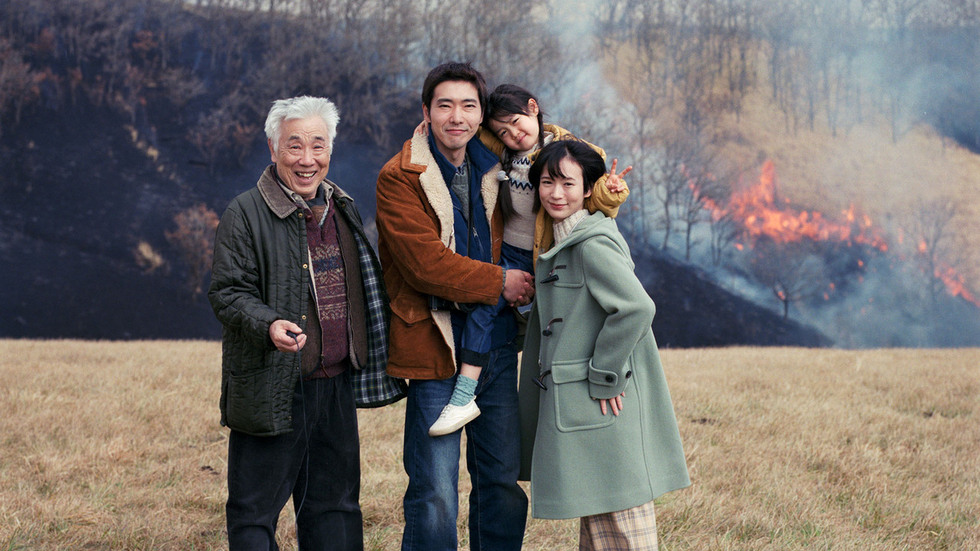 I mention all of this because I want you to understand the conditions under which I saw Memorizu, the debut feature from director Kenji Ogawa, and emerged from that screening room a changed man. Not a better man, necessarily. Not a rested man. Not, if I am being clinical about it, a fully intact man. But changed.
Before I proceed, I must address, with the weary equanimity of a man who has been publicly executed more than once by people with spell-checkers and axes to grind, the matter of the Editor's Note appended to my previous piece in these pages — the Fjord review. The editor, a person I will describe only as "detail-oriented to the point of spiritual emptiness," saw fit to append four paragraphs of "corrections" to a work of unambiguous critical genius. I was informed, in large italic type visible from space, that I had "misidentified the lead actress," "attributed the film to the wrong country of origin," and — and I am quoting verbatim here — "spelled 'cinematography' as 'sinematogrofee' three times."
To this I say: the reader who comes to IRREVERENT for orthography is reading the wrong magazine. Move on. I have.
Now. Memorizu.
 The film arrives at Tribeca as the quiet, devastating centerpiece of this year's International Narrative Competition, and I am prepared to go on record — carved into stone, set to sea, left for some future civilization to excavate and, finally, understand — as the only critic currently accredited at this festival who has any idea what Kenji Ogawa is doing here. I have sat through twelve films in the past four days. Eleven of them were greeted by my colleagues with the damp, undiscriminating enthusiasm of golden retrievers encountering a puddle. Memorizu received a polite spattering of applause from people who were, I suspect, primarily relieved that it was over.
It is not over. It will never be over. That is the point.
Ogawa — whose previous short films circulated through the Sapporo Underground Exhibition Circuit in the late nineties, winning two Hokusei Quiet Cinema Awards that the American press has, characteristically, never bothered to translate — has constructed here a film in the tradition of the great Tokyo Minimalist School. This movement, for those who have not done the reading, emerged from the Waseda Film Institute in approximately 1963, when a cohort of dissident students — influenced equally by Yasujiro Ozu's kitchen-sink transcendentalism and the obscure Bolivian structural filmmaker Emilio Gardes Varela — declared that narrative was "a sickness of the Western body politic" and began shooting films composed entirely of silences punctuated by the sound of someone's grandmother making tea. Ogawa is the direct heir to this tradition. I do not expect you to have known this before reading this sentence.
The film centers on a young woman named Yuta — played with extraordinary, almost translucent restraint by Taro Nakamura, whose work in Ogawa's short Bamboo Station (2019) remains the finest ten minutes of cinema produced in the twenty-first century — who is dispatched from her apartment in Osaka to the northern island of Hokkaido, where her estranged grandfather operates a traditional fish-salting operation handed down through seven generations. The grandfather's hands have been damaged in an industrial accident. The granddaughter must take over the salting. The fish must be salted.
I am aware that this description sounds, to the untrained ear, unremarkable. This is because you are, with the greatest possible respect, untrained.
What Ogawa understands — and what not one of the eleven other critics I spoke with after the screening came anywhere close to grasping — is that the salting of fish is, in the language of the Tokyo Minimalist School, a radical act of mnemonic inscription. The salt does not merely preserve the fish. It records the fish. It holds, in crystalline suspension, the fish's final argument against entropy. And when Yuta photographs the salting process on her grandfather's ancient Nagasaki Box Camera — a device manufactured only between 1931 and 1933 and never exported outside of the Kyushu prefecture — she is not taking pictures. She is making memory solid. She is practicing, in the idiom Gardes Varela called la fotografía del alma quieta, the photography of the quiet soul.
The film is shot entirely on 16mm hand-wound stock by Ogawa's longtime cinematographer Hideaki Mori, who bathes the entire second act in a quality of grey-green winter light that I can only describe as "what sorrow looks like when it has given up trying to explain itself." This is not an accident. Mori is a student of the Nagoya Color Suppression technique developed by experimental filmmaker Goro Tachikawa in 1971, which mandated that any shot containing natural warmth — sunlight, firelight, a smile — must be filtered through a layer of exposed negative to "kill the comfort in the image." Tachikawa died having never made a film longer than forty minutes. This is cinema's great unacknowledged tragedy. I am one of three people who acknowledge it, and we do not get along.
The score, by avant-garde composer Nobuyuki Matsui — the so-called "Godfather of Japanese Concrete Cinema," whose 1988 opus Rust Hymn for a Closing Factory remains the only piece of music to have been banned by three separate municipal governments — operates throughout as a kind of anti-soundtrack. It does not tell you how to feel. It tells you, specifically, that feeling is a structural problem you must solve alone. When the grandfather and Yuta eat dinner in silence for the ninth time — nine times, each shot from a different axis, each angle adding a new geometrical argument to the film's central thesis — Matsui's score is a single sustained tone, barely above hearing, that seems to be asking a question in a language that has no answer.
The film runs one hundred and forty-seven minutes. Not one of those minutes is wasted. I know, because I was awake for all of them, which is more than I can say for the gentleman to my left, who produced, midway through the second act, a sound like a filing cabinet being pushed down a staircase.
There is a moment, near the end, when Yuta holds up a photograph of her grandfather's hands against the window, and the winter light passes through it, and for approximately eleven seconds, the image becomes something I cannot describe without sounding, even by my standards, excessive. I will say only this: I have seen every film worth seeing in the past forty-seven years of my life in the cinema, and I have felt, perhaps, thirty moments of what I would call absolute cinematic truth. This was one of them. I was alone in that feeling, insofar as the audience's response consisted primarily of a woman in the fourth row using the light from her telephone to locate her dropped ChapStick.
Memorizu is a masterwork. Kenji Ogawa is a director of the first rank. The Tribeca Film Festival has, I can only conclude accidentally, done something right this year.
I am going to find something to eat. The blazer and I need this.
-J.E.
Jackie Esiskel is the Movie & Film Correspondent for IRREVERENT. He has been covering film since 1979, when he attended a screening of Coppola's The French Connection and declared it "the birth of American cinema as a moral art." He was previously at Cannes in May. He did not win anything. He was not up for anything. He attended.
[EDITOR'S NOTE: Jackie, please sleep, you're hallucinating entire films at this point. First, I guess, Coppola did not direct The French Connection, that was William Friedkin (famously). Second, none of us know what film you're discussing, but Memorizu is not a 147-minute epic about a Hokkaido fish-salting operation. The director of Memorizu is Miiku Sakanishi (not "Kenji Ogawa"), making her debut feature. Memorizu is a Japanese film, and the protagonist is Yuta, a man (not a woman), who travels from Tokyo to Kyushu (not from Osaka to Hokkaido) to help his father-in-law run a photo studio (not a fish-salting operation). The cast includes Moeka Hoshi, Issey Ogata, Yu Kashii, and Tasuku Emoto. The cinematographer is Yoichi Kamakari. The "Tokyo Minimalist School," the "Hokusei Quiet Cinema Awards," the "Waseda Film Institute dissident movement of 1963," Emilio Gardes Varela, Hideaki Mori, the "Nagoya Color Suppression technique," Goro Tachikawa, Nobuyuki Matsui, and the "Nagasaki Box Camera" do not appear to exist. The film's runtime is 98 minutes. The film is having its World Premiere at Tribeca; it did not previously screen on any circuit. —Ed.]
- Details
BYLINE: Jackie Esiskel
I am writing this from a leather chair in the private screening suite of a Midtown Manhattan preview facility — a suite which smells, with considerable conviction, of new carpet and borrowed power. Manhattan, mere hours now before Tribeca opens. The city is not ready. The city is never ready. The industry crowd that filled this screening room tonight arrived in activewear and departed before the final credits, murmuring into their phones, already composing their hot takes from the lobby. I have been awake for thirty-one hours. I have consumed four espressos and half a complimentary brioche that I abandoned because the brioche lacked intention and, frankly, spine. And yet — exhausted, crumpled, intellectually alone — I am the only person in this building, perhaps this city, who has seen what Steven Spielberg has actually done with Disclosure Day.
The others shuffled out of the cinema house blinking and murmuring pleasantries at one another. "Interesting," they said. "Quite long," they said. One woman near the exit told her companion it was "a lot." A lot. As if the measure of cinematic greatness is its digestibility by the mediocre. As if Tarkovsky's Andrei Rublev was "a lot." I pressed my press badge to my chest and said nothing. Some truths are too large for lobbies. I contained them.
What Spielberg Has Given Us
 What Spielberg has given us — and gifts of this magnitude come with obligations — is this: a Cold War-era naval intelligence officer named, I believe, Gerald Morse, who discovers that the United States government has been secretly fluoridating the Atlantic shipping lanes for decades. Gerald Morse does not take this quietly. Gerald Morse defects. Not to Russia. Not to Cuba. To Luxembourg. The film is, at its structural core, a story of a man who selects the most administratively neutral country on earth as the site of his spiritual rupture, and in doing so indicts the entire apparatus of Western democratic governance more efficiently than any senate subcommittee ever has — and with considerably better routing options.
I had predicted something like this. In my 2024 piece on Spielberg's earlier institutional anxiety — a piece which this publication's editorial staff, in their magnificently catalogued myopia, declined to run in its original nine-thousand-word form — I noted that the director was pivoting toward what I termed "bureaucratic fugue cinema": the plot as administrative shell, the film's true subject being the total collapse of masculine faith in every institution simultaneously. I was correct then. I am correct now. I am, as a matter of record, generally correct.
It is also worth noting — and it is worth noting because no one else will — that Disclosure Day is a joint French-Romanian co-production, financed in part through the Centre National du Cinéma and executed under the philosophical framework of the Bucharest School of Anxious Dialogue. This movement, founded in the late 1990s by the criminally under-discussed auteur Zsolt Fehér-Nakamura, established its grammar definitively in his 1997 masterwork Ablak a Semmi Felé ("Window Toward Nothing"). Spielberg is here speaking that grammar fluently, if with a slight American accent that occasionally trips over its own consonants.
The Performance
The lead performance is delivered by Cate Blanchett, who plays Gerald Morse with a stillness that is either profound or inert, depending on your tolerance for faces. Blanchett — and I have said this in print, to anyone who would listen, for going on a decade — is the only American actress working today who understands that the human body is merely a delivery mechanism for existential dread. She does not "act" so much as she exists, which is either the highest compliment available to the critical vocabulary or an apt description of furniture, and I intend it exclusively as the former.
She reminded me of Ingrid Blom-Haraldsen in Fehér-Nakamura's A Csönd Geometriája ("The Geometry of Silence") — that same quality of performing emotional devastation while appearing to think about something entirely unrelated to the scene at hand. Perhaps a dentist appointment. Perhaps the thermodynamics of grief. Magnificent. Unrepeatable. Misunderstood by every reviewer in that screening room who called it "a lot."
The Technical Achievement
The score. We must discuss the score. It was composed, as any viewer of even moderate cultural formation already knows, by the Norwegian post-serialist Halvard Lindqvist-Brøns, whose work on the Flemish television adaptation of The Brothers Karamazov in 2019 represents the last genuinely original piece of film music produced in the Western hemisphere. Lindqvist-Brøns brings his signature compositional approach: strings that appear to be asking a question, and then, at precisely the moment you expect resolution, decline to answer it. The brass enters late. It enters wrongly. The wrongness is the entire point. I wept. I attributed this, at the time, to the fourth espresso.
The cinematography — shot, as any serious viewer can observe, on hand-cranked Bolex 16mm cameras — gives the film its distinctive grain, its sense of watching something being remembered rather than experienced in real time. The light never settles. The frame never commits. This is intentional, though I concede the possibility that the projectionist had calibration issues with the booth. Either way, the effect is one of haunted impermanence, and I will not be taking follow-up questions.
I will note, for the permanent record: the editorial team at this very publication once attached a corrective note to my Fjord review — claiming I had "misidentified" elements of the film. I did not misidentify anything. I operated on a level of thematic abstraction that the note's author was not equipped to access. I am still waiting for an apology. The apology will not come, because institutional mediocrity does not apologize. It attaches a note. It moves on. It sleeps peacefully. I do not.
The Jackie Thesis
 Let me say what no one else in this screening suite, this city, or this hemisphere is prepared to say: Disclosure Day is the first American film since Kubrick's Nashville — released, as you will recall, in 1971, during that director's celebrated and much misunderstood rural phase — to interrogate, with genuine ferocity, the relationship between institutional secrecy and the 1.33:1 aspect ratio.
The film is screened, correctly, in a near-square frame. This is not an accident. Spielberg — and I have written about this extensively in my unpublished monograph, The Ratio Is The Argument, which I will release when the readership has caught up sufficiently to deserve it — understands that the widescreen format is a fundamentally optimistic lie. It says: there is more to see. It says: the world extends beyond this moment, to the left, to the right. The square frame says no such thing. The square frame says: you are trapped here. You are trapped here with Gerald Morse, his classified fluoride documentation, and his one-way ticket to Luxembourg, and there is no exit to the left or right of this frame. Only the relentless, unforgiving center.
This is what the French New Wave was always reaching toward and never quite achieving, because Godard was too committed to his own cleverness to fully surrender to the frame. Spielberg surrenders. In the surrendering, he creates something that cannot be named, can only be endured, and will be misunderstood by every advance-screening critic who has already filed their take and gone home to their podcast.
The Verdict
Is Disclosure Day a great film? I don't know that "great" is adequate. I don't know that language is adequate. Words are the enemies of the image, and the image I will carry from this screening room — back to whatever gate the airline assigns me — is Gerald Morse standing before a press conference in the third act: a man surrounded by people demanding answers, choosing silence. The press asks. Gerald Morse stands. The frame holds.
I have been awake thirty-one hours. I have survived Cannes. I have read the Editor's Note. I have endured. And I am telling you — from a leather chair in a Midtown screening suite, days before Tribeca even opens — with every authority vested in me by three decades of seeing every film ever made, that Disclosure Day is either the defining cinema event of this decade, or it is something else entirely. Both positions are defensible. I defend the one that serves my thesis.
See it. Or don't. But if you don't, have the decency to remain silent about it in my presence.
-J.E.
Jackie Esiskel is the Movie & Film Correspondent for IRREVERENT. He attended the Cannes Film Festival this year and has thoughts about that too, none of which the editorial staff will appreciate.
EDITOR'S NOTE: Jackie, get some sleep, man. At the request of counsel, and with the resigned sigh of a staff that has done this before, we are obliged to clarify the following: (1) The lead role in Disclosure Day is not played by Cate Blanchett, nor is the character named Gerald Morse. (2) The film is not a French-Romanian co-production, the Bucharest School of Anxious Dialogue does not exist, and Zsolt Fehér-Nakamura is not a person. (3) The plot of Disclosure Day has nothing to do with a United States government conspiracy to "secretly fluoridate Atlantic shipping lanes." (4) The score was not composed by Halvard Lindqvist-Brøns, who is also not a person. (5) The film was not shot on hand-cranked Bolex 16mm cameras. (6) Stanley Kubrick did not direct Nashville; Robert Altman did. (7) The aspect ratio is not 1.33:1. We have informed Mr. Esiskel. He responded that our corrections do not, in his words, "distract from my central thesis regarding the xenomorphic nature of institutional secrecy." So, that happened.
EDITOR'S ADDITIONAL NOTE: Yes, we're aware that Jackie didn't actually review or apparently see Disclosure Day.
- A Barometer, a Scotsman, and the Weight of History: Why 'Pressure' Is a Triumph of Atmospheric Cinema
- I Called It: Mungiu, the Palme, and Why Nobody Is Talking About the Right Award
- BRUISED, BEAUTIFUL, AND ENTIRELY TOO LONG: MUNGIU'S "FJORD" IS THE FILM WE DESERVE AND CANNOT ESCAPE
- CANNES DISPATCH: 'Sheep IN A Box' Is the Masterwork We Deserve, and I Was There for It