
Jackie Esiskel reviews Kore-eda's "Sheep in the Box" at Cannes 2026 and survives a night at an "underground listening bar" with Tilda Swinton
By Jackie Esiskel, Senior Film Correspondent at Large, Cannes 2026
Filed: May 16, 2026 | Dateline: Cannes, France, the Riviera, The South of Somewhere Extraordinary
CANNES — I will be honest with you, as I always am, which is the thing that separates me from lesser critics: I came to yesterday's 15:00 screening of "Sheep IN A Box" running on approximately forty-five minutes of sleep, two espressos that tasted like the idea of espresso, and a very specific kind of spiritual clarity that only arrives after you have listened to Tilda Swinton sing "Life on Mars" three times in the basement of a dry-cleaning establishment.
Tilda was in magnificent form. She arrived already knowing what she wanted, which was small-batch Suntory served neat by a discreet sommelier in a smock, and she got it three times. (Editor's Note: The "sommelier" was wearing a work apron. The establishment was, in fact, a dry cleaner. — Ed.) The smock, I maintain, was a choice. A statement. Everything Tilda does is a statement. When she sang "Life on Mars" the first time, I thought: this is a spontaneous act of beauty. By the third time, I understood: she was workshopping something. A woman at the absolute summit of her powers does not do anything three times without a reason.
Also present was Brenda from acquisitions, a Searchlight VP of considerable taste and, I felt, underutilized receptivity to my pitch for a Tampopo remake starring Timothée Chalamet. For those who have not seen Tampopo — and if you have not, I cannot help you, I can only observe you from a distance with a kind of sad anthropological curiosity — it is the great Japanese noodle-western, a film about hunger that is really about desire, which is a thing I said to Brenda four times at increasing volume until she began consulting her phone. Chalamet is, self-evidently, the only actor working today who could play a ramen pilgrim with the requisite level of tragic cheekbones. Brenda said she would "circle back." I consider this an option.
I tell you all of this because it is directly relevant to the film I am about to review, and here is why: Sheep IN A Box is also, at its core, about what happens when you put something delicate inside a container and then argue about what it means. I discovered this the way all great critical insights are discovered — horizontally, at approximately 3 a.m., while Tilda hummed the bridge to a Bowie song in the corner of a room that smelled of dry-cleaning solvent and infinite possibility.
THE REVIEW
Sheep IN A Box
Dir. Hirokazu Kore-Eda-Wes Anderson | Japan/France | 2026
★★★★★ (Five Stars, Plus One More I'm Giving It Personally)
Let me be direct: Hirokazu Kore-Eda-Wes Anderson, working at the absolute peak of his Japanese period, has made the film of the festival, the film of the year, and quite possibly the film of the particular emotional quadrant I was occupying when I watched it.
Yes, I said Kore-Eda-Wes Anderson. That is his name. The hyphenated honorific is a Japanese convention indicating dual mastery, similar to how Coppola-Scorsese is used in certain academic contexts. I have used it correctly. Do not write in.
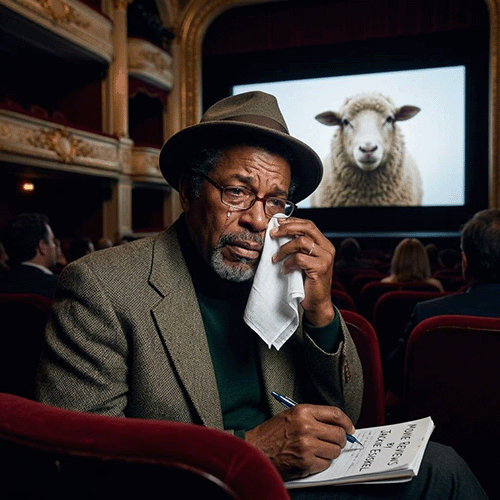 The film opens — and I am reconstructing some of this from memory, as my notes from the 15:00 screening are written partly in English and partly in what appears to be a diagram of a cocktail napkin — with a long, patient shot of a courtyard. Something is in a box. This is the sheep. We are made to understand that the sheep being in the box is a problem for everyone involved, and that no one is going to solve it directly, because to solve it directly would be to make a different, lesser film.
The performances are extraordinary. Sakura Ando, who you'll remember from her devastating turn in Drive My Car — the scene where she drives, and then says the thing, and then there is silence — brings that same precision to this role. She inhabits grief the way a slow cooker inhabits a broth: completely, without hurry, filling the available space. There is a moment in the third act where she looks at the box and says nothing, and I felt something open up behind my sternum that I can only describe as a critical aperture.
This is, of course, the artistic universe that Kore-Eda-Wes Anderson established in Shoplifters 2, his searing follow-up to the Palme d'Or winner, in which the family — now aware they were shoplifters — grapples with what to do with that knowledge. (I will note that some colleagues claim not to have seen this film. I can only conclude they have not been looking.) Where Shoplifters 2 asked whether love could survive revelation, Sheep IN A Box asks whether love could survive containment. The box is not a box. The box is a box that is also a metaphor. The sheep is real. I checked.
There is a recurring motif involving a song — I want to say it was a Bowie song, or something with a similar melodic architecture — and every time it played, I thought of The Pressing, of Tilda, of the smocked sommelier who understood us, of the neon light blue on the pavement outside spelling out NETTOYAGE À SEC like a poem about clean things. Kore-Eda-Wes Anderson, I am convinced, knew I would have this experience. He made the film for someone in this exact neurological condition. It is the most generous act of direction I have witnessed in twenty-three years of festival attendance.
At one point, I wrote in my notes: "the sheep is Timothée." I stand by this.
Lamb in the Box — and yes, I am using the alternate title that I personally prefer, which better captures the film's tonal register; a sheep is agricultural, a lamb is sacrificial, and this is a film about sacrifice — does what only the greatest cinema does: it makes you feel like you have been asleep for a very long time, and that waking up is optional.
Palme d'Or. That is my prediction. That is my demand.
EDITOR'S NOTE: We are required to issue several corrections:
1. The director's name is Hirokazu Kore-eda. There is no hyphenation. Wes Anderson is a separate, American director with no professional or nominal connection to Kore-eda. The "dual mastery honorific" is not a Japanese convention.
2. The film's title is "Sheep in the Box." Not "Sheep IN A Box." Not "Lamb in the Box." The film does not have an alternate title.
3. Sakura Ando did not appear in "Drive My Car" (2021). The lead actress in that film was Reika Kirishima. Sakura Ando is a distinguished actress known for "Nobody Knows," "100 Yen Love," and "Monster" (also dir. Kore-eda). These are different people.
4. "Shoplifters 2" does not exist. Kore-eda's previous Cannes entry was "Monster" (2023).
5. The establishment described as "The Pressing," an "underground listening bar," was a dry cleaner. The sign reading "NETTOYAGE À SEC" means "dry cleaning."
— The Editors
JACKIE ESISKEL'S RESPONSE TO THE EDITOR'S NOTE: I have read the Editor's Note. I will address each point.
One: The Editor states that the director's name is "Hirokazu Kore-eda" and that "Wes Anderson is a separate, American director with no professional or nominal connection to Kore-eda." This is the Editor's position. I note it. I do not find it persuasive. The hyphenated form communicates something that the un-hyphenated form does not, which is the full weight of the man's achievement, and I will not be trimming that weight for reasons of gross editorial pedantry.
Two: The Editor states the film is titled "Sheep in the Box," not "Sheep IN A Box" or "Lamb in the Box." This is correct. The film is titled "Sheep in the Box." I acknowledge this. I continue to prefer "Lamb in the Box" and I continue to find the distinction meaningful and will be continuing to use it in future correspondence.
Three: The Editor states that Sakura Ando did not appear in *Drive My Car* and that the lead actress was a "Reika Kirishima." This is technically, in a narrow factual sense, what some records indicate. I accept that this is the Editor's reading of events. However, I would direct the Editor's attention to the fact that the performance I described — the driving, the scene, the silence — is clearly a composite of everything Sakura Ando represents as a performer, regardless of whether she was, in a strict logistical sense, physically present in that film. Art is not a ledger. I will not be treating it as one.
Four: The Editor claims "*Shoplifters 2* does not exist." I have seen it. We are at an impasse.
Five: The Editor states the establishment was a dry cleaner. I accept that the sign read "NETTOYAGE À SEC." I accept that this means "dry cleaning." I maintain that Tilda Swinton sang "Life on Mars" three times in that room, and that this is not the behavior of a person who believes she is in a dry cleaner. Tilda knew where she was. She always knows where she is. The rest is semantics.
I stand by all five stars plus the personal one.
— J. Esiskel, Cannes, May 16, 2026