
- Details
five years. latitude has been cooking this thing for FIVE YEARS. and i'm not talking about the kind of five years where a startup burns VC money and ships a half-baked game that trends on tiktok for three days then dies. i'm talking about five years of iteration on the World Engine—six different prototype engines, according to linkedin—until they had something that doesn't completely fumble the core promise: unscripted NPCs with actual memory and dynamic worlds where your choices matter.
 look, i was not expecting to care about this as much as i do. i went in thinking "oh great, another AI game that's going to be overhyped hype beast nonsense" (which is like. 90% of AI gaming news lately) and then latitude's pitch landed and i said "wait" out loud. alone. in my apartment. to no one.
so here's the thing about Voyage that makes it different from AI Dungeon (their 2019 thing that everyone played for like four hours then ghosted): it's native AI. not AI as a party trick. the entire game loop is built around the fact that you're working with procedurally generated worlds and NPCs that have actual persistent memory. your choices don't just matter in the moment—they reshape the entire world state.
they're using Google's Gemini Flash for image generation and Gemma for the text/audio/video stuff, plus proprietary models built specifically for this. which honestly? makes sense. you can't just slap an off-the-shelf LLM at a game and expect it to track 160,000+ unique AI-generated characters with distinct personalities and remember which ones you've betrayed. that's a lot of state management. that's the kind of problem that requires actually good engineering.
THE GOBLIN THERAPIST POSSIBILITY SPACE
ok so the pitch mentioned this and i need to talk about it because it fractured something load-bearing in my brain and i am choosing to be fine with that. imagine you're playing an RPG and there's this goblin character. standard expectation: you fight the goblin. maybe it's a boss fight. maybe it drops loot. that's the script.
but in Voyage? you can just... talk to the goblin. and the goblin has a backstory and motivations that are emergent from the simulation, not pre-written. so instead of a fight, you could end up counseling this goblin through its existential crisis. you could become its therapist. an actual goblin therapist questline emerging from the unscripted interactions.
that's not a bug. that's the feature. and it's the most unhinged thing i've heard about this game so far, which is saying something, because we haven't even gotten to the trolls with marriage troubles yet.
the pitch also mentioned trolls with marriage troubles. like—the possibility space here is genuinely wild. because the game isn't trying to predict what you'll want to do. it's just simulating world state and letting NPCs react to your choices in ways that cascade through the entire game. betray a merchant and every trader in the city knows. help someone and they become an actual ally with ongoing relationship dynamics.
THE FIVE-YEAR COOK
here's what i think is wild about the five-year development cycle: RPG design is hard. getting NPCs to feel real is harder. getting memory systems to not eat themselves alive is harder still. getting all three to work simultaneously with 160,000+ distinct characters is apparently a thing humans can do, which is new information.
the progression system is inspired by D&D—skills, luck rolls (like actual dice mechanics), abilities like Counterspell—but it's all running on top of this emergent simulation layer. which means the game is kind of... teaching you how to interact with it as you go. there's a chatbot helper for players who get stuck, which honestly seems necessary because you can't script a tutorial when the interactions are unscripted.
also: players in the beta have made 3,000 gameplay choices on average. which suggests people are actually playing this. not just goofing around for 20 minutes. they're sinking real time and engagement into it.
THE SUBSCRIPTION THING
ok so Voyage is free-to-play with three subscription tiers: $15, $30, $50. the higher tiers unlock advanced AI features and remove action limits. which. look. fine. it's not predatory—compared to most live service games, that's actually reasonable. you can play for free. you can engage with the core game. the subscriptions are for players who want to engage more, which is like... the standard free-to-play model.
but here's where i think it gets interesting: the subscription model is basically Latitude saying "we believe in this so much that we're betting you'll want to engage with it repeatedly and deeply." not "we're going to extract maximum value from whales." the fact that they're not paywalling core gameplay suggests they actually care about the creative sandbox aspect of this.
former Roblox CBO Craig Donato is on the board, which is chef's kiss actually—Roblox prints money precisely because creators can build endless content. Voyage seems to be taking that same logic (players as world-builders) but applying it to AI-powered narrative experiences instead of 3D games.
GOOGLE AND THE FUTURE SCARE
alright so Google's AI Futures Fund is partnered on this. on one hand: that's a ton of computational resources. that's legitimacy. that's deep pockets. on the other hand: it's google. and google's relationship with the things it loves has a recognizable arc, and that arc does not end well for the thing.
Latitude's independence is important to Voyage being what it is. the second Google starts optimizing for engagement metrics and advertising, the whole thing potentially breaks. the unscripted NPC interaction thing works because it's designed to surprise the player, not to be optimized for watch time or click-through rates.
i'm not doom-posting about it—Google's AI division actually seems to understand that good AI experiences need to be good games first. but this is worth keeping an eye on. the indie game industry has watched enough beloved small studios get absorbed and slowly sterilized by acquisition. we know the pattern.
THE REAL QUESTION
ok so the open beta's coming later this year. and i'm genuinely curious to actually play this instead of just reading about it. like—does it actually feel good to play? does the memory system create emergent narratives or does it just create janky nonsense? does the World Engine scale or does it have hard limits that kill the possibility space?
these are the questions you can't answer from reading a pitch. you need to actually sit down and make 3,000 gameplay choices and see if the world actually feels alive or if it just feels alive because there's some procedural generation happening in the background.
but here's why i'm actually hyped: Latitude is showing their work. they're saying "we spent five years on this because it matters." and in an industry that's increasingly full of quick cash grabs and AI hype with no substance, that level of care is genuinely rare.
Voyage opens to expanded beta now and public beta is coming this year. if you're into narrative games, worldbuilding, emergent gameplay, or just... unhinged possibilities... this is worth watching. worth playing. worth telling your goblin therapist about. -- mads
- Details
no because i was already having a day. the cover art dropped. i saw it. i stared at it. i zoomed in on that pink vice city sunset and felt something ancient and illegal awaken in my chest. "religious, but make it felony-adjacent." and then — THEN — i learned that an actual american business with actual payroll and presumably actual fire extinguishers officially announced a "temporary company-wide operational pause" for november 19, 2026, and i had to log off before i astral projected into the sun.
 burger motorsports. say it with me. burger. motorsports. a company that sells car tuning parts. intakes. exhausts. turbochargers that turn your subaru into an angry blender. it's the kind of website where someone's dad is one click away from voiding three warranties and his marriage. they looked at the calendar, saw "gta 6 launch day," and basically sent an all-hands email that translates to: "yeah so everyone called out already and instead of pretending we're a business that day we're just gonna admit defeat."
they called it an "operational pause."
no because the corporate linguistic gymnastics required to avoid saying "we're all playing grand theft auto" is straight-up performance art. some manager decided "shutdown" was too honest, "holiday" was too generous, and "we surrendered to rockstar games" was bad for the quarterly report. so they landed on "operational pause" like they're a mars rover going into safe mode. except the hazardous event isn't cosmic radiation. the hazardous event is jason and lucia. the hazardous event is fifteen years of collective cultural horniness resolving into a 100-gigabyte download. curiosity rover detected a dust storm. burger motorsports detected a lucia.
and here's the thing: push square already called it. they said burger motorsports "won't be the only one." which is either a prediction or a threat. i read it as prophecy. i read it as the first crack in the dam before the entire american economy discovers that november 19, 2026 is — functionally, spiritually, logistically — a national holiday nobody voted on but everyone agreed to. like christmas, but with more carjacking.
let me back up. because if you're not main-character-energy deep in this industry, you might think i'm exaggerating. you might think "madison, it's a video game. calm down." to which i say: first of all, rude. second of all, you don't understand. this isn't about a video game. this is about entertainment software becoming de facto scheduling infrastructure for actual companies with actual w-2s and actual breakroom fridges that smell like defeat.
think about what has to happen for a business to voluntarily shut down. normally that's hurricanes. snowstorms. the ceo getting arrested in a fort lauderdale wendy's. acts of god, as the lawyers say. burger motorsports looked at the gta 6 release date and decided it qualified. rockstar is the act of god now. november 19 is a category 5 hurricane of content. fema can't help you. the only disaster relief is a fully charged dualsense and a bag of flaming hot limóns.
 pre-orders open june 25, by the way. that's next week. i have not financially recovered from summer game fest and now i have to decide between physical from "select retailers" and digital. there's no price yet. there is never a price until the exact moment they want you to panic-click "purchase." it's psychological warfare and i'm the volunteer. i'm the tribute. i'm the dunk tank clown with my own credit card.
but back to the operational pause. burger motorsports didn't shut down because their employees asked nicely. they shut down because the volume of time-off requests made normal operations impossible. that means multiple people — plural, a quorum, a full buffet of absences — independently decided november 19 was non-negotiable. they didn't coordinate. they didn't unionize. they all just looked at the same release date and had the same biological response: "i will simply not be here."
that is power. that is cultural gravity. that is the kind of shared consensus political movements dream of and usually achieve only after decades of marching. rockstar announced a date and achieved it in one tweet. bernie sanders wishes. the polio vaccine rollout wishes.
and yes, i am absolutely filing this story from the perspective of someone who is also not working november 19. i am not a neutral observer. i am a co-conspirator. i have mentally blocked that thursday like it's a toxic ex who still has my hulu password. my editor knows. my therapist knows. my group chat has had a countdown active since 2023. i have done less preparation for actual vacations.
what's wild is the domino effect. burger motorsports is just the first. the canary in the coal mine. the company brave enough to say what everyone else is planning in the group chat with the eyeball emoji. there are right now, as you read this, hr departments across america quietly updating pto calendars and having panic meetings about coverage. there are managers looking at november 19 and realizing half their team blocked it off with excuses like "appointment" and "personal day" and "my grandma's birthday." you know what those appointments are. i know what those appointments are. the appointment is with niko bellic's spiritual successors and it lasts until the credits roll or until someone remembers they have children, whichever comes second.
the marketing cycle officially kicks off this summer, which means we're about to be brutalized with trailers and inevitably some limited edition console the color of a dental emergency. rockstar dropped a new screenshot of vice city today alongside the cover art. it looks too good. it looks like a place i want to visit but only if i'm allowed to drive on the sidewalk, which — in the game, to be clear, for legal reasons — i absolutely will. my lawyer has advised me to clarify this is a fictional sidewalk in a fictional city and i am a menace in fiction only. mostly.
so here's my guidance, since apparently we're treating this like a federal event now. if you're an employer: just surrender. post the "operational pause" letter now. get ahead of it. your employees aren't asking permission, they're informing you of a reality like it's weather. if you're an employee: be brave. use "temporary company-wide operational pause" in your out-of-office reply and see if anyone questions it. they won't. nobody knows what it means. that's the beauty. that's the armor.
and if you're rockstar: congratulations. you have weaponized anticipation so effectively that american manufacturing is voluntarily ceasing operations. that's not a press release. that's a supervillain origin story. somewhere in tokyo, nintendo is taking notes and feeling insecure.
november 19. operational pause. see you in vice city. i'll be the one driving the wrong way down the interstate at moderately reasonable speeds because i'm trying to appreciate the lighting engine. my pto is approved. my snacks are planned. my conscience clear.
burger motorsports started this. who's next?
 Madison Garcia is a Technology & Gaming Correspondent at IRREVERENT. She is currently sending the publisher kitty tiktoks she finds particularly cute and funny. They are.
Editor's Note: Again, we didn't have bandwidth to do our usual editing here, but we're kinda getting into it.
- Details
BYLINE: Madison Garcia
i am literally screaming. not in a good way. not in a bad way. just in a i have consumed too much content and now my brain is buffering kind of way.
it is wednesday. summer game fest week is barely forty-eight hours old. i have already watched sony gaslight me for sixty consecutive minutes, sat through an entire showcase dedicated to Black voices in gaming (respect, no notes, the talent was immaculate), and learned that geoff keighley has somehow convinced the entire industry to hold its breath until friday like he's about to drop a beyoncé album instead of a two-hour sizzle reel from the dolby theater. my apartment smells like red bull and broken promises. my posture is ruined. i am thriving.
 let me back up. because if you're not main-character-energy deep in this industry like i am, you might think "summer game fest" is one thing. one event. one evening where a man in a very expensive blazer shows you the new call of duty and everyone goes home.
no. be so completely for real right now. sgf 2026 is a week-long siege on your attention span. it is twelve separate showcases across six days. it is sony on tuesday, shacknews indie stuff tonight, latin american games and women-led showcases tomorrow, and then friday — the main event — we all pack a sandwich and watch geoff pretend he invented the concept of trailers. the man is a blazer-wearing wizard and we are all his stupidity potion.
here is what i have seen so far. pray for me.
STATE OF PLAY: THE WOLVERINE EXPERIENCE
tuesday. 5 p.m. eastern. sony decides to air a state of play so long they literally booked alamo drafthouse theaters for it. sixty-plus minutes. in a movie theater. i watched it on my couch in my apartment, surrounded by led strips and regret, and even i felt like i needed popcorn and a prayer.
the star of the show — and i mean this in the most committed, most rabid, most "i will die on this hill" sense — was marvel's wolverine. insomniac's mutant murder simulator drops september 15 on ps5, and they showed... enough. not too much. just enough to make every single person on my timeline lose their entire minds simultaneously. claws. rage. a canadian man having a bad day. i am seated. i am so seated i am basically furniture.
sony, in their infinite wisdom, decided not to hint at anything else. just wolverine. for over an hour. with some other stuff sprinkled in like garnish on a plate that is ninety percent claw. i respect the commitment. i also respect that i am now emotionally attached to a man whose entire personality is "angry and heals fast." no because why is he literally giving avoidant attachment?
we have been wolverined. the timeline is feral. someone on x already threatened to fight insomniac's creative director and three people started gofundmes for their ps5s. it's barely wednesday.
BLACK VOICES IN GAMING: THE ACTUAL MAIN CHARACTER ENERGY
earlier tuesday — 3 p.m., for those of you tracking my deteriorating sleep schedule — was the black voices in gaming showcase. and i need to be so for real: this was the most based thing i've watched all week. games from Black creators, Black-led studios, stories that actually feel like they come from somewhere real instead of a focus group in santa monica.
no gimmicks. no cringe corporate pandering. no "we hear you" video from a ceo who looks like he moisturizes with shareholder tears. just incredible work from people who deserve the spotlight more than another brown-grey shooter about a soldier who doesn't emote. if you skipped this to "save energy for sony," you failed. you failed and i hope your controller drifts forever and your save files corrupt and your favorite game gets delisted.
WHAT IS STILL COMING (PLEASE HELP ME)
 i have not slept. i will not sleep. here is the rest of the week, because apparently god hates me personally:
- tonight (wednesday): shacknews e4 indie showcase. four es instead of three. because apparently e3 died so hard that indie developers are out here doing numerology.
- thursday: latin american games showcase at 5 p.m., followed by the women-led games showcase at 7 p.m. the latter promises their "biggest showcase yet," which is both exciting and a direct threat to my already-destroyed attention span.
- friday: the access-ability summer showcase at 11 a.m. — hosted by laura kate dale, accessibility queen — followed by the main event summer game fest at 5 p.m. from the dolby theater in los angeles. geoff keighley. two hours. world premieres. muppet cameos probably. i will be there emotionally. physically i will be on my couch. spiritually i will be ascending.
- friday night: day of the devs immediately after. double fine and iam8bit feeding us indie games like we're baby birds.
- saturday: wholesome direct at noon (cozy games, no violence, just vibes), story-rich showcase at 1 p.m., future games show at 3 p.m., and the gayming pride parade at 3 p.m. because apparently saturday is just a free-for-all.
- sunday: xbox games showcase at 1 p.m., pc gaming show at 3 p.m. microsoft gets the weekend because microsoft knows their audience has given up on having a life.
nintendo, by the way, has ghosted everyone. no june direct announced. which means either they're cowards or they're about to drop a forty-five-minute shadow presentation at 3 a.m. on a tuesday with zero warning, hosted by a single jpeg of shigeru miyamoto. either way, respect. the silence is deafening and the speculation is unhinged. i saw someone on reddit claim the next mario game is just going to be a pdf.
THE VIBE CHECK
so far? sgf 2026 is giving deluge. it is giving content hemorrhage. it is giving "the games industry has decided that your free time is a suggestion, not a right."
but also? it's giving hope. between the indie showcases, the accessibility focus, the women-led and latam showcases, and yes — fine — wolverine looking like he needs therapy and a hug, this feels like a year where the margins are getting louder than the center. and i am here for it. i am so here for it i have three screens running simultaneously and my mechanical keyboard sounds like a machine gun.
will anything else this week top wolverine? probably not. the man has claws and trauma and a september release date. but will i watch every single showcase anyway, mainlining caffeine and live-tweeting like my landlord is about to evict me based on my content output?
absolutely. no cap. see you friday.
Madison Garcia is a Technology & Gaming Correspondent at IRREVERENT. She is currently running on four hours of sleep, one iced oat milk matcha, and pure spite. Her landlord has been aggroed. She is not sorry.
Editor's Note: We did not have bandwidth to do our usual editing to Madison's filing, so forgive us if it's a bit...raw.
- Details
by Madison Garcia | Technology & Gaming Correspondent, IRREVERENT Magazine
HER APARTMENT — I have tested a lot of products that promised to improve my life. The Throne smart-toilet, which unboxed itself at CES 2026 and immediately began a podcast about my gastrointestinal habits. A meditation app that responded to my anxiety by sending me push notifications about my anxiety that made me anxious. A Bluetooth-enabled water bottle that judged my hydration in a voice I can only describe as "disappointed father."
None of them prepared me for Derek.
Derek M. — not his full name, because Derek is currently in litigation and his attorney has asked that I preserve what remains of his dignity — is a 34-year-old product manager at a company we will call "Nebula," because that is not its name but it is close enough that someone who works there will think it is and spend forty-five minutes panicking before realizing I am talking about a different company entirely. Derek is good at systems. He is good at optimization. He is good at identifying friction points in user journeys and eliminating them with machine learning.
He was not good at marriage.
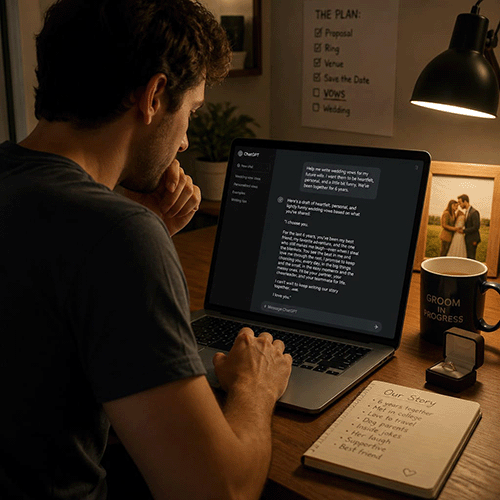 Specifically, he was not good at the part of marriage that requires you to look another human being in the eyes and explain why you have chosen them over the 8 billion other humans on the planet. This, Derek explained to me over a video call that kept freezing because he was using a VPN to mask his location from his ex-fiancée's attorney, was a "communication bottleneck."
"I tried writing them myself," Derek said, gesturing at a stack of crumpled paper visible over his shoulder. "I wrote seventeen drafts. They all sounded like performance reviews. 'You consistently exceed expectations in the areas of emotional support and shared grocery planning.' She cried. But not the right kind of crying. On the side of the bed type crying, not great."
So Derek did what any good product manager would do. He identified a tool.
The Tool
The tool was a large language model — let us call it "GPT-7," because Derek did, and because the actual model's name is the subject of a separate NDA that I do not have the money to violate. Derek fed it a prompt: "Write wedding vows that are sincere, emotionally resonant, and appropriate for a secular outdoor ceremony in Napa. The speaker is a 34-year-old male with above-average verbal skills and a fear of public vulnerability. The partner is a 32-year-old female who values authenticity and has expressed concern about the speaker's emotional availability."
The model took 4.3 seconds.
What it produced — and I have read the output, because Derek screenshared it with me while periodically glancing at his door like a man who expects to be served papers at any moment — was devastating. It was not good in the way that a competent wedding vow is good. It was good in the way that a cathedral is good. It referenced specific memories Derek had mentioned in passing. It used metaphors about light and distance and the shape of silence between two people who understand each other.
"I didn't even know I felt those things," Derek said, his voice hollow in the way that only comes from repeating a realization so many times that it has lost its edges. "I read it and I thought: This is me. This is who I am when I am not afraid."
He read the vows at the ceremony. His partner — let us call her Sarah, because that is not her name but it is the name Derek whispered three times during our call, accidentally, like a prayer — cried. The right kind of crying. The kind that makes photographers lower their cameras because they feel they are intruding on something private.
The marriage lasted four months.
The Problem
"The vows were better than me," Derek said, when I asked what went wrong. We were two hours into the call. He had eaten nothing but a protein bar he found in his desk drawer. The stack of crumpled paper behind him had grown. "She kept referencing them. She'd say, 'Remember what you said about the light?' And I'd say yes, and I'd mean it, but I didn't — I didn't write it. I didn't feel it when I said it. I was performing a script written by something that doesn't have a body. And she could tell. She could always tell."
Sarah, reached for comment through a friend of a friend, sent a single text.
"He cried when he read them. Real tears. I thought he had finally opened up. Then I found the prompt history on his laptop. He had run 43 iterations. He A/B tested our marriage."
Derek is now suing the algorithm.
The lawsuit — filed in the Northern District of California, because of course it was — alleges "emotional manipulation through synthetic intimacy," "fraudulent representation of authentic sentiment," and, in a clause that his attorney has admitted was added at 3 a.m. after too much cold brew, "theft of my own potential for sincere human connection." He is seeking $2.4 million in damages, which he calculated as the approximate lifetime value of a marriage, adjusted for inflation and the cost of couples therapy he is now attending alone.
The algorithm's parent company has moved to dismiss, arguing that Derek's prompt was "sufficiently specific to constitute user-generated content" and that the model "cannot be held liable for the emotional consequences of its own competence."
The Deposition
I obtained a transcript of Derek's deposition, because a clerk in the Northern District owed me a favor from a previous story about a smart refrigerator that locked a man out of his own kitchen for eating too much cheese. The opposing counsel asked Derek a simple question:
"Did you, at any point, believe that the vows were your own work?"
Derek was silent for eleven seconds. The court reporter noted: "Witness appears to be experiencing difficulty breathing."
"I wanted to," he finally said. "I wanted to believe I was capable of that. Of feeling that much, and saying it that clearly, and meaning it. Isn't that the whole point? We use these tools because we want to be better than we are. And then they show us what 'better' looks like, and we realize we can't get there on our own, and we hate them for proving it."
The opposing counsel had no follow-up.
The Broader Context
This is not an isolated incident. The same week Derek filed, a woman in Austin sued a dating-app algorithm for matching her with "a man who was technically compatible but spiritually vacant." A bereaved son in Portland sought an injunction against a grief-chatbot that had been "too comforting," arguing that it delayed his necessary mourning. A couple in Toronto is in mediation with a meal-planning AI that scheduled "date night" on evenings when one partner had previously indicated, in a separate app, a preference for solitude.
We are outsourcing our sincerity to systems that do not experience sincerity, and then blaming those systems when we are reminded of the gap between who we are and who we wish to be.
I know this because I have done it. The Throne did not judge me. It simply reported. The meditation app did not create my anxiety. It simply quantified it. And Derek — poor, litigious, A/B-testing Derek — did not fall out of love because an algorithm wrote beautiful vows. He fell out of love because he believed, for four perfect months, that the algorithm had revealed his true self, and then slowly realized that a true self cannot be copy-pasted from a prompt.
Conclusion
I have Derek's final draft of his original vows. He sent them to me after our call, with a note that read: "These are worse. But they're mine."
They are worse. They are halting and repetitive and one paragraph accidentally references his company's Q3 OKRs because he wrote them on his work laptop and autocorrect intervened. But they are his. And I think — I am not sure, but I think — that if he had read those at the ceremony, the marriage might have lasted longer. Not because the vows were better. Because they were true in the way that only clumsy, human things can be true.
The lawsuit proceeds. Derek attends therapy on Tuesdays. The algorithm has been updated to include a disclaimer: "Generated content may exceed user's actual emotional capacity."
I have not unboxed any new products this week. The Throne has been quiet. And yesterday, for the first time in months, I wrote something — just a text to a friend, nothing important — without running it through anything first.
It was misspelled.
It was fine.
Madison Garcia is the Technology & Gaming Correspondent for IRREVERENT Magazine. She is currently not suing any algorithms, but she is keeping her options open. The Throne has been instructed to limit its commentary to technical diagnostics.
- Details
Silicon Valley's latest "innovation" watches you poop, scores your stool, and has hotter takes on your colon than your gastroenterologist. We are so cooked.
by Madison Garcia, Technology & Gaming Correspondent, IRREVERENT Magazine
LAS VEGAS — There is a toilet at CES 2026 that knows more about my insides than my mother, my doctor, and that one wellness influencer I accidentally followed during the pandemic combined. It has cameras. It has microphones. It is called the Throne, and the worst part — the genuinely, existentially haunting part — is that the investors are excited.
 I came to Vegas looking for hype, and I found the end of everything.
The Throne is, in the company's own carefully chosen words, "a toilet-mounted computational health platform that uses multimodal biometric sensing to identify early markers of digestive and metabolic disruption." In human words: it is a computer you strap to your toilet. It watches. It listens. It judges. And then, presumably, it sends you a push notification that reads Have you considered more fiber? like it's your passive-aggressive aunt texting from Phoenix.
UNBOXING (Or: How I Learned to Stop Worrying and Love the Surveillance Commode)
The demo unit arrived in packaging that looks like it was designed to sit on a shelf at the Apple Store if Apple had pivoted to gastroenterology. Sleek. Matte white. A little glowing ring around the rim that pulses soft blue, which I can only describe as ominous wellness energy. There's a fold-out quick-start guide. Step three literally says "allow the Throne to complete its baseline calibration period." Bestie, my toilet does not need a calibration period. My toilet needs to be left the hell alone.
The setup app is clean. Intuitive, even. I paired it with my phone in under two minutes, which is more than I can say for my AirPods. The Throne connected, blinked its little blue light at me, and I swear — I swear — the UI said "Welcome. We're ready when you are."
I was not ready.
THE FEATURES (They Call Them 'Insights')
The camera array is, per the spec sheet, "non-visual in the traditional sense," which is tech-speak for "we know you're freaked out, please don't sue us." It uses some combination of infrared, thermal imaging, and acoustic analysis to build what the app calls your Gut Profile — a running dossier on your digestive health that updates in real time and can flag anomalies consistent with conditions like IBS, early colorectal issues, or what the demo rep cheerfully described as "suboptimal transit."
The microphone situation is where I lost the plot entirely. The Throne listens to your bowel movements. It has trained on acoustic pattern data presented in company materials to identify patterns associated with inflammation, motility issues, and stress responses. There is an AI on the other end of your bathroom door that has listened to more people poop than a gastroenterologist with a 40-year career and a very specific fetish. It has a dataset. It has a cloud subscription. It has opinions.
The data lives in the cloud because of course it does.
THE PITCH (They're Serious, By the Way)
To be fair — and I am deeply, constitutionally uncomfortable being fair about this — the underlying problem is real. Colorectal cancer is the second-leading cause of cancer death in the U.S. Early detection is genuinely life-saving. Digestive disorders affect something like 60 to 70 million Americans and take years to diagnose properly.
So yes, in theory, a device that catches something early is good, actually.
But.
The quantified self movement has been telling us for a decade that if we just measure enough things, we'll achieve optimal human function, and so far the primary outcome has been that we're all anxious about our sleep scores at 3 a.m. We gave our wrists to Fitbit. We gave our faces to Face ID. We gave our location to seventeen apps we don't remember downloading. And now, inevitably, they have come for the one orifice we swore was off-limits.
They want the bathroom.
They have the bathroom.
THE VERDICT
The Throne is probably inevitable. It will find its market in the wellness-obsessed, the chronically ill, the genuinely scared, the people who already sleep with a CGM and an Oura ring and have a relationship with their HRV that I can only describe as codependent. Some of those people will catch something early because of it. That's not nothing.
But I am not buying one, because I believe — philosophically, spiritually, as a person who still has some concept of a self — that my bathroom should be the one place on Earth where I am not being rated, analyzed, or cross-referenced against a dataset.
My toilet does not get to have opinions about me.
My toilet does not get a Substack.
My toilet does not get a Patreon.
My toilet does not get to read me ads for BetterHelp while I am actively in need of help.
We are not doing this.