
- Details
There is a particular hour in Chicago, usually around ten o'clock on a Thursday in late autumn, when the city arranges itself into something almost defensible. The lakefront goes quiet, the grid exhales, and the amber-lit interiors of certain establishments promise a civility that the sidewalks do not. I have lived here for twenty years, which is nineteen years longer than I ever intended, and I have learned to accept these moments of grace without inquiring too closely into their provenance. Tonight I have hired a car. The expense guidelines suggested, in that sorrowful tone peculiar to accounting departments, that I spend no more than seventy-five dollars on transportation. The car cost three hundred and forty dollars, and I am not going to address that further.
 The Copperstave — Gold Coast
The Copperstave does not advertise. It does not need to. Its mahogany is the deep, accumulated brown of old money left in good light, and its brass fixtures have been polished by the same pair of hands, Gerald's hands, since approximately the turn of the century. I do not know Gerald's surname, and he does not know mine, which is the correct relationship between a barman and a correspondent. He knows Islay from Speyside, he knows when to speak and when to let the glass do the talking, and that is sufficient.
I ordered a Laphroaig 16 and a Glenfarclas 21. The Laphroaig arrived with its medicinal smoke intact, a bonfire on a beach that someone had the decency to age properly in ex-bourbon casks. The Glenfarclas was darker, rounder, a whisky that tastes the way inherited furniture should, assuming you were fortunate enough to inherit from someone who understood wood. I took notes. The paper was crisp. My handwriting was legible. Sobriety has its uses, chief among them the ability to judge a dram without sentiment.
Rating:
- Selection and Provenance: 19/20
- Technical Execution of Pour: 18/20
- Atmosphere and Propriety: 20/20
- Value Relative to Station: 17/20
- Overall Correctness: 19/20
- Total: 93/100
Loretta's Barrel — Lincoln Park
Loretta's Barrel is what happens when Americans discover that brown liquor has a history beyond their own borders. Exposed brick, a deer head that appears to have died of ennui rather than violence, and a handwritten rye list that Todd, the barman, treats as scripture. Todd is enthusiastic. I find enthusiasm in whiskey service exhausting. It suggests a need for validation that the whiskey itself does not require, a desire to be thanked for the pour that I find unseemly.
I ordered a Michter's 10 Bourbon, which was competent in the way that American whiskey often is, straightforward and without subtext, like a man who tells you exactly what he does for a living within ninety seconds of introduction. Todd suggested a George T. Stagg. I accepted under mild duress, the duress being Todd's face, which is not a face that accepts refusal easily. The Stagg was very good, a cask-strength argument for patience and oak that I was not prepared to hear, let alone enjoy. I was annoyed, which is my resting state in Lincoln Park, and I remained so for the full duration of the glass.
Rating:
- Curation of List: 18/20
- Pour Precision and Temperature: 17/20
- General Vibe, Minus Deer: 16/20
- Value Proposition: 16/20
- Aggregate Impression: 17/20
- Total: 84/100
The Tributary — Wicker Park
 The Tributary requires you to consult a clipboard. The menu arrives on one, bound with a metal clip that has been artificially distressed to suggest farmwork or maritime labor. The bartender has a waxed moustache, and I mention this only because it is impossible not to, given that it curls at the ends like a punctuation mark that has lost its sentence and refuses to admit it. I ordered something called a Smoke and Regret, which I assumed would be a punishment, a liquid lecture on the excesses of craft culture, and which turned out, infuriatingly, excellent. Artisan bitters, an expression of bourbon from a distillery that operates out of what I suspect is a repurposed garage, and a smoked ice cube that I resent having noticed, because noticing it meant admitting that it worked.
I am two drinks in now, and the evening has begun to soften at its edges, the way evenings do when you have stopped counting ounces and started counting hours. Craft cocktail culture, I should say, is where simplicity goes to die. There was an evening in 2019, in a bar not dissimilar to this one, involving a tepache reduction, a man in a vest who called himself a mixologist with no apparent irony, and a misunderstanding about the bill that I will not elaborate upon further. Some memories are best left in the clipboard, filed under regret, which this drink, despite its name, did not induce.
Rating:
- Drink Quality, Against All Expectations: 17/20
- Degree of Nonsense Tolerated: 12/20
- That Moustache, Which I Cannot Unsee: 9/20
- Ambiance and Lighting: 15/20
- Whether I Would Return Sober: 8/20
- Total: 61/100 (adjusted upward because the drink, damn it, worked)
Han Nok — Albany Park
Han Nok is clean, spare, and quietly confident in the way that good Korean bars often are, the confidence of a place that does not need to explain itself to you because it has already decided whether you are worth the effort. Jiyeon tends the stick with the economy of someone who has already calculated the exact number of seconds required for every motion, and who executes them without flourish. She poured me a GoldenBlue, which is a South Korean blended whisky, and I must pause here because I was not ready for this, not at the third stop, not while the Smoke and Regret was still making its case in my bloodstream.
Scotland has been making whisky since the fifteenth century. Korea has not. The British judges, who have historically treated world whisky as an internal British-Irish matter with occasional Japanese exceptions, filed their results in 2026 and the category is being reconsidered, which is a polite way of saying that certain assumptions have been overturned. I gave the GoldenBlue a proper nose. I took my time. I made Jiyeon wait, which she did without comment, without checking her phone, without the small sigh that indicates impatience. It is not bad. It is, I must pause here to stare at the ceiling, rather good. I have decided not to enjoy this. I am enjoying it.
Scotland spent five hundred years arriving here. Korea has perhaps fifty before they reach the same destination, and I am not going to apologize for feeling ambivalent about the maths, which favor the patient and punish the proud. Ten years ago I called Japanese whisky a novelty, and I had to eat that word cold, with a spoon, in print, which is the only way words should be eaten. India is next, and I refuse to be surprised again, though I know I will be. I will note, once, that I am calling Korean whisky by the Scottish spelling, a courtesy I extend without obligation, because tonight is full of choices I did not expect to make.
Rating:
- Correctness of General Atmosphere: 18/25
- Quality of Liquid in Glass, Absent National Prejudice: 22/25
- Sense That the Barman Is Not Judging You (Wrong): 15/25
- Whether I Am Prepared for the Future: 4/25
- Total: 59/100 (but I am revising this upward in my head, which I do not do often, because the head is where the honesty lives)
Krolczyk's — Pilsen
Krolczyk's is a corner bar in the Polish-American manner, which is to say it has linoleum that remembers the seventies and a back bar assembled over four decades by someone who cared only that the bottle pour straight and the label face forward, aesthetics be damned. The rye selection is quietly staggering. I found a Pikesville 20-Year that has no business being in Pilsen, and I say that with affection for Pilsen, which has better bars than it is credited with and worse ones than it admits.
Maureen has been here since 1998. She refilled my water glass without asking. I almost cried. I am four drinks in, and I have lost my notes for sub-category three, assuming there ever was a sub-category three. The certainty is not returning.
 The Korean whisky was better than I wanted it to be, and I have been thinking about it since Albany Park. I would like to say I have moved on, but I am fifty-two, and moving on is not the skill I have cultivated. I cultivate memory, and grudges, and the occasional unexpected fondness.
IRREVERENT is scrappier than it looks, and funnier than it knows. That is not a criticism. Scrappiness is a virtue in a publication, and knowing your own humor is a kind of death, the death of surprise. Meadow is a better editor than he lets on and a worse businessman than he thinks, but he was right to back The Anvil even though it closed in 2014, because the food was correct and the timing was wrong, and I would do it again, every dish, every night, every loss. I owe him something for that, and I suppose I am paying it here, in a corner bar in Pilsen, with a water glass that never empties and a rye that understands me better than I understand myself.
The staff at the magazine, the ones who stay late and correct Esiskel's delusions and worry about the next issue as if the next issue were a living thing that requires feeding, they are the reason the words matter. You know who you are, and I am not going to name you, because naming would make it official, and I prefer to keep my affection structurally unsound, a load-bearing wall that looks like it should not work but does.
Three and a half geese.
No.
Four geese.
The Lincoln Continental pulls away from the curb on 18th Street, and the city slides past the window in its grid-like fashion, sensible and indifferent and mine in the way that cities become yours after two decades of reluctant cohabitation. Maureen refilled my water glass. The GoldenBlue was good. I am not going to make a big thing of it. Some nights you set out to confirm your prejudices, and you return with them slightly bruised, which is, I am told, the closest thing to growth available at my age. The car is very quiet. The expense report will be a separate matter, and I intend to ignore it until it goes away. I look out at the lake, dark and familiar, and I do not forgive myself for loving this city. I simply do.
-J.C.
- Details
The Union Stockyards processed five hundred million animals between 1865 and 1971. I want you to hold that number for a moment, because numbers like that don't behave like regular numbers. They don't fit inside a sentence and stay there politely. Five hundred million. The entire population of the Western Hemisphere, give or take. Steer after steer after hog, shuffled through a system so efficient that Upton Sinclair wrote a book about it and accidentally invented the FDA. The Yards closed in 1971. The land sat there doing what land does when you've asked too much of it — quietly composting its own sins under fifty years of Illinois weather.
 Someone opened a vegetarian restaurant there.
I'll give you a moment.
V-Food occupies a converted brick building on the south end of the district, flanked by a livestock auction house that closed in the nineties and what appears to be a very optimistic artisanal candle company. The exterior is honest enough — weathered timber signage, rope-and-iron hardware, the kind of faux-distressed aesthetic that costs more to execute than actual distress would. The sign is a green V branded like a cattle iron. Subtle as a foghorn at a wake.
My dining companion, a woman named Helen who edits cookbooks and has therefore suffered more than most, looked at the sign and said, "Oh no."
I said, "Yes."
We went inside.
The interior commits fully. That's the first thing I'll say in V-Food's defense — whatever they're doing here, they're not doing it halfway. The seating is arranged in narrow corridors, maybe four feet across, with low wooden rails on either side. Cattle chute seating. You shuffle in single file, you take your place, you are penned. The lighting is warm and amber, which is either rustic charm or the color of the slaughterhouse floor, depending on what you've been thinking about on the drive over. I had been thinking about what I'd been reading, so I was squarely in the second camp.
The servers wear cowboy hats. Not ironically. They wear them with the full solemnity of people who have been told the cowboy hat is non-negotiable and have made their peace with it. Our server, a young man whose name tag read JAKE and who had the earnest energy of someone who had recently completed a hospitality program in Columbus and had not yet been disappointed by anything, welcomed us to our "stall" — their word, not mine, printed on the menu — and handed us the bill of fare.
 "Can I start you folks off with something from our range?" he said.
Helen looked at me. I looked at the ceiling. The ceiling had exposed beams hung with vintage livestock brand irons. I counted eleven of them before I forced myself to stop. Twelve would have meant something.
"What do you recommend?" I asked.
Jake brightened the way young servers do when they've been waiting for this exact question. "Our Big Moo-V is the most popular entrée. It's our signature portobello mushroom steak, dry-rubbed with a house smokehouse blend, finished in cast iron, served with roasted bone marrow butter — vegan, obviously, made from coconut and smoked almonds."
"Vegan bone marrow butter," I said.
"It's incredible," Jake said. He said this with total sincerity. I believed him. That was the unsettling part.
I ordered it. You would have too.
 We started with the "Branded Board" — a charcuterie arrangement the menu describes as "the finest cuts from our garden," which is the kind of sentence that should come with a warning label — or possibly a restraining order — for people who take language seriously. What arrived was, in fact, genuinely lovely: thick slabs of smoked beet carpaccio plated to suggest raw beef, a walnut pâté with the exact color and density of country terrine, pickled mushrooms dressed to look like lardo. The presentation was studied and technically accomplished, the work of a kitchen that has thought hard about what it's pretending to be.
The beet carpaccio tasted of beet — which is to say, it tasted of iron and earth and something faintly sweet underneath, the way good beets do when someone hasn't ruined them with goat cheese. I ate it and thought of blood, which I suspect was the point, and felt something shift slightly in my chest that I chose not to examine too closely.
Helen ate the walnut pâté on a small rye cracker and said, "This is actually good."
I said, "I know. That's the problem."
The Big Moo-V arrived and it was, by any honest measure, a serious piece of work. The portobello was enormous — the size of my outstretched hand, which is a meaningful hand — and had been treated with the kind of respect you usually reserve for prime ribeye. The dry rub had formed a genuine crust under the cast iron, dark and crackling at the edges, giving way to something yielding and deeply savory underneath. Mushrooms, when you cook them properly, are not trying to be meat. They are trying to be themselves, which is stranger and more interesting than meat. This kitchen knew that. They'd cooked it to temperature — whatever the portobello equivalent of medium-rare is, this was it: firm at the surface, tender at the center, running with dark liquid that was absolutely not blood but occupied exactly that visual register.
The vegan bone marrow butter pooled beside it, tasting of coconut fat and smoke and the ghost of something umami and deep — present, committed, technically not beef.
I sat with a bite of it in my mouth and thought: five hundred million.
The thing about the Union Stockyards is that the ghosts aren't sad, exactly. Or they're not only sad. They're present. This land has a density to it, a weight in the air that isn't just my imagination, or my history degree, or the fact that I ate too much on the drive over. The Yards shaped Chicago's economy for a century. They fed the country. They did it at an industrial scale of violence that we collectively decided not to think about too hard, which is a decision we renew every single time we sit down to a meal. Some of us just renew it at a cattle chute table surrounded by brand irons while a man named Jake calls our mushroom a steak.
Does V-Food grapple with any of this? Not exactly. The concept is playful where it could be haunted, ironic where it might have been genuinely strange. The ghost is in the room but they haven't introduced themselves. That's a missed opportunity, or maybe it's a mercy, depending on your appetite for being made uncomfortable by your dinner.
The food, though. The food is real.
We finished with a "Cowpat Cake" — their name, their cross to bear — which was a dark chocolate flourless torte with salted caramel and a smoked oat crumble. It was very good. It did not need its name. I ate it and did not think of cow pats. I thought of my mother's kitchen, which is what flourless chocolate torte always does to me, which is its own kind of haunting.
The bill came in a weathered leather fold stamped with the V-Food brand. Jake, still wearing his hat, thanked us for dining and said he hoped we'd enjoyed "the full stockyard experience."
Helen said, "It was memorable."
I left a good tip. Jake deserved it. He wore that hat with dignity, which is more than most of us manage.
V-Food is not a great restaurant. It's a gimmick restaurant with a great kitchen hiding inside it, like a portobello mushroom with a cast-iron crust — surprising and, in the right light, genuinely moving. The irony is load-bearing, as advertised. Whether it bears the weight of what this land actually remembers is a question the menu doesn't ask and the beet carpaccio can't answer.
But go. Eat the mushroom. Sit in the cattle chute and think your thoughts. The food earns something. The ghosts will wait.
They've had practice.
V-Food, Union Stockyards District, Chicago. Reservations recommended. Ask for a chute seat by the window if you need the light.
- Details
Monday night, June 15th, two thousand people in their best clothes filled the Lyric Opera of Chicago. There were awards. There were speeches. There was, presumably, an open bar and whatever catered thing you feed two thousand people who've just spent forty-five minutes congratulating each other on being in the same room — poached salmon, probably, and a speech about community.
I was not there.
 This was not an oversight. I know where the Lyric Opera is. I know what the James Beard Awards are — I've cooked under the shadow of the nomination process long enough to understand exactly how much and how little it means. I just decided that on Monday night I had better things to do, which mostly involved my couch and a bottle of something from Burgundy that didn't need an audience to be excellent.
Tuesday, though. Tuesday, I got in the car.
Chef Jake Lancie was a finalist this year. In case you missed the envelope — and apparently he did — he did not win. I'm not going to pretend that doesn't sting, because I know firsthand how much it does, and anyone who tells you awards don't matter is either lying or has never spent three years trying to be taken seriously in a city where taken seriously has a zip code, a valet, and a tasting menu.
But here's the thing about Jake Lancie: the man went back to his restaurant on Tuesday. Mise en place at three. Service at five-thirty. Forty-odd covers in a strip mall in the western suburbs, a BALUT sign in block letters above a door that has made its peace with the weather, and a kitchen running at the kind of quiet intensity you can only build when you've stopped caring what the room sounds like from the outside.
I respect that more than I would respect a medallion.
The room is modest. I say this not as criticism but as statement of fact. There are maybe sixteen tables, wooden chairs, a chalkboard menu above the pass, and walls hung with what I can only describe as a curated family archive — photographs of people eating, cooking, laughing, aging. It smells, when you walk in, of garlic and vinegar and something roasting low and slow in the back that makes your posture involuntarily improve.
 The server — I'm told his name is Manny, and he moves with the calm efficiency of someone who has given this particular speech a thousand times and means every word of it — walked me through the menu without performing it. No narrative arc. No metaphor about grandmother's hands. No menu printed in a font that costs more than the produce. Just: here's what we make, here's what it is, here's what you should probably have.
I had the kare-kare first. Oxtail, braised in a peanut sauce with fermented shrimp paste on the side — bagoong, for the uninitiated, a condiment that smells like a dare and tastes like a revelation. The oxtail was falling off the bone, which is not remarkable. What was remarkable was that the sauce had texture. Depth. It didn't taste like it had been made that afternoon; it tasted like it had been thought about for considerably longer. That's not a technique thing. That's a caring thing.
The sinigang came next — a sour tamarind broth with pork ribs and long beans, aggressive in its acidity in a way that I found clarifying rather than assaulting. This is the kind of food that asks something of you. You have to meet it. A lot of chefs are afraid of that. Lancie is not.
Then came the balut.
I want to be precise here, because precision is the only courtesy a fertilized duck egg deserves.
The egg has been incubated for — depending on tradition and preference — somewhere between sixteen and twenty days. Long enough for the embryo to develop, not long enough for it to be anything other than what it is: a duck, in progress. You crack the shell from the top, drink the broth that has collected inside, then eat what's there with a pinch of salt and a splash of vinegar.
Manny set it in front of me without ceremony, which was exactly correct. There is no ceremony appropriate to a fertilized duck egg — no amuse-bouche, no presentation, no server crouching beside the table to describe the chef's personal journey to this particular embryo. You either eat it or you don't.
I ate it.
What it tastes like is difficult to describe to someone who hasn't had it, so I will try only once and then be done: it tastes like the ocean and a barnyard have reached a diplomatic agreement, and someone has resolved their negotiations with salt and acid. The broth is rich in a way that is almost uncomfortable, the kind of richness that makes you slow down. The egg itself is tender. The embryo — and I'm not going to look away from this — is small and soft and entirely recognizable for what it is, and you eat it anyway, because Lancie has set it before you in the spirit of honesty, and the least you can do is meet honesty with the same.
It is not a dish designed to make you comfortable. It is designed to make you present.
 Jake Lancie didn't win the James Beard Award. Two thousand people were at the Lyric Opera on Monday, and his name was not on the envelope. Someone else's was. I won't say whose, because I would like to continue eating in this city. On Tuesday, he was back in his kitchen, making oxtail and sour broth and fertilized duck eggs for forty people in the suburbs, and he wasn't performing grief about it — he was just cooking.
I've cooked in kitchens that won awards. I've cooked in kitchens that deserved them and didn't get them and cooked in kitchens that got them and didn't deserve them. The award is a conversation. The food is the truth.
At Balut, in the western suburbs of Chicago, on a Tuesday night in June, the truth was very, very good.
Balut is located in the Chicago suburbs. Reservations recommended. Go hungry. Order the kare-kare. Eat the egg.
- Details
by Julian Cross | Food & Dining Correspondent, IRREVERENT
WINNETKA, IL — The hostess at Guts asked if I had any dietary restrictions. I told her I was morally opposed to wasting my time. She smiled as if I'd said something charming and led me through an Edison-bulb gauntlet to a table where the napkin had been folded, with evident pride, into a small intestine.
I ordered a black coffee. The server asked if I'd like it "course-integrated." I looked at him until he went away and came back with coffee in a cup. It was the only thing that arrived without a backstory.
 Guts opened six weeks ago in a converted Victorian on Green Bay Road, the kind of address where real estate agents use words like "storied" to mean "expensive." The concept, according to the press release I didn't request, is "an unflinching elevation of the whole animal." The chef, a 31-year-old named Derek who spent eighteen months staging in Lyon, wants to make offal "approachable." I spent twenty years in professional kitchens. I can tell you what makes offal approachable: not charging $42 for it.
The first course arrived on a slate tile the size of a license plate. "Le Jardin d'Abats," the server announced, "a curated garden of the animal's lesser-celebrated architecture."
It was a cold terrine of tripe, rolled into rosettes, arranged around a pool of bone marrow mousse dyed green with parsley oil to resemble moss. There were also what the menu called "pickled auricles" — which, translated from the original nonsense, meant pig ears sliced thin enough to see through. It looked like something you'd find in a biology lab's wet specimen drawer. It tasted like the jar.
I flagged down the coffee cup and sat with it for a moment. The room was full of people who had driven from the city in luxury SUVs to eat parts of an animal that butchers used to give away for free in buckets. A woman at the next table was photographing her plate with a ring light clipped to her phone. I quietly wished her battery would die in a house fire.
The second course was "Foie de Volaille en Deux Températures." Translation: chicken liver. One half was seared and served rare; the other was whipped into a parfait and piped into a cylinder that reminded me, structurally, of bathroom caulk. The menu noted that the bird was "pasture-raised in Jo Daviess County and humanely dispatched to fulfill Chef Derek's vision." I would argue that any chicken whose destiny is a $28 liver parfait has not, in fact, been humanely dispatched. It has been ironically dispatched.
 The server asked how I was enjoying the meal. I said the plate was very clean. He took this as enthusiasm and described the "soil" beneath the parfait — a crumble of dried blood and rye — for ninety seconds. I nodded in the specific rhythm that makes people stop talking. Under my breath, I muttered, "It's cold water, Kevin."
Course three: "Ris de Veau, Émulsion de Lardon." Sweetbreads. Thymus gland, to be precise, though Guts prefers the term "veal secrétaire," which I assume is French for "gland that filters hormones and is now on your fork." The sweetbreads were well-cooked, I'll give Derek that. Properly cleaned, soaked, blanched, and pan-seared until the exterior had the kind of caramelization that used to mean someone in the kitchen knew what they were doing. Then he ruined it by draping it in a bacon foam.
Foam. Of course there was foam. Because nothing says "I respect the ingredient" like turning it into a texture you can wipe off a countertop with a squeegee. I moved it to the edge of the plate and it sat there like a witness considering a plea deal.
By the fourth course, the room had developed a rhythm. Small plates arrived with grave ceremony. Diners leaned in, photographed, whispered. It was the hushed reverence of a church where the communion wafer is made of heart valve.
"Cœur de Bœuf, Compote d'Oignon," the server intoned. Beef heart, braised in red wine until it achieved the texture and approximate color of a failed relationship. It was served with pearl onions that had been glazed until they wept. The heart was tender, I'll admit. It had also been tender when it was doing its actual job inside a living animal. Now it was doing a different kind of labor: justifying a $58 tasting menu in the northern suburbs.
 The chef emerged from the kitchen to make rounds. He was wearing clogs and an apron that said "OFFAL RESPECT" in block letters. He asked what I thought of the "philosophy." I told him philosophy is what you study when you're avoiding trade school. He laughed, uncertainly, and moved on to the ring-light woman, who was now filming a video about the "mouthfeel" of pickled auricles.
Course five arrived under a glass dome filled with applewood smoke. When the server lifted it, the smoke curled upward like a soul departing. What remained was "La Langue de Mère" — Mother's Tongue — described on the menu as "an ode to the matriarchal lineage of nourishment." It was cow tongue. Sliced thin. With horseradish cream. The matriarchal lineage of nourishment had been brined for seventy-two hours and plated on a ceramic disc handmade by a collective in Michigan.
I ate it. It was fine. Tongue is fine. Every culture that ever had to feed itself has figured out tongue. The Koreans barbecue it. The Mexicans braise it into tacos. The French call it langue de bœuf and charge fourteen euros at brasseries where the chairs don't have lumbar support. Here, it was "an ode" and cost more than my first knife.
The final course was dessert. Or rather, it was called "Le Dernier Muscle" — the last muscle — which turned out to be a panna cotta made with rendered beef tallow and topped with candied kidney. I took a bite. It tasted like someone had described vanilla to a person who had never tasted vanilla, over the phone, in a different language, during a hurricane.
I paid the check. It was $187 before tip. For that money, I could have bought three entire animals and eaten every part myself in a parking lot, with my hands, in the rain, with greater dignity.
Walking out, I passed the open kitchen. Derek was arranging something on a plate with tweezers. A line cook next to him was trimming a lobe of something I didn't want to identify. They both looked very serious. They both looked very young. They both looked like they believed that calling a thing by a French name makes it French, and that bravery is what you charge for the parts other people discard.
It's not gutsy to serve tripe. It's gutsy to serve tripe honestly, without the fog machine and the tweezer architecture and the $42 price tag. What Guts serves isn't bravery. It's boutique anxiety dressed in a chef's coat, hoping you won't notice that the emperor's new clothes are made of actual intestine.
I got in my car and drove south until I found a diner on Roosevelt where the coffee was burnt and the waitress didn't ask about my vision. I ordered eggs and hash browns and sat there until the sun went down. No one folded my napkin into anything. No one told me the chicken's life story. The eggs tasted like eggs. The coffee tasted like penance.
It was the best meal I'd had all week.
Julian Cross is Food & Dining Correspondent at IRREVERENT. He lives in Chicago, drinks his coffee black, and is still banned from three kitchens in the West Loop.
Editor's Note: It took every ounce of intestinal fortitude I have to not work the phrase "offal dining" into this piece.
The "Guts" restaurant discussed here is fiction and any resemblance to any existing restaurant is coincidental and sad.
- Details
The logo is wrong in a way that only I would notice. The anvil itself — my anvil, the one I had sketched on a paper napkin at two in the morning in 2009 and paid a designer in Wicker Park four hundred dollars to turn into something with actual gravity — is maybe fifteen percent larger than it should be, and the weight of it sits differently on the door glass. Whoever reproduced it was working from a photograph of a photograph. Close enough to pass. Not close enough to fool the man who made it.
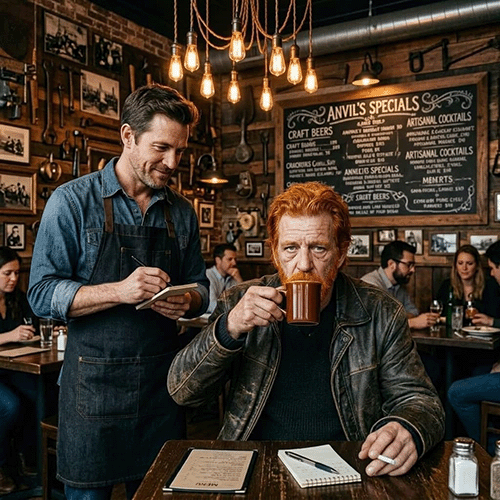 I stood on the sidewalk for a moment longer than was dignified.
Then I went inside.
The interior has been redone. The original Anvil was stripped wood and blackened steel — deliberate, industrial, warm in the way a working kitchen is warm, which is to say functional rather than romantic. What occupies the space now looks like someone described my restaurant to an interior decorator over the phone and the decorator was not taking notes. The bones are recognizable. The skin is wrong. Edison bulbs where there should be clean floods. Exposed brick that was never meant to be decorative and now very much is. A chalkboard menu on the east wall I want to stop looking at because I can see, from across the room, in a handwriting that is not mine, a dish I invented in the winter of 2011.
The braised short rib with charred leek and bone broth reduction.
My braised short rib. My charred leek. My reduction, which took me four months to balance properly because the fat content of domestic short rib shifts meaningfully by season and you have to account for that or the whole thing breaks into grease and sentiment.
I sat down. A server came. Young, cheerful, the good kind of enthusiastic that you try not to extinguish in young people even when you are profoundly not in the mood for it.
I ordered the short rib. I ordered the bone marrow crostini. I ordered coffee, black.
He said they had a pour-over program.
I said that was fine.
He said it was a single-origin Ethiopian, fruity, natural process.
"It's cold water, Kevin," I said. Not to him. To the room.
He brought the coffee. It was actually quite good, which helped nothing.
The menu is mine. Not all of it — whoever built this place around those recipe cards filled in the gaps with the safe generic vocabulary of modern American bistro: burrata, some variety of flatbread, a beet salad dressed in a way that suggests the chef has heard the word "sumac" but has not yet decided what to do with it. But the load-bearing dishes, the architecture of the thing, the items that give the menu its identity and justify the price point — those are from a notebook I kept in a drawer in River North from 2008 to 2014. They went somewhere when I cleared out. Apparently, they went to a storage auction.
I had to make a phone call.
I want to be clear about the nature of the call: it was not a legal strategy session. It was not a coordinated response. It was two minutes in a single-stall bathroom off the main dining room, sitting on the closed lid of a toilet, calling a number I have called maybe twice in the last decade, and saying, when it picked up on the third ring, "They bought the recipes out of storage. I'm looking at the menu right now."
Scott Meadow, who backed the original Anvil in 2009 on what he called a bet and I called an act of faith, said nothing for a moment. Then he said, "What? Are you eating there?"
"I'm in the bathroom."
"Order the short rib."
"I already did."
"Call me back," he said.
I did not call him back. I washed my hands and went to the table.
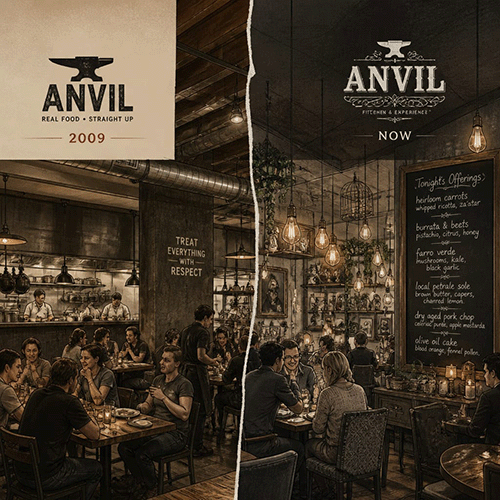 The short rib arrived in a bowl I would not have chosen — too wide, too shallow, the kind of vessel that lets the reduction spread thin before the fork even touches the meat. The presentation was earnest and almost correct: charred leek laid across the braise in the right orientation, bone broth pooled with the right color, a dusting of something that was meant to be the smoked salt I used to finish it but is running at perhaps sixty percent of the grain size and half the smoke level. Close. The way a photocopy is close.
The meat itself was competent. It had been braised long enough, rested correctly, pulled from the liquid at the right moment. Whoever cooked this — and I mean the actual person who stood over the pot and made the decisions — has a working knowledge of what they are doing. The braise had body. The leek had genuine char without bitterness. The reduction held the fat in suspension rather than breaking.
I ate it. I wrote nothing in my notebook for several minutes.
The bone marrow crostini was a lesser story. The bread — here is where the provenance becomes apparent, because the bread matters enormously and the bread is wrong. My crostini used a levain from a bakery in Logan Square that I had a standing arrangement with for eleven years, and that bread had a specific chew, a specific crumb structure, that gave the whole dish its resistance. What I was eating was a commercial sourdough, acceptable, not embarrassing, but the dish without that resistance is a different dish. It is a dish wearing my clothes. The marrow was fine. The gremolata was slightly underseasoned. The dish did not fail — it simply was not the thing it believed itself to be.
I want to say something about the chef, whose name I was given as Marcus, whose full name I am not printing here because he did not open a fake restaurant in bad faith — he opened a restaurant in inherited faith, which is a different crime, and arguably not a crime at all.
Someone found my notebooks. Someone sold my notebooks. Someone built a business model around the idea that a dead restaurant's intellectual property was fair salvage, and someone pitched that proposition to a young cook with enough technique to make it plausible and not enough biography to know what he was standing in. Marcus is not the grift. Marcus is what the grift looks like when it's working. He is cooking real food from someone else's real ideas and doing it without the years of failure that produced those ideas, which means he is cooking the answers without having sat the exam. He is very good at it.
When he came to my table — tableside visits, of course, because this is that kind of place now — he was warm and knowledgeable and named three techniques by their correct names without prompting. I asked him where the short rib recipe came from. He said he'd developed it over time, drawing on classical French braise methodology. He said it with the confidence of a man who invented it.
I thanked him and meant it.
The check came. I paid it without incident. I tipped well because the server had done nothing wrong and the kitchen, whatever its borrowed foundations, had fed me with genuine care.
Outside, the street was still doing what Chicago streets do in early summer — that particular warmth that pretends to be permanent and isn't, the smell of the lake two miles east like a rumor. I walked for a while before I hailed anything. I thought about the Anvil, the original one, the one that ran from 2009 to 2014 and closed because I chose to close it rather than watch it become something I didn't recognize. I thought about the fact that it apparently became something I didn't recognize anyway, just without my participation.
There is a version of this piece that is a takedown. The recipes, technically, belong to me — I have never disputed that, I simply did not pursue it when the restaurant closed because I was tired and because the law is a blunt instrument and I was not interested in spending years converting grief into paperwork. There is a version of this piece that ends with citations and consequences.
This is not that version.
The new Anvil is a restaurant built on salvage, cooking real food from someone else's hard-won years, in a room that doesn't quite remember what it's supposed to look like. The dishes that were mine are still good, because the ideas were always good, and good ideas survive whoever is holding them. The dishes that are new are uneven in the way that unsupported instinct is uneven — flashes of real ability interrupted by the confident choices of a man who does not yet know what he does not know.
It is worth eating. It is not worth forgiving.
I left a cash tip and did not leave a note.
Julian Cross is a former two-Michelin-starred executive chef and Food & Dining Correspondent for IRREVERENT. He lives in Chicago and drinks his coffee black. No exceptions.
- Vessel, Chicago: A Review of a Man Playing a Character in a Room Full of Mirrors
- I Infiltrated Chicago's Underground Ketchup-on-Hot-Dogs Fight Club. There Were No Winners, Only Casualties.
- I Drank a Gallon of Raw Milk for Journalism and My Doctor Stopped Returning My Calls
- I Have Been Told I May Lose My Sight. I Would Lose It Again for the Uni.