
by Julian Cross
Editor's note: The CDC and FDA are explicit on this point: raw, unpasteurized milk can contain E. coli, Salmonella, Listeria, Campylobacter, and a rotating cast of other pathogens capable of causing severe illness, hospitalization, and death. Do not drink raw milk. Do not do what Julian did. He is a trained professional who has made significantly worse decisions than this, and even he is not recommending it.
The woman behind the counter at Bovine & Bloom — the Wicker Park "milk bar" that had been showing up in my feed with the frequency and inevitability of a parking ticket — wore a linen apron and spoke about unpasteurized dairy the way a sommelier speaks about a first-growth Bordeaux. She had opinions about herd terroir. She used the phrase "living milk." She told me, with the absolute conviction of someone who had never worked a kitchen in her life, that pasteurization was "basically just violence against flavor molecules."
I ordered a small pour of their house raw whole milk, three dollars and seventy-five cents, served in a hand-thrown ceramic cup with a drawing of a very happy cow on it.
I asked the cow if it knew what I was about to do.
The cow, being a drawing on a cup, said nothing.
I drank.
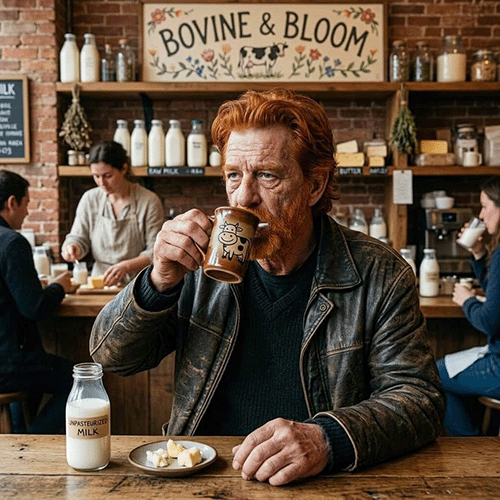 It tasted like milk. Cold, slightly grassy, with a faint sweetness behind it. Full-bodied. Genuinely good. I want to be clear about this because I am a person who takes flavor seriously: it was excellent milk. It was also, as I would spend the next seven days learning in increasingly vivid detail, a complicated choice.
Day One. I called Dr. Hsu.
Dr. Hsu has been my physician for eleven years. She has seen me through a bout of food poisoning acquired from a sea urchin in a restaurant I won't name because I genuinely liked the chef. She has seen me through the blowfish incident of 2019, which remains under a gentleman's agreement neither of us discusses in writing. She was there, in a professional capacity, after the casu marzu tasting in Sardinia — research, I told her, and she said nothing, and then I spent three days producing gastrointestinal theater I am still processing emotionally.
She has never, in eleven years, sounded frightened.
"Julian," she said.
"I'm doing a week of raw milk. For journalism."
There was a silence of roughly four seconds, which for Dr. Hsu is the equivalent of another person screaming.
"I'm going to need you to text me your symptoms every morning," she said finally. "And if you develop a fever above 101, you go to the ER. I'm not negotiating on that."
I agreed to her terms.
She did not sound comforted.
Let me be direct about the raw milk situation in America, because someone has to be, and the people selling it to you at your local farmers market certainly aren't going to do it.
Raw milk has not been pasteurized, which means Louis Pasteur's nineteenth-century process of heating liquid to kill pathogens has been deliberately skipped. The FDA estimates that raw milk causes nearly three times more hospitalizations than any other food-borne illness source. The CDC has documented over 200 outbreaks linked to raw milk and raw milk products since 1993. Children, pregnant women, the elderly, and immunocompromised individuals face the sharpest risk; the outcomes can include kidney failure.
The wellness industry, in its infinite wisdom and its determined relationship with motivated reasoning, has decided this is a feature.
The argument for raw milk — and I want to steelman it, because I am a fair person — is that pasteurization kills beneficial bacteria, enzymes, and nutrients along with the dangerous ones; that properly handled raw milk from grass-fed, small-herd operations is categorically safer than industrial dairy; and that human beings drank raw milk for roughly ten thousand years before Pasteur and mostly survived. There are peer-reviewed papers supporting portions of this view. The beneficial bacteria argument has genuine research behind it. The safety-of-sourcing argument has merit if, and this is a significant if, you trust your source absolutely.
The problem is that the raw milk movement has been colonized by people who do not engage with the peer-reviewed papers. They engage with podcasts. They engage with influencers who have high cheekbones and very good lighting. They engage with a deep, ambient distrust of regulatory bodies that makes every FDA warning feel like confirmation of a conspiracy rather than a description of what E. coli does to your large intestine.
This is a distinction that matters. And it is the reason I am here.
Day Two. I drove to Hartwell Family Farm, two hours north of Chicago, just past the Wisconsin border, down a county road so flat you can see the indifference coming from three miles away.
Dwight Hartwell is not what you expect when you expect a raw milk farmer. He is sixty-one, taciturn, and deeply skeptical of anyone who uses the word "artisanal" without irony. He has twelve cows. He has been farming this land his entire life. His herd is tested twice a month. His operation is clean in the way that only operations run by people who actually care about the work tend to be.
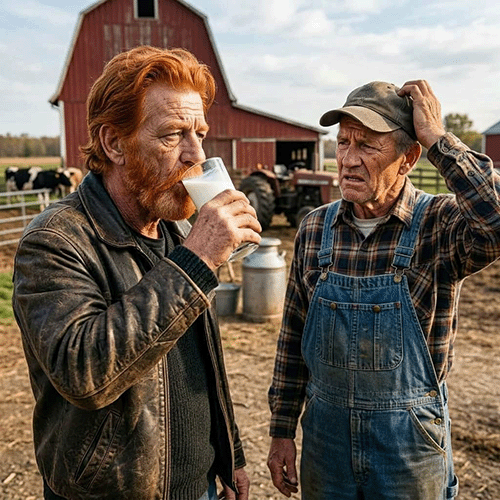 "I know what the risks are," he said. We were standing in his barn. It smelled like hay and manure and something surprisingly not-unpleasant underneath, which I chose not to examine too closely. "I drink it every day. My kids grew up on it. But I also know that I know my animals. I know their health. I know how they're handled. You buy this from me and you're buying that knowledge."
I asked him what he thought about the wellness people.
He looked at me for a long moment.
"They're buying a story," he said. "I'm selling milk."
This felt like the most honest thing anyone had said to me in months.
I bought two gallons. I texted Dr. Hsu a photo of the farm.
She texted back: "This is not reassuring."
Day Three. I attended the Third Annual Raw Dairy Wellness Summit, held in a repurposed event space in River North that still had the exposed ductwork from its previous life as something industrial and honest. Ticket price: $185, which included a "curated tasting flight" and access to what the website called "educational panels."
The panels were not educational in the way that word is conventionally used.
I sat through a forty-five minute presentation by a man with a podcast called The Sovereign Gut who explained that pasteurization was invented not to prevent disease but to "centralize control of the food supply" — a claim that made me want to call Louis Pasteur's ghost and apologize to it. I sat through a Q&A in which a woman asked whether feeding raw milk to her infant was "intuitively safer" than formula, and the panelist, to his credit, declined to answer directly, which was the correct response but also left me deeply concerned about what she was going to do when she got home.
I drank four ounces of raw colostrum. It tasted like concentrated dairy and tangy regret.
The booths sold raw milk kefir, raw milk butter, raw milk cheese, a "raw dairy gut reset protocol" that cost $340 and appeared to be a branded reusable jug and some pamphlets, and something called "Raw Milk for Pets," which I stared at for a long time without speaking.
"Are you okay?" asked the woman staffing that booth.
"I'm fine," I said. "I just need a moment."
I texted Dr. Hsu: Raw milk summit. Very much a thing. Considered 'Raw Milk for Pets.'
She texted back, after a pause: Julian. Please eat a vegetable.
Day Four. Symptoms: none, so far. I was eating Dwight's milk with cereal. I was drinking it straight, cold, at the kitchen counter at 7 AM. I was making a very good béchamel with it that I immediately felt guilty about because pasteurized milk would have been fine for béchamel and the whole exercise was about drinking it raw.
I felt fine. I want to be clear that I felt fine. I also want to be clear that this is not the point.
This is the problem with anecdote as evidence: I felt fine, therefore the thing I did was safe. Millions of people have driven drunk and arrived home without incident, and this has done precisely nothing to reduce the death toll from drunk driving. Survivorship bias is not a health policy. It is not a culinary philosophy. It is not, however much the wellness industrial complex would like it to be, a substitute for microbiology.
I still texted Dr. Hsu every morning.
She was still responding.
Day Five. I went back to Bovine & Bloom.
I watched the customers. I watched the way they photographed their ceramic cups before they drank. I watched a man explain to his date that raw milk "reprogrammed" his gut in four days, a claim that requires a flexible relationship with both immunology and time. I watched a woman in activewear photograph the chalkboard menu for her Instagram story.
I ordered another small pour.
I talked to the owner. Her name was Calla. She was thirty-four, formerly in marketing, and she had started Bovine & Bloom after her own "gut reset journey," which had begun with a raw milk cleanse recommended by a podcast that I will also not name because its host has enough attention.
"I just felt so much better," she said. "My inflammation went down. My brain fog cleared."
I asked her who her supplier was.
"We rotate," she said. "We work with farms we trust."
I asked how she verified the farms.
There was a pause. "We visit them," she said. "We do site visits."
I asked if they did any bacterial testing on incoming product.
Another pause, slightly longer.
"We trust our farmers," she said.
I finished my milk. It was still very good. It was still not tested.
Day Six. Dr. Hsu called me. Not texted. Called.
"How are you feeling?"
"Fine," I said. "Genuinely fine. No fever. Normal digestion. I'm a little tired of milk, honestly."
"Julian," she said. "I want you to understand something. The fact that you are fine does not mean this was a good idea. It means you got lucky. Or it means Hartwell's operation is as clean as it appeared. Or both. But you have no way of knowing which."
"I know," I said.
"Do you?" she said.
She said it the way you say something to a person you have been arguing with for eleven years and have not once won an argument against, and she said it with the exhausted patience of a woman who has decided that documentation is the only victory available to her.
"Dr. Hsu," I said, "I need you to know that I deeply respect you and I understand that I am an unreasonable patient."
"Yes," she said. "I know. Text me tomorrow."
Day Seven. The last glass. I drank it standing at the kitchen window, looking at the Chicago morning coming through like it always does — low and gray and functional, no nonsense, no performance. I thought about Dwight Hartwell in his barn with his twelve cows and his bimonthly tests. I thought about the man at the summit with his podcast and his theories about food supply centralization. I thought about Calla and her ceramic cups and her site visits that apparently did not include microbiological sampling.
I thought about the fact that these are not the same thing.
This is the conversation the raw milk moment refuses to have with itself: the difference between Dwight and the Sovereign Gut guy is not a matter of degree. It is a matter of category. Dwight is a farmer. The Sovereign Gut guy is a content creator. Bovine & Bloom is a retail operation. The Raw Dairy Wellness Summit is a trade show for people who have decided that their distrust of institutions is itself a kind of expertise.
Raw milk from a rigorously managed, regularly tested small herd is a different product, bacteriologically, than raw milk sourced from "farms we trust" on the basis of a vibe. The wellness industry does not want you to understand this distinction. The wellness industry wants you to feel that your instincts and your podcast listening habits are equivalent to the kind of knowledge that comes from, say, knowing what E. coli O157:H7 looks like in a petri dish.
They are not equivalent.
I drank the glass.
I called Dr. Hsu to tell her I was done.
She exhaled in a way that sounded like she had been holding it for a week.
"I'm going to need you to come in for a panel," she said.
"I'm fine."
"Julian." Her voice had that quality again. "You don't know that. Get the panel."
I got the panel.
The panel was fine.
The milk was fine.
I am fine.
Do not do this. I mean it. I did this so you don't have to, and I had a medical professional monitoring me every step of the way, access to a farmer whose operation I could personally evaluate, and twenty years of professional food experience that has given me a calibrated (if somewhat battered) risk tolerance and a working relationship with my gastroenterologist.
You have the Sovereign Gut podcast and a $185 ticket stub.
I'm not judging you. I'm just telling you it's not the same.
The milk was very good. The farm was real. The stakes were real.
Everything else at that summit was a well-lit story told by people who have never had to clean a walk-in at 2 AM or explain to a health inspector why a specific surface reads hot.
Drink your pasteurized milk. Buy it from small farms if you can. It's still very good milk.
Leave the raw stuff to people who know what they're doing, and ask hard questions about whether those people actually do.
Julian Cross is IRREVERENT's Food & Dining Correspondent. He is fine. Dr. Hsu has requested that this not be taken as a general endorsement of his lifestyle.
CDC raw milk guidance: cdc.gov/foodsafety/rawmilk