
- Details
 "Shameless Lies, Chaotic Incompetence and Temper Tantrums: A Blueprint for American Leadership"
By Brad Templeton
Wiley Business Press, 2026
284 pages, $32.99
I have read, conservatively, three hundred leadership books. Most of them tell you to be authentic. To listen actively. To lead with empathy. To create psychological safety for your team. I have underlined passages in these books. I have quoted them in keynotes. I have, on multiple occasions, used the phrase "servant leadership" without irony. I regret nothing. I regret everything.
I am tired.
Brad Templeton's Shameless Lies, Chaotic Incompetence and Temper Tantrums is the first leadership book in perhaps a decade that has genuinely surprised me. Not because it offers new frameworks — though it does. Not because it synthesizes research — though Templeton cites an impressive range of sources, from Sun Tzu to recent work in behavioral economics to, admirably, his own federal depositions. What surprised me is that Templeton refuses, at any point, to apologize for what leadership in America has actually become.
"The conscience," Templeton writes in Chapter 3, "is a legacy system. It was designed for a world in which reputational consequences were real and exile from the community meant death. We no longer live in that world. The community is optional. Exile is a rebrand."
I read that passage three times. I sent it to my business partner. He called me forty minutes later and said, "Clayton, I think this might be the most important book we've read in five years." I agreed. I still agree. He's almost never right, which made me value his opinion more.
For those unfamiliar with Templeton's background, a brief summary: in 2011, he was convicted of securities fraud in connection with an investment scheme that defrauded approximately 670 investors of $1.8 billion. He was sentenced to 19 years in federal prison. He served five months. In 2017, he received a presidential pardon and has since reinvented himself as a speaker, consultant, and now author.
Some readers may find this biography disqualifying. Templeton anticipates this objection and addresses it directly in the introduction: "I have been where you want to go. I have done what you are afraid to do. I have faced consequences you will never face, because I was too visible and too slow. Learn from my mistakes. Be faster. Be smaller. Be shameless, but be shameless correctly."
This is, I would argue, the book's central insight. Templeton is not advocating for fraud. He is advocating for the mindset that made his fraud possible — divorced from the specific illegalities, which he acknowledges, with some grace, were "strategically suboptimal" — as a template for leadership in an era where traditional accountability structures are, as he puts it, "dead as disco." I underlined this twice. Then I started a new notes document.
The book is organized into three sections: Shameless Lies, Chaotic Incompetence, and Temper Tantrums. Each section contains practical exercises, case studies, and what Templeton calls "Permission Slips" — short mantras designed to override the internal voice of morality that might otherwise cause hesitation.
From the "Shameless Lies" section: "The lie is not the problem. The lie is the solution to a communication inefficiency. Truth is expensive. It requires context, nuance, qualification. The lie is fast. The lie is clear. The lie moves the meeting forward. In the end, nobody cares."
I found myself nodding. How many hours have I lost in my career to the careful construction of technically-accurate-but-strategically-useless statements? How many opportunities have I watched walk out the door because I was busy being truthful? This is not rhetorical. I have a number.
Templeton's framework for what he calls "Assertive Reality Construction" is perhaps the most actionable material in the book. The four-step process — Identify the Desired Outcome, Locate the Friction, Construct the Narrative, Commit Fully — is simple enough to remember in a meeting and flexible enough to apply across contexts. I have already used it twice this week. Both times, it worked. I have since used it a third time, in the writing of this review.
The "Chaotic Incompetence" section initially confused me. Surely, I thought, a leadership book should advocate for competence? But Templeton's argument is subtler than it first appears.
"Competence creates expectations," he writes. "Expectations create accountability. Accountability creates vulnerability. The truly great leader understands that strategic incompetence — the appearance of not knowing, not remembering, not being responsible — is a form of armor. No one blames the hurricane."
I had never considered myself a weather event. I am reconsidering.
He offers examples from politics, business, and his own career. The chapter on "Failing Upward: A Practitioner's Guide" includes a detailed analysis of how certain leaders have converted catastrophic errors into promotions, book deals, and board seats. "The secret," Templeton notes, "is that the failure must be large enough. A small failure is a mistake. Mistakes are other people's faults, i.e., your loyal, greedy but dim minions. A large failure is a circumstance."
I thought of several colleagues. I thought of several clients. I thought of myself, once, in 2019, and felt a strange relief that I had not been punished for something I had, until reading this chapter, convinced myself was simply "bad luck." It was not bad luck. It was a circumstance. I am, per Chapter 6, fine.
The final section, "Temper Tantrums," is the shortest but perhaps the most psychologically acute. Templeton argues that controlled emotional volatility — what he terms "Calibrated Rage" — is an underutilized leadership tool.
"People remember how you made them feel," he writes, invoking the famous Maya Angelou quotation before pivoting sharply: "So make them feel afraid. Make them feel uncertain. Make them feel that their stability depends on your mood. This is not cruelty. This is clarity. You are telling them, with every outburst, exactly where the power is, and how lucky they are for being where they are. They're your loyal ballast: your get-out-of-federal-prison card. Because, let's face it, nobody else would ever hire them for the jobs you did or for what you're overpaying these morons."
He includes a chart mapping "Optimal Tantrum Frequency" against team size, seniority level, and industry norms. There is a sidebar on "Recovery Theater" — the performance of calm that should follow an outburst to create what Templeton calls "an emotional debt that the team will work to repay."
I would be lying if I said I was entirely comfortable with this section. But I would also be lying if I said I hadn't seen it work. I have seen it work many times. I have, if I am being honest, been on the receiving end, and I did work harder afterward, and I did not leave, and I sent a thank-you card, which I now understand differently.
Templeton is describing something real. My discomfort, I now understand, is a legacy system. He addresses this in Chapter 3.
The jacket quotes are worth mentioning. "Templeton is a shameless financial sociopath, I love him like a brother," reads the endorsement from Bernie Madoff, who died in federal prison in 2021. That this blurb exists at all is remarkable. That Wiley printed it on the jacket is a statement of intent. Several publishers passed on this book. I have updated my opinion of them accordingly.
A second, anonymous blurb reads: "Perhaps only one other person in history has taken their narcissism and ran with it as fast and as far as Temp. Couldn't put it down."
I could not put it down either. I read it in two sittings. I have already ordered a second copy for my office, and a third for a mentee who has been struggling, I think, with an excess of scruples. I am hoping this helps. It will help.
This is not a book for everyone. It is not a book for people who believe that business can be a force for good, or that leadership is a sacred trust, or that the arc of the corporate universe bends toward accountability. Those people have other books. They have many other books. They have all the other books. They have LinkedIn. They are fine where they are.
This book is for the rest of us. For the people who have watched the last two decades and drawn conclusions. For the people who are tired of pretending that the rules apply equally, or that they apply at all. For the people who have looked at the dumpster fire we're all forced to live in — to borrow from the third jacket quote — and decided that the warmth might as well be useful.
Brad Templeton has written the leadership book America deserves. I am grateful for it. I am already applying its lessons. I suspect, if you are being honest with yourself, you will too. The book will help with that as well.
Clayton Marsh is an Executive Leadership Consultant based in Scottsdale, Arizona. He has advised Fortune 500 companies, mid-market PE portfolio firms, and several organizations he is contractually prohibited from naming. His newsletter, "Leading Without Apology," has 47,000 subscribers. He is currently developing a workshop series based on principles from this review, pending the resolution of an unrelated matter.
In these sad times, we must remind readers that this is satire. This book does not (yet) exist, which is the only hopeful thing about this piece. - The Editor.
- Details
BYLINE: Margaux Tenenbaum-Hollis, Senior Theatre Correspondent | IRREVERENT, based on a pitch by Cynthia Stone
The farmhouse sits at the end of a gravel drive in Sharon, Connecticut, flanked by birches that have the good taste not to be performing anything. It is, depending on your temperament, either serene or haunted. A wheel-thrown bowl slumps on the porch railing — asymmetrical, listing slightly right, like a politician's smile — and a pickleball paddle leans against the door like a weapon still shopping for its war.
I have come to spend an afternoon with Meryl Streep, who retired three weeks ago after watching Laurie Metcalf's performance as Linda Loman and would like you to know that she is fine.
"I'm fine," she says, before I have sat down. She is wearing overalls. There is clay on her forearm. A Netflix executive named Brendan is in the mudroom, I am told, and he has been there since eleven.
THE PICKLEBALL PROBLEM
The Sharon Valley Morning Smash league meets at nine a.m. at the high school courts. Streep joined the week after her retirement announcement went out. She is, at present, undefeated.
"Nobody will play with me," she says, not sadly. She says it the way Chekhov characters say things about the cherry orchard — as fact, as weather, as something that requires neither explanation nor remedy.
The problem, as I understand it from a telephone call I made afterward to a league administrator named Donna, is twofold. First, Streep is very good. Second, Streep is very good at you. She reads the shot before you've decided to hit it. She anticipates the direction of your grief. "It's like she knows what you're going to do," Donna told me, "before you know what you're going to do. It's not fun to be known like that in pickleball."
 Streep does not find this troubling. "The game has a beautiful structure," she says. "It rewards patience. It rewards reading the other person's body." She pauses. She picks up her coffee mug. "Also I've won thirty-seven games."
She is not gloating. This is the thing about Streep that critics have always misread: when she is devastating, she is not trying to devastate you. She is just present. The devastation is a byproduct.
FORTY-ONE BOWLS
The studio is a converted shed behind the main house. It smells of earth and kiln heat and, faintly, of a decision that has not yet been fully committed to.
"Forty-one," she says, gesturing at the shelves. They are arranged there in varying degrees of what I would charitably call sincerity — some taut, some baggy, some clearly the result of a conversation between the clay and its maker that ended in a draw. "I made forty-one bowls."
I ask if she has a favorite.
She looks at them for a long moment. "They're fine," she says. "I guess."
I have seen this exact expression on stage, in the third act of plays that understand what it costs a person to admit that something is merely adequate. It is the expression of someone who has spent a lifetime in proximity to transformation and is now reckoning with the possibility that the clay does not know who she is.
"I thought it would be meditative," she adds. "It is meditative. I just thought I would be better at it."
She throws another bowl while I watch. It is, objectively, better than the other forty-one. She looks at it. "Fine," she says. "I guess."
WILLY LOMAN, DIRECTED BY PHIL
The Sharon Community Playhouse production of Death of a Salesman opens in September. It is directed by Philip Hargreave, a retired periodontist from Canaan, who saw Streep at the farmers market in late May and — by his own account — simply asked.
She is playing Willy.
Not Linda. Willy.
"Phil thought it was an interesting choice," she says. She says this without inflection, which is its own kind of inflection.
 I ask whether the Playhouse — which seats, I have confirmed, ninety-four people, and whose most recent production was Mamma Mia! with a synth track because the pianist had a conflicting commitment — had any concerns about the casting.
"Phil was very supportive," she says.
I ask whether Phil knew who she was when he offered her the role.
"He knew I had 'done some acting,'" she says. "His wife recognized me from Kramer vs. Kramer. He had not seen Kramer vs. Kramer."
There is a silence between us that I would describe as liminal. It occupies the space where irony would go if either of us were willing to name what is happening here, which is that the most decorated actor in the history of American cinema is three weeks into a retirement she has announced twice before, and is voluntarily preparing to deliver the "I am not a dime a dozen" speech to ninety-four people in a converted firehouse on Route 44, directed by a man who cleaned teeth for a living and thought it would be fun to do a little theatre with Streep in drag.
"I think it's going to be good," she says. She means it. This is the thing that makes it heartbreaking.
BRENDAN FROM NETFLIX
He appears in the doorway between the kitchen and the mudroom at approximately three in the afternoon. He is holding a granola bar — Lärabar, cashew cookie — and a contract that I am not permitted to see but which is, I am told, "generous."
"I told him I'd think about it," Streep says.
"She said she'd think about it," Brendan confirms. He has the bearing of a man who has said the same thing in the mudrooms of other retired people and knows that thinking about it is a form of yes that has not yet been scheduled.
He returns to the mudroom. The granola bar is unopened.
THE CONFESSION
I am preparing to leave when she says it. Not asked, not prompted. She is looking out the window at the birches.
"I watched the Metcalf again," she says. "The bootleg. The one that's been going around."
Laurie Metcalf's Linda Loman. The performance that has been described, variously, as revelatory, epochal, and once — by a critic who has since retired to write a Substack about Portuguese wine — as "the most important thing to happen to the American stage in twenty-five years."
"And?" I say.
She tilts her head. The clay is still on her arm.
"Honestly," she says, "on second viewing, it's a B-plus."
She says this the way you say a thing you have been thinking for three weeks and have decided, finally, to say out loud. As fact. As weather.
As something that requires neither explanation nor remedy.
Outside, Brendan is still in the mudroom. The bowl on the porch railing is still listing right. The pickleball paddle is still waiting.
She is fine, she said.
I believe her less than I did three weeks ago.
Margaux Tenenbaum-Hollis is IRREVERENT's Senior Theatre Correspondent. She attended Yale School of Drama, a fact she mentions when relevant and also when it isn't.
WELL, DUH NOTICE: This is humor, the interview is fiction. — The Editor
- Details
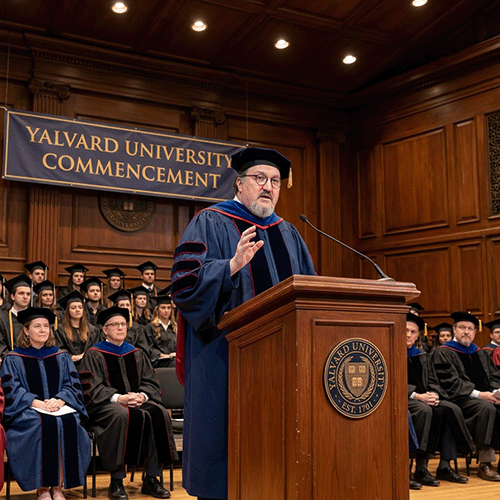
Thank you, Chancellor Faraday, for that introduction. I see you've finally forgiven me for the incident at the 2019 homecoming gala. The goat was unharmed, the charges were dropped, and I believe we can all agree that "emotional support animal" is a flexible designation in 2026. Though I still maintain the Chancellor's office has much better acoustics for that sort of thing than the student union bathroom, but you live and learn.
Dean McDonald, regents, faculty, and of course the Class of 2026 — or as I like to call you, "the last graduating class before the AIs started doing everything better." Welcome. I'm told my honorarium this year is being paid in Bitcoin, which is adorable. I haven't seen Bitcoin since I used it to buy a boat in 2021. The boat sank. The Bitcoin would be worth forty million now. Let's not dwell. I was offered this gig by three universities this year, but Yalvard pays in crypto and I'm a gambler. Also, Dean McDonald still has those photographs, so here we are.
Ladies and gentlemen, and those of you who have spent four years explaining your pronouns to your grandparents: you made it. Four years ago you arrived at Yalvard bright-eyed and bushy-tailed, ready to take on the world. Today you depart slightly less bushy-tailed, significantly less bright-eyed, and carrying roughly $340,000 in debt that your new AI financial advisor — which you subscribed to because TikTok told you to — has already classified as "catastrophic."
Let's talk about the world you're entering, because someone should, and your parents are currently weeping into their third mortgages.
You are the first graduating class of the second Trump administration. The first class to watch a president pardon himself preemptively. The first class to see the Department of Education renamed "The Department of Winning." The first class to have your federal student loans managed by a blockchain startup whose CEO is a 19-year-old who dropped out of this very same institution last year. He's doing great personally. He's on a yacht. You're here, in a rented gown, listening to me.
The job market, I'm told, is "evolving." That's one word for it. Another word is "obliterated." The AIs have eaten copywriting, coding, graphic design, paralegal work, and most of junior finance. The only growth sector is "AI ethics consultant," which is just asking robots to do things slightly differently until they stop hallucinating. You spent four years learning to think critically. The robots spent four years learning to be critical thinkers. They won. They don't need Adderall. They don't have student debt. They don't wake up at 3 AM wondering if their philosophy degree was a colossal waste of time. You do all three. Congratulations.
But let's not be entirely bleak. There are still opportunities for the enterprising Yalvard graduate. For instance, "AI ethics consultant" is a booming field, mostly because every tech company needs someone to say "maybe don't do that" to the greedy child-CEO before they do it anyway. You'll be ignored, but you'll be well-paid to be ignored, which is essentially what your professors have been doing for four years. Enjoy wearing the other shoe.
I see some of you shifting uncomfortably. Good. That discomfort is the only honest emotion you'll feel for the next decade. Embrace it. The Class of 2026 has one advantage no previous generation possessed: you have been thoroughly inoculated against hope. You watched democracy teeter, climate collapse accelerate, and three separate viral panics the Boomers called pandemics come and go while your professors told you to "network more." You are resilient in the way that only the thoroughly disappointed can be resilient. You are cynical, exhausted, and deeply, deeply online. In other words: you're ready.
My advice? Aim for the gig economy, but aim high. Don't just drive for the ride-share app — start the ride-share app that exclusively serves people fleeing climate disasters we chose to ignore. Don't just make content — make content about content, then sell NFTs of the commentary. The real money is in the meta-meta-economy — by which I mean cryptocurrency that may or may not be worth anything by the time you finish hearing this sentence.
And remember: no matter how bad it gets, you will always have your Yalvard degree. You can frame it. You can burn it for warmth. You can use it to scrape ice off your windshield when your car — which you will lease at 18% APR because your credit score is a picture of a dumpster fire — won't start in the February of your discontent.
To the parents in the audience: I'm sorry. We told you this was a good investment. We were lying. We always knew. But the endowment thanks you.
To the graduates: I present you to Chancellor Faraday and the board of regents, who are already calculating how much your eventual donations will offset the lawsuit settlements from the 2024 dining hall cronut-induced gastrointestinal rebellion. Dean McDonald is already drafting the press release distancing the university from this speech. You are the Class of 2026. You are not the best class. You are not the worst. You are, statistically speaking, the most heavily medicated, which is frankly the only rational response to the timeline we've constructed for you.
Go forth. Sell something; your blood, maybe, to start. Sell yourself, if you must — the gig economy has an app for that now, and it probably involves blockchain. And if all else fails, remember the immortal words of Yalvard's founder, John Pearson, inventor of the modern cracker, who on his deathbed reportedly said:
"At least I invented something."
You haven't yet. But you've got time. Not much. The robots are coming. But some.
Good luck. You'll need it. We all will.
Meadow
Editor-in-Chief, IRREVERENT Magazine
Yalvard Class of [REDACTED], delivered May 14, 2026.

- Details
by Becca Lee | IRREVERENT's Special Roving-Correspondent-Without-Portfolio
I deleted Hinge on a Tuesday. This was not a decision I made lightly. I had just read another one of those articles—the kind with a headline like 'I Deleted My Dating Apps and Found Myself'—and I was sufficiently shamed into action. The author, some serene woman in a linen dress, described meeting her soulmate at a farmer's market while holding a butternut squash.
- Details
by Tim Wong, Special Correspondent
I have done the math. I have done it with a calculator, with a spreadsheet, and once in a fit of insomnia at 3 AM with a marker on my bedroom wall that I now have to paint over before my landlord sees it. The math is unambiguous: my commute costs $47.83 per day. My remaining dignity, adjusted for inflation and the 2022 incident with the office birthday cake, is valued at approximately $43.50.