
- Details
By Kharla, Fashion Director, IRREVERENT
She is in the car from Charles de Gaulle. The driver has not spoken since the airport. Paris receives her the way Paris always receives her: as an inconvenience that has been scheduled in advance.
 Paris in July is a city that believes in its own mythology. The light is golden in a way that suggests color correction by a committee. The streets are warm with the specific warmth of entitlement. I am here because the Fédération de la Haute Couture et de la Mode does not make requests — it issues commands, delivered on cardstock heavy enough to constitute a physical threat. The calligraphy alone suggested consequences.
I am twenty-nine. This is relevant because Haute Couture believes it is relevant, and because the mathematics of how long I have been attending these shows are someone else's problem. Milan was last month, and Milan was complicated. Milan had Marco. Paris has better lighting and fewer witnesses. I find this adequate.
The Negroni arrives at the hotel. It is the first one. She does not think about this. She does not need to.
CHANEL — The House Blazy Built, One Fairy Tale at a Time
Matthieu Blazy's second couture collection for Chanel is called, and I am reading this correctly, "The Beanstalk and the Camellia." I put down the program. I picked it up again. I drank half my Negroni.
Then the first look came out and I forgave him everything.
What Blazy understands — and what his predecessor at Chanel never quite grasped after the early years — is that couture is not a demonstration of difficulty. It is a demonstration of conviction. The house's beloved camellia arrived here as trompe-l'oeil embroidery in double-layer silk mousseline, approximately 165 grams per square meter, with a drape coefficient that made the chest look like a garden deciding to happen in real time. A jacket in ivory bouclé tweed — the real thing, the Lesage atelier, threads looped with a density that only justifies itself at these prices — arrived with botanical detailing at the lapels so precise it looked like the weeds had been personally invited.
There is a swan, because of course there is a swan. A ballgown in white silk duchess satin, structured with internal horsehair boning from hip to hem, opening into a train with the wingspan of something inconvenient and magnificent. The woman in front of me — an oil heiress from somewhere that produced both significant oil and very bad marriages — actually put her hand to her chest.
I found this relatable. I also found it mildly infuriating, because I have spent, by conservative estimate, twenty-nine years cultivating the ability to not do that, and Blazy almost broke me in a single look.
She considers a camellia brooch at the boutique appointment. The brooch is twelve thousand euros. She thinks about this briefly, then stops thinking about it and acquires it. She does not examine the feeling that accompanies this decision. She puts it in her bag. The bag is from last season. No one here knows this.
DIOR — Jonathan Anderson at the Musée Rodin, or: A Sculpture Garden Decides to Get Dressed
The second Negroni arrives. She is, technically, between shows. The Musée Rodin is thirty-one degrees Celsius and smells of antique stone and expensive sunscreen. She is fine. Everyone is fine.
Jonathan Anderson has not looked up from his obsessions long enough to notice that most couture designers would have withered in the shadow of Taylor Swift's wedding dress — which no one has seen, which has been described through a chain of informants terminating in a woman who once watched someone who attended the wedding leave a restaurant. By all accounts it constitutes a moment. Anderson showed up to his Dior couture debut acting as though none of this had happened, which is either extraordinary discipline or extraordinary hubris. I have decided it is both and that I respect it.
The collection is a conversation with sculptor Lynda Benglis — her Peacock series, her Indian chintz obsessions. Anderson translated this through plissé bows in lamé that moved the way water doesn't, fringe in degraded silk velvet falling from shoulders in densities that made the garments technically tasseled and practically transformative. Metallic pleats — knife-sharp, hand-pressed over polished organza — caught light at angles the palm trees didn't fully block.
A coat in red silk faille referenced the 1948 Arizona pattern from the Dior archive. I know this because the program told me. I would have known it anyway.
Across the garden, a man in a light linen jacket held himself the way expensive men hold themselves when they are pretending not to be noticed. For exactly four and a half seconds I thought it was Marco. It was not Marco. It was a Belgian art dealer from Art Basel 2019. We nodded. We did not speak. The show continued.
SCHIAPARELLI — "The Abyss," or: Daniel Roseberry Calls the Void
I find Schiaparelli exhausting. I also find it necessary, the way a very good therapist is necessary — by which I mean expensive, uncomfortable, and correct.
"The Abyss." L'appel du vide. Roseberry looked at Elsa's legacy of surrealism and said: fine. I'll use latex.
Couture latex is not what you're imagining. It is latex developed in collaboration with the Chambre Syndicale to achieve a finish so precisely calibrated — matte in some sections, mirror-polished in others, thickness varying across a single garment to suggest the architecture beneath — that calling it a material undersells it. It is a position paper. Gowns arrived with sugar water-preserved flowers embedded under stretched silicone panels, the blooms visible through a layer that was simultaneously skin and not-skin. Corset bodies in the house's anatomical style, cast in reinforced resin with a warmth that made them organic rather than Gothic.
She is on the third Negroni. The room is very loud. She is aware that she is on the third. This is fine. The flowers in the silicone deserve a third Negroni.
The woman three rows ahead of me looked like she was going to be sick. Elsa herself would have considered this a standing ovation.
 VALENTINO — Alessandro Michele and the Comfortable Weight of Interruption
"Interferenze." Interference — the softer word, two signals occupying the same frequency rather than one destroying the other. This is Michele's gift: he reads the archive not as a thing to be honored but as a thing to be in dialogue with.
Volumes were large in the way that confidence is large. Velvet in double-weave construction — the kind of technical decision that produces almost no visible evidence of itself beyond the way the fabric moves when the model stops walking. Embroidery in multi-thread silk, historical references loosened from their context, made strange and new.
A gown in deep aubergine — approximately 380 grams per square meter in silk crêpe duchess, backed with organza to prevent the weight from pulling — had the particular quality of a garment that carries memory better than the person wearing it. Someone in this room will wear it to something that matters. She may not even know. This is sufficient.
FENDI — Maria Grazia Chiuri in Rome, or: The Territory Shifts
Maria Grazia Chiuri's inaugural couture show for Fendi took place on the ninth of July at the National Gallery of Modern and Contemporary Art in Rome — not Paris — and the fact that Fendi reasserted its Roman identity at the precise moment Rome's other great couture house was being reinterpreted by a Welshman struck me as either diplomatic genius or an expensive accident that became diplomatic genius in retrospect. In fashion, these are the same thing.
The collection suggested she heard the brief. Furs worked in the Fendi tradition — long-haired, manipulated with the house's distinctive inlay technique — arrived alongside tailoring in silk-and-wool ottoman weave that absorbed the gallery's northern light in a way that made the garments look lit from within. Embellishment was architectural rather than decorative. The Baguette arrived in ten variations, including one in intarsia leather with a depth of detail that justified the price the way very few things justify their price.
I watched the exit and felt, unexpectedly, the particular emotion of being present at a beginning. I have been present at beginnings before. I am twenty-nine; I have witnessed several. They feel like this — like the air adjusting to accommodate something new.
The fourth Negroni arrives. Paris has been adequate. Paris has been, on balance, exactly what Paris always is: glorious and self-impressed and completely correct about itself. She does not hate Paris. She would simply prefer Milan. This is different from hate. This is merely loyalty, which Paris, being Paris, has never had to understand.
 EXIT
EXIT
The car from Paris back to CDG is the same car in reverse. The driver does not speak. Paris releases me, or I release Paris — it is difficult to tell, and it has always been difficult to tell, and the difficulty is part of the relationship.
In my bag: a Chanel camellia brooch in eighteen-karat white gold with pavé diamonds that I have decided I needed. In my body: four Negronis and the particular satisfaction of having watched the industry announce itself, loudly and with extraordinary craft, to everyone willing to hold an invitation printed on cardstock heavy enough to cause injury.
I am twenty-nine. The season continues. Paris was, as promised, Paris.
Kharla is the Fashion Director of IRREVERENT. She is 29.
- Details
By Kharla, Fashion Director, IRREVERENT
Sits in the car from Malpensa. The driver says nothing. Milan receives her the way Milan always receives her: without ceremony, without warmth, without acknowledgment.
Milan in June is a city that has made peace with being wrong. The light arrives at an angle that flatters no one over forty, which is irrelevant to me — I am twenty-nine — but I notice it on behalf of others. The streets are warm in a way that does not build character. I am here because the menswear shows wait for no one, and because if I were not here, someone else would be, and that is not a position I am prepared to occupy.
The Negroni arrives at the hotel bar. It is the first one. She does not think about this.
PRADA
The show opened in a space stripped to its load-bearing architecture, which may or may not have been intentional and was certainly appropriate. Miuccia and Raf have spent recent seasons testing what a suit can hold — how much argument can be pressed into tailoring before it collapses — and SS27 answers the question by refusing it entirely. The collection is not conceptual. It is structural.
The silhouette is elongated at the torso. Not stretched — elongated. There is a difference, and it matters: the jacket's waist suppression has been removed, replaced by a single seam running from shoulder to hip without interruption, giving each look the quality of a load-bearing column that has not yet committed to a building. The trousers drop at the crotch in a manner that has nothing to do with streetwear's gesturing at ease and everything to do with weight distribution and the specific gravity of bonded cotton-nylon. The fabrication is matte. Concrete, ecru, and one deliberate red in look seventeen that functions exactly as a period functions at the end of a sentence you did not expect to end there.
 The argument Prada is making is about shelter. Not warmth — shelter. There is a difference, and it is the entire difference. I respect this without pleasure. It is the correct argument.
She orders the second. She is still thinking about the red.
MARNI
Marni came in the afternoon of day one and I was unprepared. Francesco Risso has been building toward something for several seasons and I have been watching with the focused suspicion I reserve for people who are about to be right about something. The SS27 opening looks: a pieced coat in four weights of the same ecru linen — 100, 140, 180, and 240 grams per square meter — not mismatched, pieced, assembled with the deliberateness of someone who knows exactly what they are doing and requires you to watch. By look nine my strong negative reaction had resolved into something worse: admiration.
I do not forgive him for this. I bought the coat.
She does not order a third. Not yet.
ZEGNA
The Oasi house has been building toward something for several seasons and SS27 feels, uncomfortably, like arrival. The silhouette is soft in the way that only very expensive things are soft — not yielding, but resolved, as if the fabric has already had the argument about structure and won it quietly, in a room without witnesses.
The linen is the issue. There is a specific weight — somewhere between 160 and 220 grams per square meter, I cannot tell you which because I am still not sure, and I am never unsure — in a color I will not be naming. It is not beige. It is not sage. It is not the greige everyone keeps trying to make happen. It is the color that exists in the half-second after you switch off a lamp in a room someone has recently left, and it is perfect, and I find this irritating. The degree is not available for discussion.
 The aperitivo after Zegna is at a place near the Brera that everyone is pretending they did not all separately decide to attend. She is on her second Negroni by the time she sees him.
He has a new haircut.
It is good.
She takes a sip. She looks at the coat — the dove-grey double-faced she helped him choose two seasons ago, when helping people choose things did not yet carry consequences. He is wearing it exactly as she told him to wear it.
He does not look at her. Or he looks at her the way you look at a painting you have already decided.
She finishes the Negroni. She does not signal for another. Yet.
The Zegna linen weight remains unresolved. This matters in the way that things matter when you cannot put them down. I have attended approximately ten menswear seasons — I am twenty-nine, so the mathematics are someone else's problem — and I cannot place this fabric. It drapes with the authority of something heavier. It breathes with the nonchalance of something lighter. The color I will not name persists at the edge of articulation. The show's final exits, four looks in this fabric arranged as a quiet argument about ease, have been in my head since the tent emptied.
She signals for the third. The bar is very loud. This is fine.
 FENDI
FENDI
There are shows you see and shows you experience and the Fendi menswear was, this season, unfortunately the latter. Silvia Venturini Fendi has been working with volume in a way that is not about volume — it is about containment, which is a different project entirely. The SS27 tailoring is double-breasted with curved lapels, the construction that exerts pressure on the perimeter and makes no demands of the center. The shoes are extraordinary: a low boot in grained leather with a waist seam raised four millimeters, as if the shoe itself has a structured torso. I purchased them before I left the tent.
The collection had feelings in it. I am not attributing these feelings to the collection. I am noting their presence the way you note weather — dispassionately, accurately, without implication.
She is on the fourth Negroni. The bar noise has become ambient in a way she finds comfortable. The aperitivo is now behind her.
BOTTEGA VENETA
Matthieu Blazy has been doing something with intrecciato that I have been tracking since Resort, and SS27 is the moment it becomes impossible to look away. The weave — historically intimate in scale, historically an argument about craft — has been recalibrated. Not enlarged, which would be a mistake, but scaled: the logic of the pattern adjusted for the proportions of outerwear. A double-faced wool coat in the final sequence carried intrecciato panels in 3.5-centimeter strips running shoulder to hem, not as applied decoration but as structural element — the woven sections replaced the seam allowance entirely. The coat held itself together through the weave. It had its own argument about integrity, and the argument was airtight.
I am watching this house with the full attention I usually reserve for things that are about to be significant and that I am not yet ready to publicly credit. Consider this the record of my watching.
She is watching the coat leave the stage. The room is very quiet. She is thinking, specifically, about nothing.
The last show of the week was Bottega, and it ends the way the best collections end: not with a conclusion but with a condition. A thing has been stated. A response will be required. Milan releases her — or she releases Milan, she will not be ruling on this — without ceremony, which is the only appropriate exit for a city that never pretended to owe her anything.
She finds her car outside. It is warm. She gets in.
The driver says nothing.
The coat, she thinks. He wore it exactly as she told him to. She gave excellent advice.
Kharla is the Fashion Director of IRREVERENT. She is 29.
- Details
I came to Toronto for the FAT S/S 2026 previews and, through a series of events now preserved in at least one municipal incident report, stayed three weeks longer than any person of taste should stay anywhere that sells poutine at 2 AM. Takes a long pull of the Hazelton's exceptionally decent Negroni. The productive part of that extended sentence was Silas Vance.
Which is not something I expected to write.
 Vance received me in his Yorkville penthouse on a Tuesday morning, wearing a double-breasted coat in what I can only describe as the precise color of a parking garage at dawn — which is to say, perfect. He did not offer me coffee. He did not comment on my coat, which was a 2024 Bottega and cost more than a reliable European sedan. He was the second person in three weeks. He said, "You're the one from the Italian magazine," and I said, "I'm the one from the only magazine," and he made a sound that might have been a laugh and poured me a very small espresso from a Moka pot on the kitchen counter as if I were a foreman he'd already decided was adequate.
This is, I want you to understand, the most romantic thing a man has done for me in four years.
Sips Negroni.
Let us discuss the clothes, because the clothes are the reason I am still in a city that considers a bespoke turtleneck a personality.
VANCE Fall 2026 — titled, with Vance's characteristic refusal to poeticize anything, "Load-Bearing Structures" — is a collection about what happens to the body when the world decides to apply pressure. Vance's thesis, stated in a press release that reads like a structural engineering report and is, therefore, the most interesting press release I have encountered in my career (which began very recently, given that I am twenty-nine), is this: clothing either transmits force or redirects it. There is no neutral garment. There is only armor you chose and armor you failed to.
The centerpiece is the Tribunal coat. Floor-length, double-breasted, constructed in what Vance calls a "compound-weave obsidian" — an 850-gram wool-cashmere-silk blend he sources from a mill in Biella that has been quietly producing fabric for military dress uniforms since 1923. The shoulders are enormous in the way that 1980s power-dressing was enormous, but without the apologetic quality of the decade that birthed it — these shoulders do not want to be forgiven for taking up space. They simply take it. The seams are saddle-stitched by hand, each stitch placed with the precision you see in historical jousting plate, where a single missed seam is the difference between a champion and a funeral. The lapels are asymmetrical: left rolls broader than right by eleven millimetres, a detail so subtle it reads as feeling rather than fact, a persistent sense that the person wearing it knows something the room does not.
I asked Vance why eleven millimetres. He said: "Twelve was obvious. Ten was nervous." And then he moved on.
 Vance grew up in Rosedale — old Toronto money, corporate lawyers, the particular variety of privilege that expresses itself as an obsession with competence rather than spectacle. As a child he was, by his own description, "pathologically interested in things that were built to withstand things." Brutalist architecture. The defensive geometry of medieval fortification. And, somewhat inexplicably, the corporate-thriller aesthetic — the world of Gordon Gekko suits and Michael Clayton overcoats — of clothing designed not to be admired but to communicate a specific and credible threat.
He went to London. He did not go to Paris for a spiritual awakening. He did not go to Milan to discover his "visual language" in the shadow of some cathedral. He studied the construction of historical military armor at a research institution attached to the Victoria and Albert, and apprenticed simultaneously on Savile Row, where he learned to reconcile the engineering demands of structural protection with the biological requirements of a body that still needs to move, sit, and occasionally unnerve a boardroom. "Savile Row taught me that fit is an argument," he told me. "What the body says when it enters a room. You're either making the argument or you're ceding it."
He returned to Toronto. He built a label. He did not tell anyone what season he was feeling inspired by or what the collection was "in conversation with." His press releases listed materials, construction methods, and what load-bearing coefficient the shoulder structure was designed to achieve. Fashion editors — trained to receive declarations of emotional intent and spiritual vibration — were, as a category, baffled and therefore obsessed.
The ejection of Marielle Foss from his Yorkville showroom — she had asked, with genuine enthusiasm, what the "spiritual vibration" of the Spring collection was, and he had escorted her personally to the elevator, pressed L for lobby without a word, and been back at his desk in under ninety seconds — became, within forty-eight hours, the most discussed incident in Canadian fashion. He has never commented on it. He does not need to.
 I spent three weeks watching Vance's daily ritual and I will tell you what it looks like from the outside, because it is, in its way, the collection made animate.
Seven in the morning: corner table at Alobar Yorkville, espresso, telephone face-down, aggressively ignoring every networker in the room with the focused intensity of a man defusing ordnance. He is not brooding. He is working. The difference is visible if you know what to look for.
Ten in the morning: the floor of 119 Corbo, where he runs his hands along the seams of competitor garments with an expression of polite, load-bearing contempt. He is not shopping. He is conducting an inspection. I watched him dismiss a twelve-hundred-dollar coat in under six seconds by pressing two fingers to the collar seam. "Fused," he said, to no one. Fused, for the uninitiated, means the interfacing is bonded with heat and adhesive rather than hand-padded with canvas — a production shortcut that makes a coat lie beautifully on a hanger and betray its owner in motion. He walked out.
Eight in the evening: private booth at The Hazelton bar, in his own obsidian cashmere, observing the socialites with the detached interest of an anthropologist who finds the subject mildly amusing and not worth saving. He drinks Scotch without ice. He does not check his phone.
I have been to this bar on four separate evenings. He has acknowledged me each time with a nod of such precise calibration — warm enough to indicate he remembers me, cool enough to indicate he has not adjusted his entire evening's architecture around my arrival — that I have spent four separate cab rides composing exactly the right entrance for next time.
Finishes the Negroni. Does not immediately signal for another. This is new.
The VANCE Fall 2026 secondary pieces fill in the architecture of the Tribunal coat's argument. The "Plate" trousers — high-waisted, wide-legged, constructed in an asphalt technical wool that holds a crease like a law — have a front panel seam placed three centimetres off-center, creating a subtle torque in the silhouette that reads, on the body, as absolute certainty. The "Glacis" jacket, named for the sloped approach in military fortification designed to deflect projectiles, works on the same principle: an angled front panel in "fluorescent beige" — Vance's term, delivered without apology or eye contact, for what is in fact a pale khaki with the faintest luminous undertone, the color of institutional power at its most serene — cuts the torso into a geometry that is simultaneously wide through the shoulder and narrow in the eye.
There is also a single evening piece, the "Keep" — a column dress in the obsidian compound-weave with a sculpted bodice that echoes the structural vocabulary of medieval defensive towers, built not to be beautiful but to be impervious, and beautiful anyway, the way a well-made thing can't help but be.
I put my hand against it in the showroom. It did not give.
I leave for Milan in three days. I have opinions about what this label represents — about how Toronto has produced, in Vance, something that the Italian houses have been circling for a decade without landing: a genuinely structural luxury that does not ask the wearer to perform feeling, only to project capability. Milan should be watching. Milan should be, if we're being honest, slightly nervous.
Vance, when I told him this, said: "Milan is not nervous about anything it hasn't been told to be nervous about. That's not a limitation. That's just lag."
He poured me another espresso. He did not ask if I was enjoying Toronto. He did not ask what I was wearing, which I was, in fact, enjoying very much.
I am flying out on Thursday. The concrete penthouse will proceed without my presence and, I am choosing to believe, slightly diminished by it. This is exactly the sort of consistency I respect and I have no feelings about it whatsoever.
Sets down the glass. Adjusts the coat. Looks directly at you.
None.
Kharla is the Fashion Director of IRREVERENT. She has been covering European and international fashion since very recently, given that she is twenty-nine. She is currently based wherever the work is, which is currently, briefly, Toronto.
- Details
I did not intend to know anything about Toronto. That was not the arrangement. The arrangement was: attend Fashion Art Toronto, file the requisite piece dripping with diplomatic disdain, and leave within seventy-two hours for somewhere with a better aperitivo hour and fewer people who ask me what my sign is before offering me a business card. Gemini. No, you may not have mine.
That was May 26. It is now June 15. I am still here. [Takes a long, deliberate sip of the Hazelton bar's gin and tonic, which is, infuriatingly, competent.]
 My lawyer Geoffrey — bless him, he of the three-thousand-dollar-per-hour retainer and the unflappable manner of a Swiss undertaker — has been dismantling the circumstances that have kept me from returning to Milan. The details are nobody's business, and I have been advised not to describe them publicly, except to say that the Italian legal system has a baroque relationship with the concept of a misunderstanding, and that a certain Milanese gallerist with connections to the carabinieri will one day understand what he did. Not from me. Through channels. On June 18, Geoffrey tells me, I fly. Milan Menswear S/S 2027 opens June 19. I will be there with eight pieces of luggage, fresh fury, and whatever passes for my composure after twenty-three days in the tundra.
But I am getting ahead of myself. I owe you a dispatch. Three weeks in this city, and I have things to say.
The Hazelton Hotel, first. If you must be exiled somewhere, be exiled here. Yorkville. The fashion set's bunker of choice, and I understand why — the discretion is impeccable, the spa is genuinely restorative, and the bar mixes things properly, meaning they do not look at you sideways when you order your second Negroni before noon on a Tuesday. My suite has become something of a headquarters. I receive emails here. I eat room service frites here at midnight. I have draped an enormous number of garments over the armchairs in what I feel is an aesthetically coherent arrangement and which the housekeeping staff regards as a crime against hospitality. We have reached a détente.
The neighborhood, I will admit under duress, is not embarrassing. Bloor Street West — the Mink Mile, they call it, which is the most straightforward piece of Canadian naming I have encountered — hosts the usual suspects: the Chanels, the Pradas, the Guccis, all lined up with the earnest good behavior of students on a field trip. Holt Renfrew anchors the proceedings, and I spent an afternoon there in week one that I expected to be excruciating and was merely... adequate. They have a personal styling suite. A man named Thierry brought me things I had not asked for, and two of them were genuinely interesting, which is a success rate I have not achieved in some of the supposedly superior department stores of Europe. I will not say this to his face. I am not a monster.
119 Corbo is the real discovery. A boutique on Yorkville that stocks the kind of minimalist, avant-garde womenswear that suggests whoever is buying also buys the right books and does not describe their apartment aesthetic to strangers at dinner. I went in looking for nothing in particular and emerged forty minutes later with a coat I did not need and zero regrets. [Finishes the gin. Signals for another.] This is, I maintain, a sign of a functioning retail environment, not a personal failing.
And then there is Kith.
I need you to understand that I entered Kith prepared to be contemptuous. Streetwear meeting high fashion: a concept that has been used to launder mediocrity for the better part of a decade, and I have said so in print. But Kith Yorkville has an ice cream shop inside the clothing store. Not adjacent. Not downstairs. Inside. You can buy a cashmere hoodie and a soft-serve cone at what is effectively the same counter. I stood in front of this situation for a full minute. I ate the ice cream. I said nothing to anyone. We will speak of it no further.
Yorkdale I visited once, on a day when Geoffrey called with bad news about the timeline and I needed to walk among the concentrations of global luxury that suggest the world remains orderly. It worked. I recommend the tactic. The Bottega at Yorkdale is perfectly competent, and I bought a small leather good that I felt was medicinal.
The food, now, because apparently Toronto has decided it wants to be taken seriously on this front, and I am forced to comply.
I cannot tell you whether Alo on Spadina is as brilliant as everyone says, because they told me there were no reservations available for the duration of my stay. No reservations available. I gave the reservations line my full name, my title, and my publication. There was a pause. They said May. It is June. I did not take this personally. I took it catastrophically personally. I hung up and went to La Palma on Dundas West, where the room has the sunlit, whitewashed confidence of a Venetian trattoria that has been teleported to a more charming version of Canada, and where the one-hundred-layer lasagna is an act of structural engineering that I respect the way I respect the work of serious architects: with admiration, with slight suspicion, and with the understanding that if it ever fails, it will fail spectacularly. It did not fail. It was extraordinary. I had two glasses of a natural Fiano that the sommelier chose for me with what I can only describe as appropriate authority.
 But the place I have gone most mornings, the place I did not intend to make a habit, is Alobar Yorkville. Espresso. Quiet before the city remembers itself. A corner that has, over the course of three weeks, accumulated a kind of sediment — a particular chair, a particular order, a certain acknowledgment from the barista who has stopped asking my name.
It is also where I first encountered Silas Vance. [A pause. A sip. The gin does its work.] Some people you do not, cannot meet, you only encounter.
Vance lives in a concrete penthouse in The Hazelton Private Residences — which is either the most self-serious thing a human being can do with real estate, or an entirely coherent position, depending on how you feel about concrete as a personality. He has, in three weeks, become a recurring presence in my exile. He drinks his espresso the way he seems to do most things: without ceremony, without performing the ritual of it, which is so fundamentally at odds with everyone else in this industry that I found it disorienting at first and have since decided it is either deeply irritating or something else entirely. His label — VANCE — operates from a philosophy he describes as "defensive tailoring," and there is a companion piece forthcoming in these pages that will address his work with the depth it requiresthere is a companion piece forthcoming in these pages that will address his work with the depth it requiresthere is a companion piece forthcoming in these pages that will address his work with the depth it requires. Here I will say only that he has catastrophic opinions about mysticism, drinks a Scotch that costs less than it should, and once told me my coat was extraordinary because it was "structurally honest."
I did not know what to do with this. I still don't. [Another sip.]
Marco, for those keeping count, has not texted. Or he has, and I have not read it. The ambiguity is doing something for me that I am not prepared to examine at this altitude.
Geoffrey called Tuesday morning. The ban is lifted. The ticket is booked. June 18, Pearson to Malpensa, and then Milan, and the controlled insanity of Menswear season, and everything I know how to navigate. I should feel only relief. I feel relief and something else that is smaller and less convenient, which I am attributing to the fact that three weeks at altitude with no proper terrazza aperitivo hour has disordered my chemistry, and not to anything more confessional than that.
Toronto does not need my approval. It has been here without it for considerably longer than three weeks, conducting its impossible grid of a city with a stoic competence that I arrived prepared to condescend to and which has refused, consistently, to give me the satisfaction.
Fine. The concrete is good. I resent this. The lasagna is extraordinary. The coat from 119 Corbo is the best thing I have bought since February. The espresso at Alobar is as good as it needs to be.
I will never live here. I am leaving on Thursday.
[Finishes her drink. Looks at the view. Does not say what she is thinking.]
Kharla is the Fashion Director of IRREVERENT. She is 29 years old and has always been 29 years old. She is filing this dispatch from the Hazelton bar, Yorkville, Toronto, approximately forty-one hours before her flight home.
- Details
BYLINE: Kharla | Fashion Director, IRREVERENT
A Dispatch from the Last Place I Expected to Be, Five Days Before I Return to the Only Place I'm Not Allowed.
I have been in Toronto for eleven days. This is, by any civilized metric, nine days too many. The prosecco at the hotel bar is technically drinkable, which tells you everything about Canada that the weather failed to communicate. I have attended seven runway presentations, four installations that were described to me as "immersive spatial dialogues," and one breakfast event where a collective from Montréal handed me a linen tote bag and called it a look.
Takes a long sip of whatever this is. Signals for another.
Fashion Art Toronto S/S 2026 has been, against all geographic probability, interesting. Not Milan interesting — not "the architecture of the human form reconsidered at €18,000 per jacket" interesting. More "charming regional airport with unexpectedly good signage" interesting. I mean this as the highest possible compliment I am prepared to give a city where someone sincerely asked me if my coat was "ethically sourced."
My coat was sourced from a Florentine atelier in 2019 by a man who later became professionally inconvenient. The ethics of that transaction remain contested. Moving on.
In five days, I return to Milan. My lawyer, who has earned every cent of his considerable fee and then some, confirmed last Tuesday that the June 18th restriction has been lifted, that the incident involving the prosecco and Signor Ferretti's photography equipment has been resolved to all relevant parties' satisfaction, and that Camera Nazionale della Moda Italiana has no formal objection to my attendance at Milan Menswear S/S 2027. I received this news with the composure of a 29-year-old woman who was never particularly worried.
I was not worried. I am 29. I have a lawyer. I have a coat.
But before I board that flight and leave Fashion Art Toronto to its earnest devices, there are five things I witnessed on these runways that I must formally document — not because they deserve preservation, but because fashion history requires a witness, and I am, as always, here.
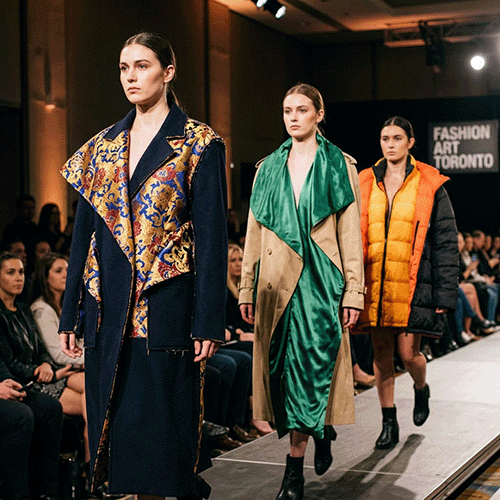 Trend One: The Exposed Lining Coat
Every third look at FAT featured a coat with the lining worn on the outside. Silk charmeuse, printed brocade, the occasional quilted polyester that I can only describe as "ambitious." The intended read: deconstruction as politics. The actual read: my dry cleaner's nightmare.
Takes a sip.
I understand the impulse. Toronto has a long and genuine tradition of treating structural inversion as a form of protest, and there is something theoretically arresting about a coat that wears its infrastructure on its face. The problem is that this particular idea has been done, redone, and thoroughly exhausted by everyone from Kawubo in 1981 to a certain Canadian collective whose name rhymes with despair. When Camera Nazionale della Moda Italiana convenes in June, no one — not a single buyer, not a single editor with a functioning frontal lobe — will be interested in seeing a coat whose inner workings are displayed like a patient etherised upon a table. Milan wants mystery. Milan wants a garment that takes three buttons to even begin to understand. This trend will not clear customs.
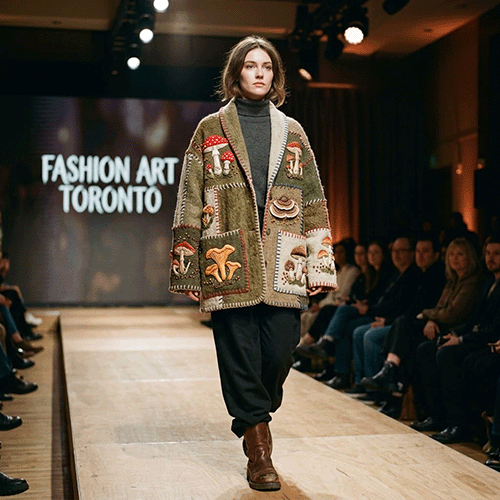 Trend Two: Craft Maximalism
I sat through four separate presentations in which designers used the phrase "the handmade." One of them said it twice, in the same sentence, while gesturing at a jacket covered in visible hand-stitching and what appeared to be embroidered fungi.
Darling. I know you made it with your hands. I can see that you made it with your hands. That is precisely the problem.
Taps her glass.
Milan does not want to see your hands. Milan wants to see what your hands cost. There is a difference — a crucial, €8,000 difference — between craft and craftsmanship, and it lives in the invisibility of the labor. The great Italian ateliers have spent a century perfecting the art of making the human hand disappear into the garment. When you display the stitching, you are not celebrating the maker; you are reminding the buyer that someone had to sit down to do this, which reminds them of work, which reminds them of a Tuesday, which is not where luxury wants to live. This trend will die at altitude, somewhere over Newfoundland.
Trend Three: Utility Dressing, Still, Apparently
Cargo pockets. Tactical silhouettes. Workwear references that someone has described, with complete sincerity, as "post-industrial pastoral." I watched a model walk a runway in what I can only describe as a vest with ambitions — straps, D-rings, the suggestion that she might at any moment need to rappel down the CN Tower for reasons of commerce.
I have nothing against function in principle. Function is an excellent quality in, for example, infrastructure, antibiotics, and lawyers. It is less compelling in a runway look. The only utility piece that Milan will countenance for S/S 2027 is an accessory with a hidden compartment for necessities — and by necessities, I mean what I mean, and I will not be elaborating. This trend will not survive the flight. It will not survive the gate.
Trend Four: Quiet Tailoring in Menswear — The One I Am Watching
Here is where I become, briefly, fair.
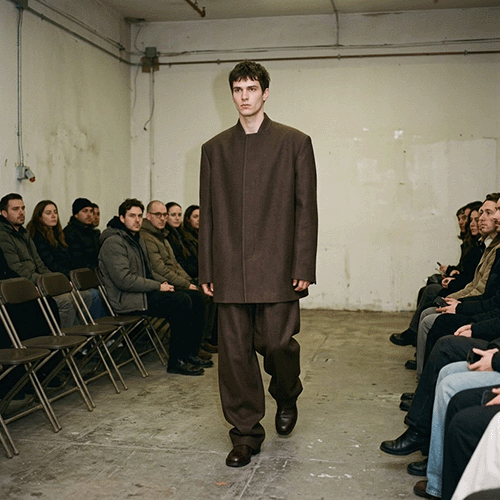 Among the wreckage, I saw something at FAT that functioned as a signal. A menswear presentation — spare room, folding chairs, no music except the ambient sound of people regretting their commute — showed a collection of oversized, column-cut suits in oatmeal, slate, and a particular shade of brown that I have not seen done correctly since Raf's last season at Dior and which I will call "bone intelligence." No hardware. No visible branding. Just the cut, and the weight of the cloth, and a jacket with a shoulder that knew exactly where it was going.
Sets down the glass. Picks it up again.
This is the thing that will survive. Not because Toronto invented it — they didn't, it's been building in the architecture of the better Italian houses for two seasons — but because they've proven that the appetite exists beyond the usual latitudes. When Milan Menswear S/S 2027 opens on June 19th, I will be there, I will be in a seat with my name on it and a press badge that no longer requires diplomatic caveats, and what I want to see from Camera Nazionale della Moda Italiana is this silhouette taken to its furthest possible conclusion. Not quiet luxury — I find that phrase economically confusing, as if wealth has any obligation to lower its voice — but architecture. Tailoring as a structural argument. The suit as a building you wear.
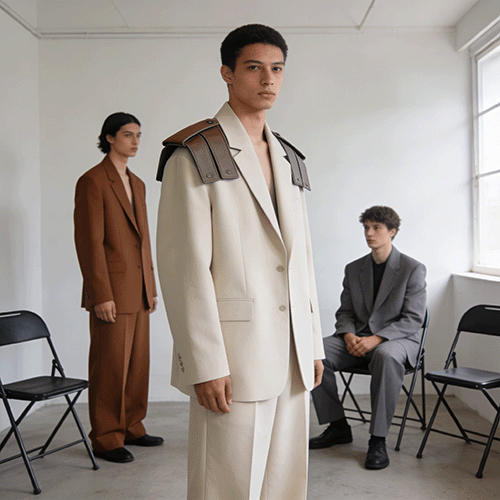 There is a certain person who used to wear his suits one size too small. This is not relevant. I simply note it for the record.
Trend Five: Ironic Logomania
No.
Long pause. Sip.
I was presented, on the penultimate day, with three separate collections that referenced logomania "ironically." Large, vintage-coded brand marks. Fake heritage insignia. One designer had constructed an entire parka around a logo she had invented for a fictional Italian house — the name translates, she told me, as "small house of significant sadness." I asked if she understood that this described most of Italian fashion. She thought I was complimenting her.
Here is my position, and it has not changed since I was in my mid-twenties, which was recently: there is no such thing as ironic logomania. There is logomania — done by people who built the logo over generations and charge accordingly — and there is everything else, which is cosplay. Milan will eat this alive. Milan will not even leave the bones. The Camera Nazionale will look at ironic logomania and feel the particular weariness of a civilization that invented the thing being parodied and would simply like everyone to stop.
Five days. My bags are already packed — all twelve of them — because I am a professional, and professionals do not scramble at departure. My lawyer has filed whatever was necessary. The June restriction, the incident, the photographs, the photographer, the prosecco: resolved, sealed, handled, done.
I am 29 years old. I have survived Fashion Art Toronto, the tundra winter masquerading as a spring, four "immersive spatial dialogues," and a hotel bar that ran out of Lillet Blanc on day three. I have filed this dispatch. I have done my job.
 Milan Menswear S/S 2027 opens June 19th. I will be there. I will have opinions. I will be wearing a coat whose lining remains, correctly, on the inside.
Whether Marco will be attending any of the same shows is not something I have looked into. I mention this only to confirm that I have not looked into it.
Finishes the drink. Signals for the check.
Kharla is the Fashion Director of IRREVERENT Magazine. She is currently in Toronto on the advice of counsel, departing June 18th. She is 29.