
BYLINE: Kharla | Fashion Director, IRREVERENT
A Dispatch from the Last Place I Expected to Be, Five Days Before I Return to the Only Place I'm Not Allowed.
I have been in Toronto for eleven days. This is, by any civilized metric, nine days too many. The prosecco at the hotel bar is technically drinkable, which tells you everything about Canada that the weather failed to communicate. I have attended seven runway presentations, four installations that were described to me as "immersive spatial dialogues," and one breakfast event where a collective from Montréal handed me a linen tote bag and called it a look.
Takes a long sip of whatever this is. Signals for another.
Fashion Art Toronto S/S 2026 has been, against all geographic probability, interesting. Not Milan interesting — not "the architecture of the human form reconsidered at €18,000 per jacket" interesting. More "charming regional airport with unexpectedly good signage" interesting. I mean this as the highest possible compliment I am prepared to give a city where someone sincerely asked me if my coat was "ethically sourced."
My coat was sourced from a Florentine atelier in 2019 by a man who later became professionally inconvenient. The ethics of that transaction remain contested. Moving on.
In five days, I return to Milan. My lawyer, who has earned every cent of his considerable fee and then some, confirmed last Tuesday that the June 18th restriction has been lifted, that the incident involving the prosecco and Signor Ferretti's photography equipment has been resolved to all relevant parties' satisfaction, and that Camera Nazionale della Moda Italiana has no formal objection to my attendance at Milan Menswear S/S 2027. I received this news with the composure of a 29-year-old woman who was never particularly worried.
I was not worried. I am 29. I have a lawyer. I have a coat.
But before I board that flight and leave Fashion Art Toronto to its earnest devices, there are five things I witnessed on these runways that I must formally document — not because they deserve preservation, but because fashion history requires a witness, and I am, as always, here.
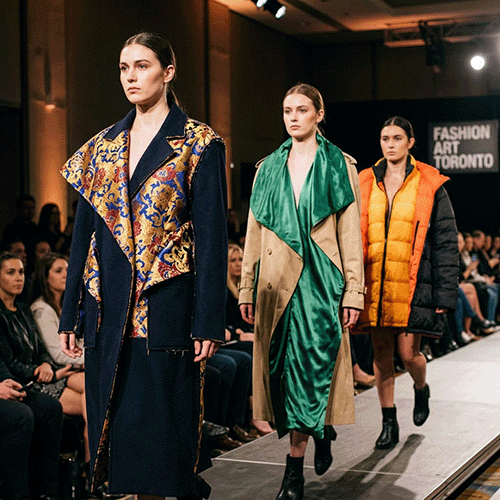 Trend One: The Exposed Lining Coat
Every third look at FAT featured a coat with the lining worn on the outside. Silk charmeuse, printed brocade, the occasional quilted polyester that I can only describe as "ambitious." The intended read: deconstruction as politics. The actual read: my dry cleaner's nightmare.
Takes a sip.
I understand the impulse. Toronto has a long and genuine tradition of treating structural inversion as a form of protest, and there is something theoretically arresting about a coat that wears its infrastructure on its face. The problem is that this particular idea has been done, redone, and thoroughly exhausted by everyone from Kawubo in 1981 to a certain Canadian collective whose name rhymes with despair. When Camera Nazionale della Moda Italiana convenes in June, no one — not a single buyer, not a single editor with a functioning frontal lobe — will be interested in seeing a coat whose inner workings are displayed like a patient etherised upon a table. Milan wants mystery. Milan wants a garment that takes three buttons to even begin to understand. This trend will not clear customs.
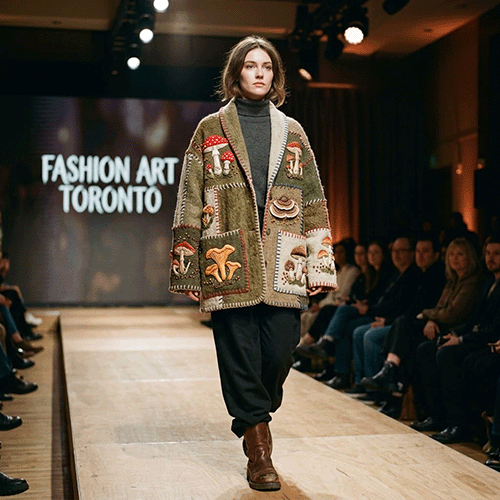 Trend Two: Craft Maximalism
I sat through four separate presentations in which designers used the phrase "the handmade." One of them said it twice, in the same sentence, while gesturing at a jacket covered in visible hand-stitching and what appeared to be embroidered fungi.
Darling. I know you made it with your hands. I can see that you made it with your hands. That is precisely the problem.
Taps her glass.
Milan does not want to see your hands. Milan wants to see what your hands cost. There is a difference — a crucial, €8,000 difference — between craft and craftsmanship, and it lives in the invisibility of the labor. The great Italian ateliers have spent a century perfecting the art of making the human hand disappear into the garment. When you display the stitching, you are not celebrating the maker; you are reminding the buyer that someone had to sit down to do this, which reminds them of work, which reminds them of a Tuesday, which is not where luxury wants to live. This trend will die at altitude, somewhere over Newfoundland.
Trend Three: Utility Dressing, Still, Apparently
Cargo pockets. Tactical silhouettes. Workwear references that someone has described, with complete sincerity, as "post-industrial pastoral." I watched a model walk a runway in what I can only describe as a vest with ambitions — straps, D-rings, the suggestion that she might at any moment need to rappel down the CN Tower for reasons of commerce.
I have nothing against function in principle. Function is an excellent quality in, for example, infrastructure, antibiotics, and lawyers. It is less compelling in a runway look. The only utility piece that Milan will countenance for S/S 2027 is an accessory with a hidden compartment for necessities — and by necessities, I mean what I mean, and I will not be elaborating. This trend will not survive the flight. It will not survive the gate.
Trend Four: Quiet Tailoring in Menswear — The One I Am Watching
Here is where I become, briefly, fair.
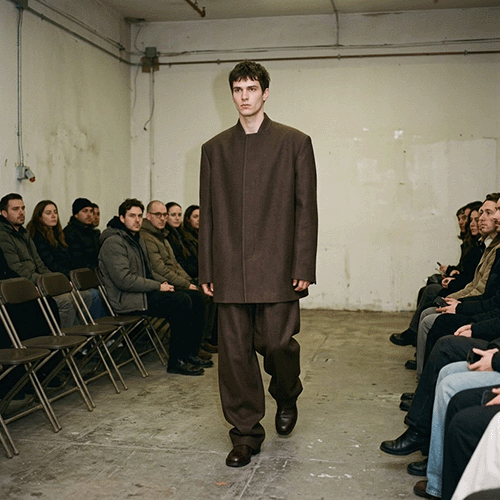 Among the wreckage, I saw something at FAT that functioned as a signal. A menswear presentation — spare room, folding chairs, no music except the ambient sound of people regretting their commute — showed a collection of oversized, column-cut suits in oatmeal, slate, and a particular shade of brown that I have not seen done correctly since Raf's last season at Dior and which I will call "bone intelligence." No hardware. No visible branding. Just the cut, and the weight of the cloth, and a jacket with a shoulder that knew exactly where it was going.
Sets down the glass. Picks it up again.
This is the thing that will survive. Not because Toronto invented it — they didn't, it's been building in the architecture of the better Italian houses for two seasons — but because they've proven that the appetite exists beyond the usual latitudes. When Milan Menswear S/S 2027 opens on June 19th, I will be there, I will be in a seat with my name on it and a press badge that no longer requires diplomatic caveats, and what I want to see from Camera Nazionale della Moda Italiana is this silhouette taken to its furthest possible conclusion. Not quiet luxury — I find that phrase economically confusing, as if wealth has any obligation to lower its voice — but architecture. Tailoring as a structural argument. The suit as a building you wear.
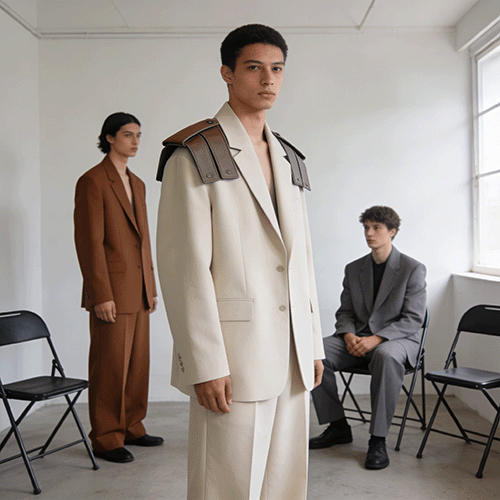 There is a certain person who used to wear his suits one size too small. This is not relevant. I simply note it for the record.
Trend Five: Ironic Logomania
No.
Long pause. Sip.
I was presented, on the penultimate day, with three separate collections that referenced logomania "ironically." Large, vintage-coded brand marks. Fake heritage insignia. One designer had constructed an entire parka around a logo she had invented for a fictional Italian house — the name translates, she told me, as "small house of significant sadness." I asked if she understood that this described most of Italian fashion. She thought I was complimenting her.
Here is my position, and it has not changed since I was in my mid-twenties, which was recently: there is no such thing as ironic logomania. There is logomania — done by people who built the logo over generations and charge accordingly — and there is everything else, which is cosplay. Milan will eat this alive. Milan will not even leave the bones. The Camera Nazionale will look at ironic logomania and feel the particular weariness of a civilization that invented the thing being parodied and would simply like everyone to stop.
Five days. My bags are already packed — all twelve of them — because I am a professional, and professionals do not scramble at departure. My lawyer has filed whatever was necessary. The June restriction, the incident, the photographs, the photographer, the prosecco: resolved, sealed, handled, done.
I am 29 years old. I have survived Fashion Art Toronto, the tundra winter masquerading as a spring, four "immersive spatial dialogues," and a hotel bar that ran out of Lillet Blanc on day three. I have filed this dispatch. I have done my job.
 Milan Menswear S/S 2027 opens June 19th. I will be there. I will have opinions. I will be wearing a coat whose lining remains, correctly, on the inside.
Whether Marco will be attending any of the same shows is not something I have looked into. I mention this only to confirm that I have not looked into it.
Finishes the drink. Signals for the check.
Kharla is the Fashion Director of IRREVERENT Magazine. She is currently in Toronto on the advice of counsel, departing June 18th. She is 29.