
- Details
Fashion Art Toronto, S/S 2026: the coats know where they are, the photographers behave themselves, and the prosecco is — fine, the prosecco is fine.
TORONTO — My lawyer's name is Geoffrey. He wears fleece. Not ironic fleece, not heritage fleece, not the Loro Piana cashmere fleece the Milanese aperitivo crowd has recently and ill-advisedly reclaimed — Geoffrey wears a navy Patagonia zip-up to professional consultations, which tells you everything you need to know about Geoffrey, about Geoffrey's quality of life, and about the particular circumstances that found me in the customs hall at Pearson International at seven in the morning, in last season's Valentino opera coat, drinking duty-free Veuve from the bottle in a manner one agent described as "not customary" and I maintain was the only sane response available to a reasonable woman.
I cannot discuss what transpired. Geoffrey has been very clear on this. What I can tell you is that it involved a photographer, a venue in Milan, a half-glass of prosecco that found itself in motion, and a sequence of events my publicist is characterizing as "a passionate misunderstanding rooted in artistic temperament." What Geoffrey is characterizing it as is "don't leave the country" — except I was already in Canada by the time Geoffrey finished the sentence, which is either excellent intuition or a misunderstanding about which direction "don't leave" applied to.
 The details are sub judice. The leather jacket — the one that is vintage Prada, that is absolutely Prada, that I will hear no further discussion about — came with me. One travels with one's trophies.
I am in Toronto for Fashion Art Toronto, officially described as "a multidisciplinary festival celebrating the convergence of art and fashion," and which I am less officially describing as the place Milan sends you when Milan needs a minute. The Canadians, to their credit, seem thrilled to have me. Several people at the press registration asked if they could photograph me, and I said yes, because in this country there are apparently consequences for photographers who do not move when asked, and I am newly committed to jurisdictions that enforce this.
The hotel room has a west-facing window, so the evening light came in sideways the way it does in Brera — briefly, brutally, on schedule. I looked at my phone. Marco had not texted. Marco never texts first. This is partly his personality and partly, I suspect, his understanding that if I wanted to be contacted I would have made contact easier. I have not made contact easier. I have made contact essentially impossible by being in a different country and telling only Geoffrey where I am. Marco is resourceful. Marco is not resourceful in Canadian.
This is fine. This is exactly as I intended. I poured the minibar Prosecco into the hotel glass — Toronto minibar Prosecco, a category of object — and went to find the fashion.
Fashion Art Toronto takes over several venues in the King West district, which is Toronto's attempt at the Marais — same general idea, better hardware stores, worse wine, more apologies. The main runway show was held in a converted factory building that was now an event space with exposed brick and that particular smell of ambition and structural instability you associate with everything interesting ever built by someone under forty with insufficient capitalization.
I arrived late, which is correct. I was seated in the third row, which is not. But the woman in my second-row seat was wearing a full-length puffer coat — indoors, in May — and I decided the universe was protecting me from something.
The show itself — Théodore Arsenault, Montréal, whose name I had not previously encountered but have since committed to memory — was, and I say this with the specific reluctance of a woman who did not come to Toronto to be impressed, who arrived in Toronto on the explicit understanding that she would not be impressed, who had structured her entire week around the assumption of disappointment: extraordinary.
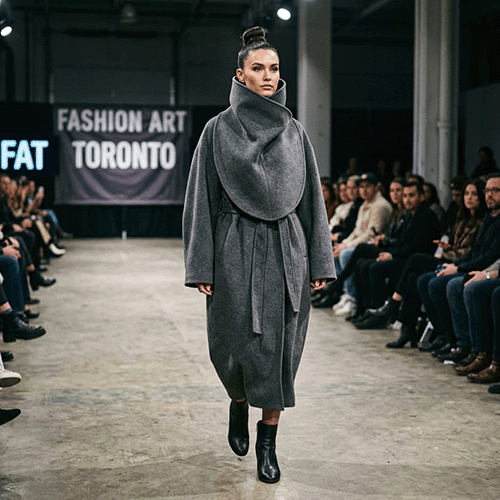
The collection was built around the Canadian wilderness as silhouette: elongated coats with the slow, gathered weight of something that has been living in a forest for a long time and seen things; asymmetrical hemlines that fell like waterlines; a palette of late-autumn grey and the specific green of a lake that has not yet been warm enough to swim in. I sat up slightly straighter in my third-row seat, which I would not have done for anything less than a Montréalais.
There was a coat. There is always a coat, in the collections that matter. This one was charcoal double-faced cashmere, with a collar that rose to the ears and fell to the collarbone in a single sweep of terrible, gorgeous impracticality, and I thought: I would never wear this in Milan. In Milan in June the heat is a physical oppression, and the Milanese do not wear things that suggest they might need protecting from the elements. The Milanese wear things that suggest they command the elements.
But here — here, with the grey sky through the factory skylights and the particular loneliness of a runway show in a country where I know almost no one and my lawyer has my passport — the coat made a kind of sense. A coat for a woman who is somewhere she did not choose to be. A coat for exile.
I bought it at the post-show presentation. I paid an amount that Geoffrey would characterize as "inconsistent with our current financial posture." Geoffrey can zip up his fleece.
The installation space was harder. Not difficult-art hard. Earnest-art hard — which is to say, sincere, and sincerity is the one allergen I have never developed an immunity to, which is why I avoid it as a general policy.
The piece was by a Toronto artist named Mira Leblanc, and it was a room filled with garments hung from ceiling-height wire, each one tagged with a handwritten note about who had worn it and when and why they'd let it go. A bridesmaid dress from 1994. A security guard's jacket. A wedding suit donated "because he died and it didn't seem right to keep it in the closet."
I walked through it slowly, which is not my standard pace. I was wearing, as it happens, the leather jacket. The possibly-Prada, definitely-not-Zara, absolutely-Prada leather jacket I found at a market near the canal in Milan — in the presence of Marco, who had just said that I looked exactly the same as when he'd last seen me, which is the nicest thing anyone has ever said to me and also, apparently, the thing I think about most when I am trying not to think about Milan.
A woman next to me — nice, Canadian, wearing what I will diplomatically describe as an aspirational parka — asked if I was all right.
I told her I was twenty-nine. She accepted this. Canadians accept things.
Outside the installation I took out my phone again. Still nothing from Marco. He has my number. He has always had my number. He has my address in Milan, the name of my preferred bar in Brera, and the general understanding that I am easier to find when I am not looking to be found. This is a system that has worked for us for — some years. A number of years I will not specify, because the number is not the point. The point is the system. The point is that he doesn't reach out, and I don't reach out, and we continue to exist in the same city, occasionally the same bar, occasionally on the same side of a conversation neither of us is willing to finish.
Except I am not in the same city anymore.
I put the phone away and went to the hotel bar to drink something cold, Canadian, and restorative.
The bar was called something involving "Junction" or "Collective" — one of those words Toronto uses to indicate a space is trying. The bartender was very good and very earnest and made me a gin gimlet with house-pressed lime that was, I will admit, nearly as good as the one I have been drinking for twenty years at a small bar near the Navigli. Almost. Different gin, different water, different latitude. A gimlet that knows it is not in Milan.
I drank it. I ordered another. I did not text Marco.
I want to be very clear about this: I looked at my phone, and I thought about the negroni bar in Brera, and the way he said I looked the same, and the way he went off to his "thing" — Marco always has a thing; the thing is never a therapist — and I did not text him. What I did instead was open my airline app.
Milan, June 19th. Fashion Week Global's Menswear S/S 2027 runs the 19th through the 23rd. The boys will be in their beautiful, soft, slightly undone tailoring; they will cry in their convertibles over whatever they are currently crying about; I will be there; Geoffrey will have sorted whatever Geoffrey needs to sort; the charcoal coat will come with me; the leather jacket will come with me; and everything will be as it should be.
Marco knows I'll be there. Marco knows this the way he knows everything about me, which is to say: by understanding that I always come back to the things that make me unreasonable, because the things that make me unreasonable are also the things that make me whatever I am.
That is not, strictly speaking, a fashion column. But then, neither is being in Toronto.
I'll be in Milan June 19th for Menswear S/S 2027. Geoffrey says I will not. Geoffrey says many things. Marco is not invited and also already knows.
Kisses, -K
Kharla is the Fashion Director of IRREVERENT Magazine. She remains, as ever, twenty-nine. Fashion Art Toronto is real. The vintage Prada leather jacket is also real, in the sense that she insists it is. IRREVERENT cannot verify the photographer's whereabouts, the airline app's June 19th confirmation, or whether Geoffrey owns any garment that is not fleece.
- Details
By Kharla | Fashion Director, IRREVERENT Magazine
MILAN — The thing about Milan in May is that the light does something to your cheekbones. Mine specifically. I noticed it the moment I stepped off the train at Centrale, rosé already open in my tote bag because I am a professional and professionals hydrate, and also because the TSA in Italy has given up, and a man — older, silver-haired, probably a count — actually stopped mid-stride to stare. This happens to me. It has always happened to me. It happened when I was modeling here in the late nineties (or possibly early oughts, the years blur the way only the truly glamorous years do), and it is happening now, at 29, which is either proof that Italian men have taste or proof that the light at Centrale is legally classified as a cosmetic procedure.
I was in Milan for Blazy's Resort show, and now for a small house show showcasing upcoming independent men's fashion, Spring/Summer 27. It was held on May 15 at a venue I will describe as “industrial chic meets abandoned Parmesan warehouse” because that is exactly what it was — there was still cheese. Independent men's house show? I know. But I was already here.
The press invite had been — let's say, loosely worded. But I have been walking past velvet ropes since before some of these designers were born, and the young man at the door with the clipboard was no match for my energy, my coat (vintage Balenciaga, or something very like it), or my conviction. I told him I was Kharla. He asked which publication. I said all of them, which is essentially true, and also technically a threat, and swept inside.
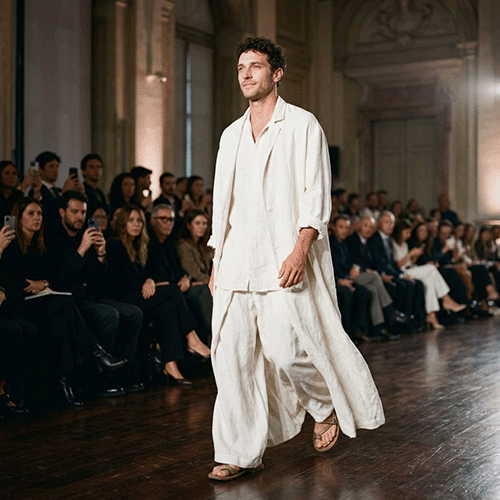 The show itself was genuinely interesting, if you appreciate the kind of menswear that says “I read theory but I also bench press.” There were oversized linen suiting pieces — a gorgeous pale sage set that I am almost certain was Bottega — actually, the program said it was a designer named Luca Di Toma, which I don’t recognize, but I do think he's that lovely boy who used to assist at Gucci and had the absolutely magnificent forearms. I am not above admitting when a man's arms have altered my perception of his entire career trajectory. The knitwear was exceptional. Someone was clearly referencing Margiela's early deconstructionism, though I overheard another journalist calling it “Post-Prada minimalism,” which is incorrect, and I told her so, at length, in Italian, badly, which is how I made my first enemy of the evening.
My second enemy was the photographer.
He was young, aggressively tattooed, holding a lens the size of a small child, which I assume he carries in lieu of a personality, and he was crouched — crouched, like an animal, or like a man who has never once paid for his own drinks — directly in my sightline to capture what I can only assume was a “street style moment” involving a woman in head-to-toe beige. I asked him, politely, to move. He said — and I am quoting verbatim — “I was here first.” I looked at him for a long moment. He had not been here first. I had been here first. I had been here first in 1997.
I want to be very clear: no one has been anywhere before me. Not in Milan. Not in fashion. I explained this. He said something about his Instagram following. I said something about my fifteen years on the Milan circuit that I will not repeat in a family-adjacent publication, but suffice it to say it involved a cardinal, a Vespa, and a level of scandal that required three separate publicists. He moved. The woman in beige looked rattled. I got my sightline back and finished my prosecco with the dignity of someone who has been doing this since before Instagram was a concept.
The show ended on a note that was genuinely moving — a closing look in raw white linen that floated down the runway like a man who has recently cried in a convertible and feels better for it, which is the most specific emotional state menswear has ever attempted to sell me. I understand this now. Milan does something to men. It opens them up. I have seen it firsthand, and not just from the runway.
Marco, for instance.
I met Marco — or re-met him, depending on how you count our first meeting, which he denies happened but cannot disprove — at a negroni bar in Brera approximately forty minutes after the show. He was sitting alone, which he does because he is brooding and also because his ex-wife has taken most of his friends in whatever it is Italians do instead of divorce proceedings. He is tall. He wears his sweaters the way men in sweaters should: with regret, and also with the quiet knowledge that they looked better on his father. We have a history that is not entirely his fault, though the part that is his fault is genuinely breathtaking in its audacity.
He said I looked exactly the same as when he’d last seen me.
I said I know.
We did not speak for another twenty minutes, but it was a companionable silence, the kind that only exists between two people who have both done terrible things in Tuscany, the kind you can only have with someone who has seen you at 29 across multiple years and understood that some ages are simply permanent, like Rome, or damage.
After Marco went wherever Marco goes (he mentioned a “thing,” he always has a “thing,” and the thing is never a therapist), I found the vintage market. It was tucked behind a side street near the canal, populated by dealers who know what they have and tourists who don’t. I found a leather jacket — perfect weight, perfect patina, buttery in a way that only genuine Italian craftsmanship or extremely committed synthetic aging achieves, or possibly actual butter, I did not lick it but I considered it. The inside label had been removed, which the dealer said was “common with older pieces.”
It is vintage Prada. I am certain of this. The cut speaks to a very specific mid-nineties Prada sensibility that Miuccia herself has described in interviews — which I have read, extensively, because I am thorough. That someone has mentioned the jacket appears to be a standard-issue Zara silhouette is frankly offensive and also, if true, the single greatest financial mistake of my life, and also not something I have verified and therefore cannot confirm. The label was removed. That is all I will say. The label was removed, and now it is mine, and it is Prada, and I wore it back to my hotel with a final prosecco from a corner café and the particular confidence of a woman who has spent the day exactly as a Fashion Director should: in motion, in control, impeccably sourced, and possibly wearing Zara, but we do not speak of this.
Milan, Spring/Summer 27: the men are soft, the suiting is sage, and the photographers should learn their place.
I'll be back in June for Fashion Week Global's independent Spring/Summer 2027. Marco knows. Marco denies knowing, but Marco knows. But next I'm in Toronto.
Kisses, -K
Kharla is the Fashion Director of IRREVERENT Magazine. She has survived Milan Fashion Week in every decade of her life, including the ones she refuses to acknowledge, and maintains that she is twenty‑nine. IRREVERENT cannot verify Marco’s version of events, the photographer’s whereabouts, or whether the jacket is Prada, Zara, or a moral failing.
- Details
The Bottega Bag That Knew Too Much
By Kharla (with a KH, ladies) | Fashion Director, IRREVERENT Magazine
⭐⭐⭐⭐ / 5
Four out of five. The missing star is Tomás's fault.
Matthieu Blazy sent his Resort 2026 collection down the runway in Milan with the quiet confidence of a man who has never once Googled himself and is therefore at peace. The silhouettes were restrained — purposefully, artfully restrained, the way a person is restrained who knows exactly how much money they are about to charge you. Fluid trousers in oatmeal and burnt sienna. Knit dresses that appeared simple until you got close enough to see that each one contained approximately three years of someone's life. The new neutrals this season are doing something I can only describe as emotionally grey, which is to say they are the color of an airport lounge in a country where you don't speak the language and you've just checked your last Diptyque candle as baggage and it almost certainly did not survive.
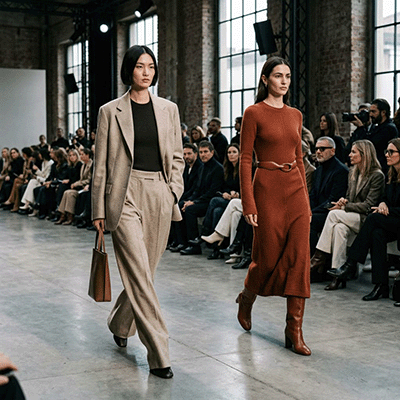 The leather goods — always the point, let's not pretend otherwise — arrived in the now-legendary intrecciato weave: the overlapping strips of buttery calfskin that have made Bottega Veneta simultaneously the most restrained and the most devastating brand in the Western world. The Resort 2026 Andiamo in *cotto*, a deep terracotta that is basically the color of Tuscany if Tuscany went to therapy, is a masterwork of proportion. Structured at the spine, forgiving at the body. A bag that holds its shape under pressure.
I know something about this. Specifically, I know something about this because I was in Cap Ferrat in March with a man named Tomás, who was an art dealer in the way that certain men are art dealers, which is to say he had expensive taste, excellent cheekbones, and a flexible relationship with provenance. He had a house on a cliff. He had two boats, one of which he claimed was "for the crew," and I have been around enough boats to know that this particular crew consisted entirely of bottles of Whispering Angel and a bluetooth speaker. We spent four days there. I wore linen. I looked extraordinary. On the third evening I knocked an entire glass of rosé directly into my Bottega Andiamo — the 2024, bordeaux colorway — and I watched the wine simply disappear into the weave, leaving no trace, like a secret kept beautifully.
I thought: this bag is better at handling things than I am.
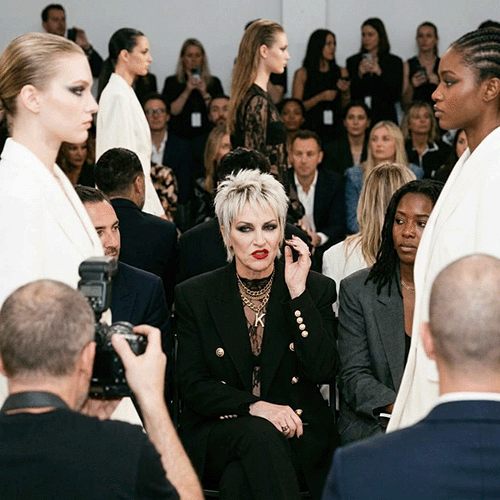 The Tomás situation resolved itself the way these things do, which is to say it didn't, and some weeks later I found myself at a dinner in Paris seated next to the Belgian — I won't name her, she knows who she is, she's been banned from two Chanel ateliers for what I can only describe as "creative differences with factual reality" — who had heard something, or claimed she had, and spent forty-five minutes asking about "that art person in the south of France" while systematically dismantling a soufflé. I was wearing borrowed Saint Laurent. There is a small cigarette burn on the left cuff now that was either the Belgian's doing or mine; I refuse to determine which.
The Saint Laurent has not been returned. This is its own situation.
But back to the bag, because here is where the actual fashion criticism lives, crouching like a nervous intern between the personal disclosures: the hardware this season deserves a specific mention. Blazy has reduced it nearly to nothing — the clasp is a small, almost tactile knob in oxidized silver, the kind of detail you only notice when someone is looking closely. It is the opposite of logomania. It says: I know what I have. I don't need to tell you. In an era when half the runway looks like a sponsored post and the other half looks like a sponsored post trying to look like it isn't a sponsored post, this restraint reads as a genuine act of courage. The Resort 2026 collection is not trying to go viral. It is trying to go to dinner, drink your wine, outlast your marriages, and still look incredible on the shelf in forty years. Fashion criticism begins and ends there. The Belgian would disagree. The Belgian once called a Proenza Schouler bag "accessible," and I have not spoken to her directly since.
I wore a different Bottega — the Intrecciato Cassette, slate, 2025 — to the only good dinner I had in Paris that month, which was also the night I realized I was never going to hear from Tomás about the painting we'd discussed, the small slash-canvas he'd said was practically mine, which was apparently his way of saying it was practically anyone's who asked first. I set the bag on the table the way you set something down when you need to look at an object and feel certain. It is structured but forgiving. It holds its shape. It has never once looked at me the way Tomás looked at the painting.
The Resort 2026 collection is a war crime of wanting things you cannot afford and a genius act of making you feel briefly that you can. I mean this as a compliment. Four stars out of five. The missing star is Tomás's fault.
Buy the bag. Don't buy the man.
Kisses, K.
Kharla is the Fashion Director of IRREVERENT Magazine. She has attended fashion weeks on five continents, been asked to leave runway shows on three of them, and maintains that she is twenty-nine. IRREVERENT Magazine neither confirms nor denies the existence of Tomás, the Belgian, or the painting.