
Our new culinary correspondent visits Brooklyn's most innovative tasting menu and has thoughts. Several of them unprintable.
By Julian Cross | Food & Dining | IRREVERENT Magazine
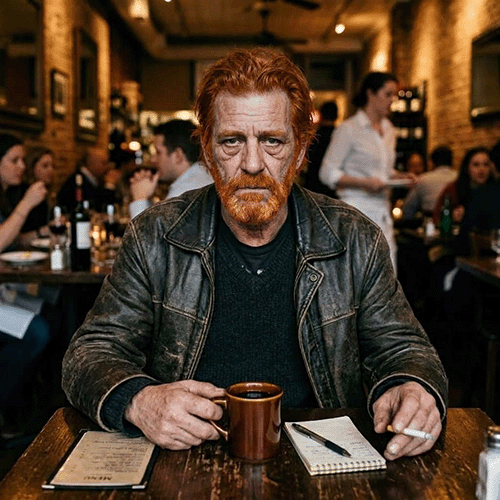 BROOKLYN, N.Y. — The restaurant is called PROMPT, which is either a statement of artistic intent or a cry for help, depending on how you feel about dinner costing more than your car payment. It occupies a converted warehouse on a street where, ten years ago, you could buy a burrito for four dollars and nobody would ask you to scan a QR code first. Those days are gone. In their place: exposed Edison bulbs, a hostess with the serene expression of someone who has already filed a trademark on her bone structure, and a small placard near the entrance that reads, "Your meal, curated by you. Interpreted by us. Imagined by AI."
I stood there for a moment. A long moment.
The concept, for those mercifully unaware: PROMPT is a twelve-course tasting menu at $295 per person where every dish is generated by a machine learning model trained on forty thousand Michelin-starred restaurant reviews. The model analyzes your social media presence — specifically Instagram — and builds a personalized tasting menu from the aesthetic data of your life. Your feed is your menu. Your curation is their cuisine.
My Instagram is black coffee. Knives. One accidental photograph of a cat that belongs to my neighbor Denise, which I have not deleted because I am not a monster.
I was seated at 7 p.m. My printed menu arrived on heavy stock in a custom sleeve. I read it with the specific stillness I usually reserve for news of a natural disaster.
The Menu
Course One: Deconstructed Espresso Foam.
I want you to read those three words again. I want you to sit with them.
The dish arrived as a white bowl containing what appeared to be the remnants of a dishwasher malfunction — a faint coffee-adjacent aroma rising from a structure that was, charitably, foam. Not crema. Not a shot. Not the thing that coffee is. A gesture toward coffee. The memory of coffee. Coffee as interpreted by something that has never had a bad morning and therefore cannot understand why the drink exists in the first place.
It tasted like a suggestion. I ate it. I noted it. I moved on, because I am a professional.
Course Three: Blade-Honed Yuzu Air.
"Air" is not a food. I want to be very clear about this. Air is what fills the space between food. Chefs began putting air on plates around 2004 and we, as a civilization, failed to stop them. This is our fault. We encouraged it. We called it innovative. We wrote think pieces.
The yuzu air arrived in a glass dome that the server lifted tableside with the gravity of someone unveiling the Pietà. Beneath it: nothing. Aromatic nothing. Citrus-scented absence.
I asked the server if the kitchen was aware that the dish had not arrived.
She explained, patiently, that the air itself was the dish.
I thanked her. I sat quietly for a moment that stretched in interesting ways.
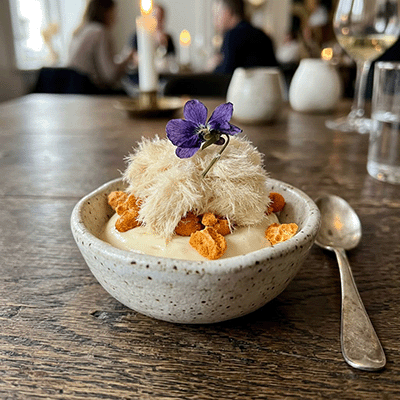 Course Seven: Whiskers in Cream.
This one is Denise's cat's fault. The AI found the photo — tabby, indifferent, perched on a radiator — and apparently processed it as a flavor profile. The result was a small ceramic dish containing cream, something freeze-dried and orange-hued, and what I can only describe as a texture that recalled fur without, legally, being fur. There was a single dried violet on top.
The menu card said: "An ode to warmth. To the domestic sublime. To things we hold."
I do not hold Denise's cat. Denise's cat does not consent to being held. The AI had generated a dish based on a cat I do not own and a relationship I do not have, and it tasted like a florist's refrigerator.
I made a note. The note said: "No."
The Exchange
Between courses nine and ten, Atlas came out.
Atlas is twenty-eight. He has good hair — the kind of hair that has never sweated through a double shift. He has not, to the best of my research, worked a line. He trained the model. He built the system. He is, in the vocabulary of our current moment, the founder.
He asked how I was enjoying my experience.
I told him the meal had been interesting.
He said: "We trained the model on forty thousand Michelin reviews."
I paused. The pause lasted approximately four seconds, which in restaurant conversation is equivalent to geological time.
"Did you train it on how to cook?"
Atlas smiled the smile of someone who has been asked this before and has a prepared answer. "That's not really the point," he said.
"I noticed," I said.
He explained the system — the neural architecture, the flavor embedding vectors, the Instagram scraping pipeline, the personalization engine. He used the word innovative four times. He used the word experience six. He did not use the words heat, salt, acid, fat, timing, or technique.
I listened. I drank water. I looked at the wall.
The problem with Atlas is not that he is stupid. He is clearly not stupid. The problem is that he is operating under the sincere belief that cooking is a data problem. That if you read enough about food, you will eventually understand food. That the distance between forty thousand Michelin reviews and a properly rested duck breast is a matter of processing power.
It is not a processing power problem. It is a heat problem. It is a patience problem. It is a 6 a.m. on a Tuesday problem, when the delivery is late and the prep cook called in sick and you have to break down forty pounds of fish before service because nobody else will.
The machine has never done that. The machine will never do that. The machine does not know what it doesn't know, which is, in my experience, the most dangerous kind of ignorance.
Lourdes
Course eleven was a single piece of chocolate.
Not deconstructed. Not aerated. Not conceptualized or embedded or curated. A single piece of properly tempered dark chocolate, snapped clean, with a gloss that told you the temperature had been controlled with care and the chocolate had been handled by someone who understood that this moment — the moment before a person bites — is a promise.
I asked who made it.
Lourdes, I was told. Fifty-two. The pastry station.
I sent my compliments.
Lourdes did not come out. Lourdes was, presumably, still working. This is what people who cook actually do.
The Observation
Here is what I will tell you, for free, before you spend $295 on an AI's guess at who you are based on your Instagram grid:
The machine didn't ruin dinner.
The machine was the excuse.
Somewhere in Brooklyn, a child with a MacBook is laundering mediocrity through math, and we are calling it innovation. We are calling it personalized. We are calling it the future of dining, because "the future" is what we say when we want to do something that couldn't survive contact with the past. The past knew what food was. The past had a grandmother. The past had a cast iron pan that weighed eleven pounds and cooked things until they were done.
Atlas trained his model on forty thousand professional opinions. He did not train it on the moment a sauce breaks and you have to decide, in real time, whether you can save it. He did not train it on the look a senior cook gives you when you plate something ugly. He did not train it on the physical memory — the kind that lives in your wrists, not your head — of knowing when something is right.
Twelve courses. One edible. Made by Lourdes, who has held a saucepan, which is more than I can say for the algorithm.
It's cold water, Atlas.
It's cold water all the way down.
Julian Cross helmed The Anvil in Chicago's West Loop from 2009 to 2014, earning two Michelin stars before departing to pursue other interests, which he declines to specify. He takes his coffee black and his knives very seriously. This is his first column for IRREVERENT Magazine.