
By Julian Cross | Food & Dining Correspondent
OUROBOROS: A Culinary Journey Through Grief — 47 Wythe Ave, Williamsburg, Brooklyn. $385/person. BYOB. No substitutions. No refunds. No dignity.
WILLIAMSBURG, BROOKLYN — The parking garage smells, correctly, like a parking garage. Oil stain topography on the floor. A single strand of Edison bulbs strung between what used to be a structural column and what is now, apparently, a dining concept. A man in a black turtleneck hands me a card that reads: You are about to begin a journey. Please silence your phone. Please open your heart. I silence my phone. I leave my heart where it is.
This is OUROBOROS. It is not, technically, a restaurant. It is an "immersive narrative-driven culinary experience interrogating the relationship between consumption and mourning," which is a sentence that someone typed with both hands and showed to a venture capitalist. The venture capitalist said yes. Thirty-two people are paying $385 apiece tonight. You do the math. I did. Several times. Each time, I got sadder.
 We are shown to our seats by a woman who introduces herself as Denial. She is twenty-four, possibly twenty-five, and performs grief the way someone performs grief after watching two documentaries about grief. She sets down a small card that tells us tonight we will be guided through the seven stages. The food, she explains, is integral to the emotional architecture of the experience. I ask if the food is integral to the eating portion of the experience. She pauses. She has not been briefed on this.
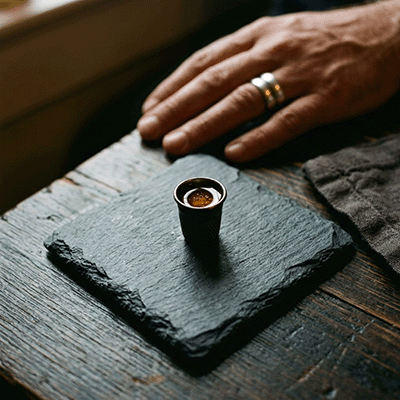
Course one arrives in the hands of a man named Anger. He places before me a thimble of smoked oil on a small square of slate. I look at it. He stares at me. Neither of us speaks. After approximately forty-five seconds, he takes the slate back. That was dinner. That was twelve dollars of dinner if you split the check across seven courses and don't think too hard about what a course is.
Course two is described on the card as Bargaining: A Reimagining of Salt. It is, and I want to be very precise here, a pinch of fleur de sel in a tiny ceramic vessel. I eat it. I am bargaining. I am bargaining that at some point a calorie will arrive at this table.
Somewhere between Bargaining and Depression, I flag down the Artistic Director. He is a man of approximately forty with the kind of facial hair that wants you to know he has thoughts about Chekhov that scholars have missed. He asks if I'm enjoying the journey. I tell him I've been on better journeys to the vending machine.
"We're interrogating," he says, "the relationship between consumption and mourning."
"I'm mourning dinner," I say.
He writes something in a small notebook. I hope it's a grocery list.
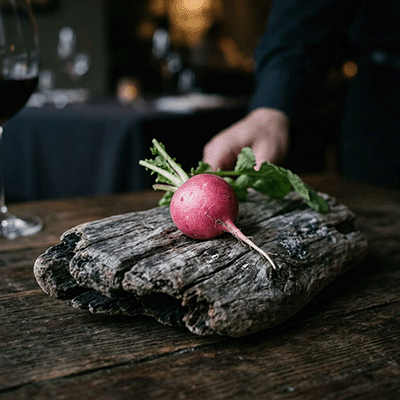 Course four is served by a man who is weeping. Not performatively, or not only performatively — there's real moisture there, and I respect the commitment even as I resent the circumstance. He places before me a single radish on a piece of driftwood. The radish is accompanied by no sauce, no garnish, no explanation. It sits on its driftwood like a small pink accusation.
I eat the radish.
Here is what I will say about the radish: it was a radish. A good radish, technically — firm, clean, with the right amount of peppery bite. It had been washed. I'll grant them that. Somewhere in this building, someone knows what they're doing with root vegetables, and that person is being profoundly underutilized by the grief theater happening in the dining room.
Course five is called Acceptance and is a small bowl of room-temperature broth. The broth is fine. The broth is trying.
Course six — and I have omitted it for reasons of self-preservation — involved something I will not discuss.
Course seven involves a violinist. She appears beside my chair without announcement and begins to play something that sounds like Arvo Pärt being processed through a feelings machine. She is standing close enough that I can smell her rosin. She does not leave. The broth goes cold. She is still playing when the next course arrives, which is a single lychee wrapped in what the card describes as Memory.
The actress playing the broth course is twenty-three years old and extraordinarily committed. She walks to my table during what I believe is the Grief Interlude and places before me a teaspoon — a literal teaspoon — of warm liquid. She leans in close. "This," she whispers, "was my mother's."
I look at the teaspoon. I look at the actress.
"Where is your mother?" I ask.
The actress blinks. This is not in the script.
"She's," she says, recalibrating, "in the kitchen."
I nod slowly. "Tell her I said hello," I say. "And that I said the broth could use acid."
She returns to character. I return to quietly computing the per-ounce cost of what I've consumed.
The check comes in an envelope sealed with wax. The wax is black. The envelope has been aged to look like it was recovered from a shipwreck. I open it. It says $385. I laughed for the first time all night.
I want to say something generous here, because I am not, despite extensive evidence to the contrary, a nihilist. The parking garage was, structurally, a parking garage. The Edison bulbs were evenly spaced. The radish was genuinely a radish. The actress playing the broth course had excellent posture and, I suspect, real potential in productions that involve chairs and food that has been cooked.
But here is what I kept thinking, through the weeping server and the violinist and the wax-sealed financial crime: somewhere in this building there is a line cook. He is twenty-two, maybe twenty-three. He came up in somebody's kitchen — a real kitchen, with fire and timing and the specific terror of a Saturday night in the weeds. He took a job plating microgreens with tweezers at eleven o'clock on a Friday because the pay was decent and the hours were reasonable and he didn't ask too many questions. And right now, while an actor in the dining room pretends to have complicated feelings about a beet, that line cook is washing a radish.
I want to meet that line cook. I want to buy him a beer — a real one, not a narrative-driven one. I want to sit across from him and ask, quietly, if he knows what we've done. If he understands that we took something he was trained to respect — technique, heat, timing, the basic covenant of feeding someone — and wrapped it in a one-man show about loss, charged the audience $385 for the privilege, and called it dining.
Because OUROBOROS is not a restaurant. It is a hostage video with a wine pairing. The food is the ransom note, and you are expected to leave satisfied.
The radish, though. The radish was clean.
Two stars out of five: one for the radish, one for the line cook I'll never meet.