
The hostess at Vessel wears all black and speaks in a register normally reserved for the reading of wills. She leads you through a corridor where the walls are raw concrete poured in deliberate, expensive imperfection, past a shelf holding a single ceramic vessel — the vessel, presumably, the restaurant's one honest gesture toward its own name — and into a dining room so aggressively atmospheric it feels like walking into someone's MFA thesis after it negotiated a liquor license.
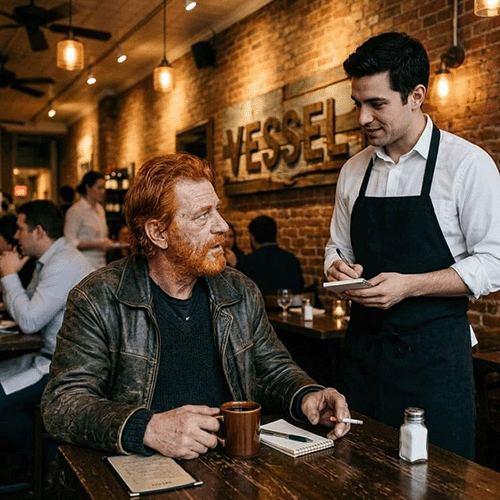 I sat down. A server materialized. He did not say hello. He said, "We'll be taking you on a journey this evening," with the gravity of a man announcing a terminal diagnosis. Not to me. To my next of kin.
I asked for black coffee.
He said they didn't have a coffee program yet but would be happy to bring me a chicory infusion.
I looked at him for a long moment. "It's cold water, Kevin," I said, into the middle distance.
He brought the chicory infusion. I did not drink it.
The chef is listed on every menu, every press release, every breathless food-media preview as "Rodrigo." Just the one name, like Cher, or a natural disaster. His biography reads: trained in Catalonia, two years under a legendary Basque master, a spiritual journey through coastal Portugal. The James Beard Foundation has him on their watch list. The food press has declared him, in their usual way, a revelation.
His name is Jud Simon. He grew up on the south side of Chicago, which I respect enormously, and is the son of a plumber from Bridgeport who, by all accounts, made an exceptional pierogi. I know this because I spent twenty minutes with a phone and a public business registration before I walked in the door.
I'm not saying the south side can't produce a great chef — the south side has produced men and women who would make the entire culinary establishment weep with shame. What I'm saying is that the invented accent — a slippery mid-Atlantic thing that veers toward Castilian when he visits tableside — is a performance tax the diner is being charged without consent. No itemized receipt.
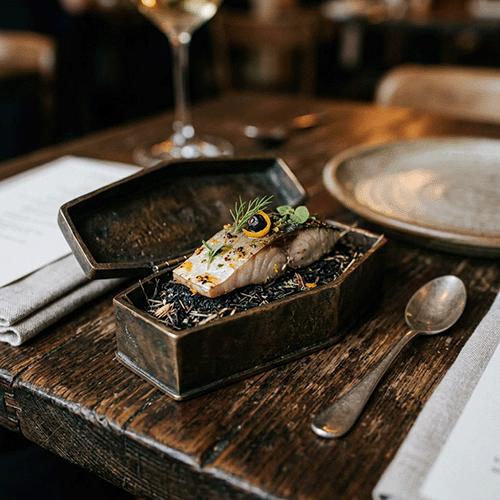 The amuse-bouche arrived in what I can only describe as a tiny bronze coffin. Inside: a single mackerel collar, cured in citrus and juniper, resting on a bed of charred hay ash. It was beautiful in the way a very expensive mistake is beautiful. It was also, undeniably, delicious — the mackerel silky and forward, the ash adding a low, woody smoke that had no business working as well as it did.
I made a note. I revised the note.
The meal escalated.
Course three was a Jerusalem artichoke prepared three ways — one roasted to a caramel density, one raw-shaved into translucent coins, one turned into something that the menu called a "soil memory," which was, on inspection, a dehydrated powder that dissolved on the tongue like the ghost of a vegetable. The server explained, at length, that Rodrigo's grandmother had a garden. Jud Simon's grandmother also had a garden. It was in Bridgeport. I ate the artichoke. The soil memory, absurd as it was, landed like a chord.
Course five arrived inside a smooth river stone — a hollow prop stone, cast resin, containing a single butter-poached langoustine draped over a smear of cauliflower cream with brown butter breadcrumbs and a single tarragon leaf positioned with the care of a man defusing a device.
This is where I must be honest with myself and with you: the langoustine was extraordinary. Supple, sweet, finished with a restraint that is, in this context, almost shocking. Whatever Jud Simon is doing with the theater, he knows exactly what he's doing with the protein. The technique is real. The flavors are earned. The vessel — the prop stone, the bronze coffin, the conceptual plating — is a costume draped over something that does not need a costume.
Which made it worse, somehow. A fraud with no talent is easy to dismiss. A talent hiding behind fraud is a grief.
I found out about Scott somewhere between course seven and course eight, which is, in my experience, the correct place to receive bad news — late enough that you've invested, early enough to still feel it.
I had stepped out to use the restroom. The corridor to the bathrooms runs past the manager's office, whose door was ajar, revealing a corkboard inside with a printed LLC filing half-pinned to it — Vessel Hospitality Partners LLC — and the names of the silent investors were not entirely illegible.
Meadow, S.
I stood there in the corridor with the ambient music bleeding through the walls — something Nordic and minor-key, naturally — and I thought about The Anvil.
 I thought about 2009. About the night Scott Meadow walked into a kitchen in River North where I was doing prep alone at two in the morning, building my menu from the floor up, and sat on an overturned milk crate and said, "Tell me what you need." He wrote the check the following week. Not a loan. A bet. He called it a bet. The Anvil ran for five years and closed on my own terms, which is more than most restaurants can say, and it happened because a man I trusted handed me a stake and asked for nothing in return except that I do the thing I said I was going to do.
I washed my hands. I went back to the table.
Course eight was a venison loin sliced thin as a secret, arranged over a smoked potato puree with pickled blackberry and a foam of something. The foam I cannot forgive; the foam is, has always been, an admission that you ran out of ideas and bought a siphon. Every siphon is a surrender. But the venison itself — the venison I could have eaten until I died. Properly hung, seasoned with the confidence of someone who has done this ten thousand times, cooked to a temperature I would have demanded in my own kitchen.
I ate all of it. I did not write anything in my notebook for a while.
Here is what I did not do: I did not call Scott. I did not compose, in my head, a review that would sand down the edges, that would praise the langoustine and the venison and quietly omit the prop stone and the false accent and the grandmother's garden monologue. I did not decide to torch the place either, to write the kind of piece that ends careers and gets read aloud gleefully at the tables of his competitors.
What I did was sit with it. The way you sit with any situation that doesn't resolve cleanly — not because you lack convictions, but because convictions, up close, in the specific rather than the abstract, are heavier than they look in theory.
Scott Meadow backed a young chef with a concept and a fake biography and a dining room designed to make people feel like they're in a museum of themselves. He has done this before. He backed me, and I was, I will say, considerably easier to defend.
The check arrived in a small ceramic bowl. There was no bill inside, just a folded piece of paper on which the total was handwritten in the manner of a personal note. A touch I would have found charming in 1997.
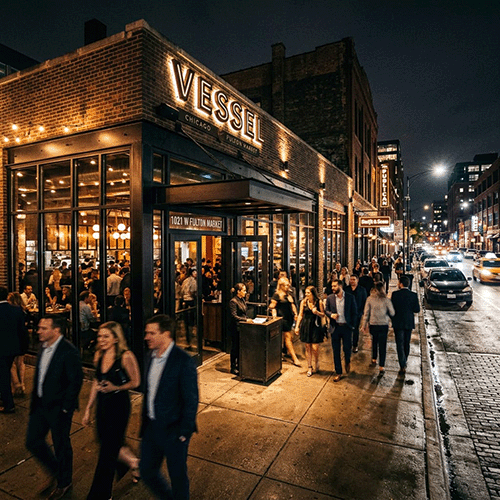
I walked out onto Fulton Market at ten-thirty on a Wednesday. The street still had the ambient roar of the industry district trying to remember what it used to be. I found a diner two blocks east and ordered black coffee — actual coffee, in an actual cup, from an actual pot that had been sitting on an actual burner long enough to qualify as a controlled substance.
I sat there until midnight.
Vessel is the best restaurant in Chicago right now that I wish I could dismiss. Jud Simon has real hands, real technique, and a real palate, all of which he has buried under a persona built from borrowed geography and a prop department. The meal is worth eating. The experience charges you for the pretending.
I have been asked, in the past, what separates a great chef from a good one. My answer has always been: the willingness to let the food be what it is.
Rodrigo, whoever he is, hasn't learned that yet.
Jud Simon might.
I left a cash tip and did not leave a note.
Julian Cross is a former two-Michelin-starred executive chef and Food & Dining Correspondent for IRREVERENT. He lives in Chicago and drinks his coffee black. No exceptions.