
The logo is wrong in a way that only I would notice. The anvil itself — my anvil, the one I had sketched on a paper napkin at two in the morning in 2009 and paid a designer in Wicker Park four hundred dollars to turn into something with actual gravity — is maybe fifteen percent larger than it should be, and the weight of it sits differently on the door glass. Whoever reproduced it was working from a photograph of a photograph. Close enough to pass. Not close enough to fool the man who made it.
 I stood on the sidewalk for a moment longer than was dignified.
Then I went inside.
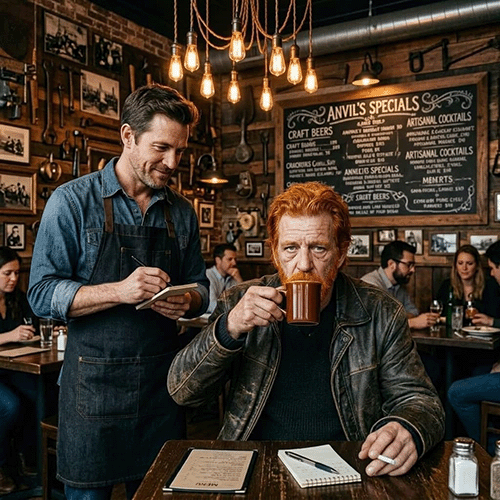
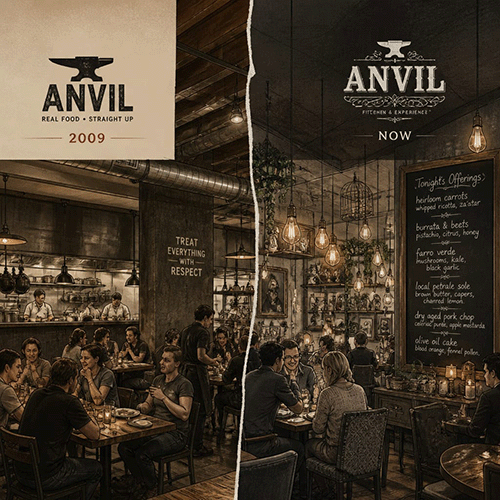
The interior has been redone. The original Anvil was stripped wood and blackened steel — deliberate, industrial, warm in the way a working kitchen is warm, which is to say functional rather than romantic. What occupies the space now looks like someone described my restaurant to an interior decorator over the phone and the decorator was not taking notes. The bones are recognizable. The skin is wrong. Edison bulbs where there should be clean floods. Exposed brick that was never meant to be decorative and now very much is. A chalkboard menu on the east wall I want to stop looking at because I can see, from across the room, in a handwriting that is not mine, a dish I invented in the winter of 2011.
The braised short rib with charred leek and bone broth reduction.
My braised short rib. My charred leek. My reduction, which took me four months to balance properly because the fat content of domestic short rib shifts meaningfully by season and you have to account for that or the whole thing breaks into grease and sentiment.
I sat down. A server came. Young, cheerful, the good kind of enthusiastic that you try not to extinguish in young people even when you are profoundly not in the mood for it.
I ordered the short rib. I ordered the bone marrow crostini. I ordered coffee, black.
He said they had a pour-over program.
I said that was fine.
He said it was a single-origin Ethiopian, fruity, natural process.
"It's cold water, Kevin," I said. Not to him. To the room.
He brought the coffee. It was actually quite good, which helped nothing.
The menu is mine. Not all of it — whoever built this place around those recipe cards filled in the gaps with the safe generic vocabulary of modern American bistro: burrata, some variety of flatbread, a beet salad dressed in a way that suggests the chef has heard the word "sumac" but has not yet decided what to do with it. But the load-bearing dishes, the architecture of the thing, the items that give the menu its identity and justify the price point — those are from a notebook I kept in a drawer in River North from 2008 to 2014. They went somewhere when I cleared out. Apparently, they went to a storage auction.
I had to make a phone call.
I want to be clear about the nature of the call: it was not a legal strategy session. It was not a coordinated response. It was two minutes in a single-stall bathroom off the main dining room, sitting on the closed lid of a toilet, calling a number I have called maybe twice in the last decade, and saying, when it picked up on the third ring, "They bought the recipes out of storage. I'm looking at the menu right now."
Scott Meadow, who backed the original Anvil in 2009 on what he called a bet and I called an act of faith, said nothing for a moment. Then he said, "What? Are you eating there?"
"I'm in the bathroom."
"Order the short rib."
"I already did."
"Call me back," he said.
I did not call him back. I washed my hands and went to the table.
 The short rib arrived in a bowl I would not have chosen — too wide, too shallow, the kind of vessel that lets the reduction spread thin before the fork even touches the meat. The presentation was earnest and almost correct: charred leek laid across the braise in the right orientation, bone broth pooled with the right color, a dusting of something that was meant to be the smoked salt I used to finish it but is running at perhaps sixty percent of the grain size and half the smoke level. Close. The way a photocopy is close.
The meat itself was competent. It had been braised long enough, rested correctly, pulled from the liquid at the right moment. Whoever cooked this — and I mean the actual person who stood over the pot and made the decisions — has a working knowledge of what they are doing. The braise had body. The leek had genuine char without bitterness. The reduction held the fat in suspension rather than breaking.
I ate it. I wrote nothing in my notebook for several minutes.
The bone marrow crostini was a lesser story. The bread — here is where the provenance becomes apparent, because the bread matters enormously and the bread is wrong. My crostini used a levain from a bakery in Logan Square that I had a standing arrangement with for eleven years, and that bread had a specific chew, a specific crumb structure, that gave the whole dish its resistance. What I was eating was a commercial sourdough, acceptable, not embarrassing, but the dish without that resistance is a different dish. It is a dish wearing my clothes. The marrow was fine. The gremolata was slightly underseasoned. The dish did not fail — it simply was not the thing it believed itself to be.
I want to say something about the chef, whose name I was given as Marcus, whose full name I am not printing here because he did not open a fake restaurant in bad faith — he opened a restaurant in inherited faith, which is a different crime, and arguably not a crime at all.
Someone found my notebooks. Someone sold my notebooks. Someone built a business model around the idea that a dead restaurant's intellectual property was fair salvage, and someone pitched that proposition to a young cook with enough technique to make it plausible and not enough biography to know what he was standing in. Marcus is not the grift. Marcus is what the grift looks like when it's working. He is cooking real food from someone else's real ideas and doing it without the years of failure that produced those ideas, which means he is cooking the answers without having sat the exam. He is very good at it.
When he came to my table — tableside visits, of course, because this is that kind of place now — he was warm and knowledgeable and named three techniques by their correct names without prompting. I asked him where the short rib recipe came from. He said he'd developed it over time, drawing on classical French braise methodology. He said it with the confidence of a man who invented it.
I thanked him and meant it.
The check came. I paid it without incident. I tipped well because the server had done nothing wrong and the kitchen, whatever its borrowed foundations, had fed me with genuine care.
Outside, the street was still doing what Chicago streets do in early summer — that particular warmth that pretends to be permanent and isn't, the smell of the lake two miles east like a rumor. I walked for a while before I hailed anything. I thought about the Anvil, the original one, the one that ran from 2009 to 2014 and closed because I chose to close it rather than watch it become something I didn't recognize. I thought about the fact that it apparently became something I didn't recognize anyway, just without my participation.
There is a version of this piece that is a takedown. The recipes, technically, belong to me — I have never disputed that, I simply did not pursue it when the restaurant closed because I was tired and because the law is a blunt instrument and I was not interested in spending years converting grief into paperwork. There is a version of this piece that ends with citations and consequences.
This is not that version.
The new Anvil is a restaurant built on salvage, cooking real food from someone else's hard-won years, in a room that doesn't quite remember what it's supposed to look like. The dishes that were mine are still good, because the ideas were always good, and good ideas survive whoever is holding them. The dishes that are new are uneven in the way that unsupported instinct is uneven — flashes of real ability interrupted by the confident choices of a man who does not yet know what he does not know.
It is worth eating. It is not worth forgiving.
I left a cash tip and did not leave a note.
Julian Cross is a former two-Michelin-starred executive chef and Food & Dining Correspondent for IRREVERENT. He lives in Chicago and drinks his coffee black. No exceptions.