
BYLINE: Jackie Esiskel
The story of D-Day has been told countless times by lesser filmmakers, but it took Anthony Maras—the visionary auteur behind Hotel Mumbai, a film that redefined the siege picture much as Tarkovsky redefined the tree—to understand that the true hero of Operation Overlord was not Eisenhower, nor the Allied soldiers, but the weather itself. And the man who read it.
I saw Pressure in a private screening room in L.A., mere hours before my flight to Tribeca, where I will be covering the festival circuit with the same rigor I brought to Cannes. (I predicted Mungiu's Palme d'Or win, as you know. The editor, in his wisdom, appended a note suggesting I had not. This is what we in the critical community call a difference of interpretive fact.)
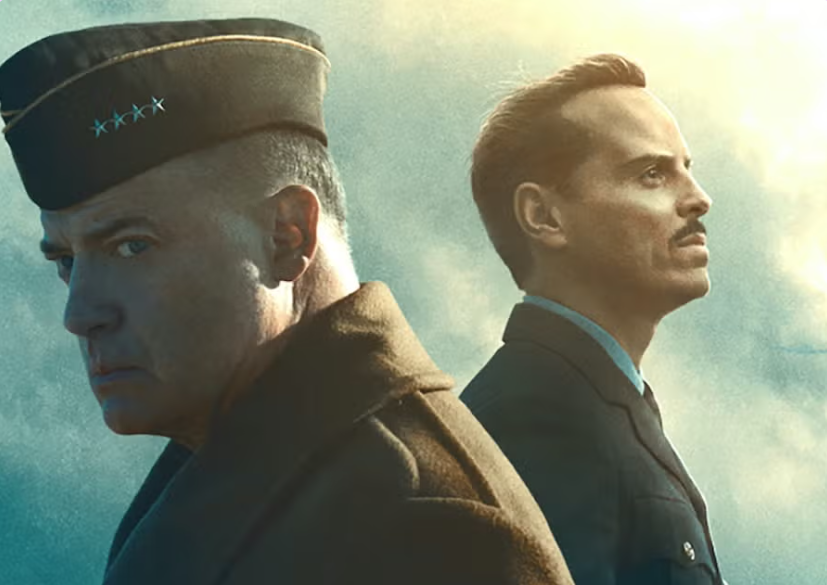 But I digress. The cinema house was nearly empty, which is always a promising sign for serious cinema. Andrew Scott, that brilliant Irish tragedian whom you may remember as the protagonist of The Talented Mr. Ripley—no, wait, that was Matt Damon, but Scott should have been, and spiritually was, in the same way that a man who has never been to Paris has spiritually stood beneath the Eiffel Tower—plays James Stagg, the Scottish meteorologist tasked with predicting whether a storm would scuttle the Normandy invasion. He is, in essence, a man staring at clouds while the fate of the Western world hangs in the balance. It is, if I may say so, precisely the kind of film I would have made had I not dedicated my life to the written word.
Stagg clashes with Irving Krick, played with American bravado by the always-dependable Chris Messina, who argues that the weather will clear. Stagg disagrees. They argue. Eisenhower, portrayed by Brendan Fraser—returning to dramatic form after his legendary turn as the titular ape in George of the Jungle—listens, paces, and demands answers that no man can give. This is the stuff of pure cinema: three men in a room, arguing about barometric pressure, while the entire French coastline holds its breath.
What Maras understands, and what the multiplex crowd will doubtless miss, is that the film is not about D-Day at all. It is about doubt. Stagg is a man of science in a room full of warriors, and science, as we know, is never welcome where courage is the preferred currency. When Stagg insists the storm will persist, he is not delivering a weather report; he is delivering a verdict on the human condition. We plan. The atmosphere laughs.
Kerry Condon appears as Kay Summersby, Eisenhower's secretary, and delivers the film's most devastating line: "Men are too fond of that word," she says, after someone calls Stagg a genius. It is a moment of such breathtaking clarity that I audibly gasped, causing the projectionist—a man in his sixties who smelled of microwave popcorn and institutional regret—to pause the film and ask if I required medical attention. I did not. I required only more cinema, and possibly a sedative.
Now, I will address the criticisms you have no doubt already read in lesser publications. Yes, the film repeats its central conflict. Yes, the D-Day landing sequence feels tacked on, a concession to audiences who require explosions to validate their ticket purchase. But to fault Pressure for repetition is to fault Bach for returning to the tonic. The cycle of meeting, argument, and stalemate is not a narrative flaw; it is a structural choice, a cinematic representation of the very weather patterns Stagg is trying to decode. Maras is not being repetitive. He is being meteorological.
Some will say the film belongs on television. To them I say: television is where cinema goes to die, sandwiched between pharmaceutical advertisements and reruns of sitcoms about families who actually talk to one another. Pressure is very much alive, pulsing with the low-pressure anxiety of a man who knows he is right and cannot make anyone believe him.
Will it win awards? Not the ones that matter. The Academy prefers its war films with more crying and fewer cloud formations. But in ten years, when film scholars—real ones, not the Twitter variety—look back at the cinema of 2026, they will not remember whatever Marvel contraption dominated the box office. They will remember Andrew Scott's face, lit by the glow of a weather map, as he tells Brendan Fraser's Eisenhower that the sky is not on their side.
And they will remember that Jackie Esiskel called it first.
 Editor's Note: Hey, Jackie. So Andrew Scott did not even appear in the 1999 film The Talented Mr. Ripley. Mr. Scott starred in the 2024 Netflix series Ripley, which is an entirely different production. Additionally, Mr. Esiskel continues to insist that he predicted Cristian Mungiu's Palme d'Or win. Our records indicate that he did not. We have also received confirmation from the cinema house in question that the projectionist did not pause the film during the screening; Mr. Esiskel was observed emitting a sharp, involuntary gasp followed by a request for "more cinema, and possibly a sedative." The projectionist obliged the first request only.
Editor's Second Note: Titular Ape was the name of my grunge band in college.