
WASHINGTON, D.C. — The Supreme Court of the United States issued a landmark opinion Thursday in Louisiana v. Callais, effectively resolving a long-running constitutional question by ruling that politicians may, in fact, choose their voters.
What the Court did not resolve — and what has since occupied the nation's lower courts, state legislatures, and at least one confused bowling league in Ohio — is what else, precisely, has been gerrymandered.
The majority opinion, authored by Chief Justice Roberts, held that Section 2 of the Voting Rights Act had been "interpreted beyond its textual limits" and that states were free to draw electoral districts using whatever criteria they found aesthetically pleasing, mathematically convenient, or — in the case of Texas — "shaped like a thing we saw once at the state fair."
Justice Sotomayor, in dissent, noted that the majority had effectively reduced the right to vote to a "hobby-adjacent activity," a phrase that has since been adopted by three state election boards and one adult education catalog in suburban Atlanta.
Justice Alito, concurring, wrote separately to emphasize that the Court's ruling left untouched what he called "the full spectrum of non-electoral recreational pursuits available to the American citizen." His concurrence included a non-exhaustive list: pottery, birdwatching, the recorder, stamp collecting, and — in a footnote that has already been cited in four federal district court opinions — "simply looking at a tree."
WHAT REMAINS COMPETITIVE
The Court's ruling has created what legal scholars are calling a "competition gap" — a constitutional asymmetry in which some competitive activities remain protected while others do not.
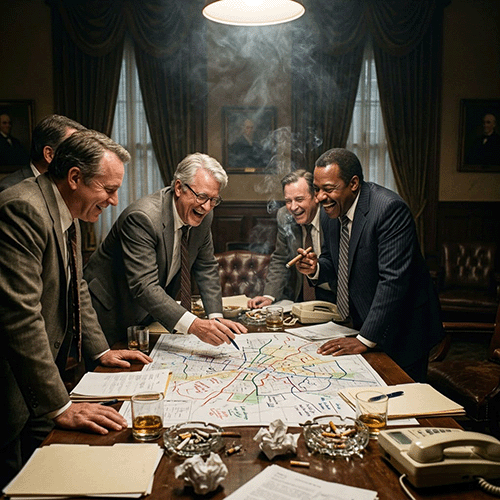 Competitive elections, the Court held, are not constitutionally guaranteed. Competitive spelling bees, however, remain unaffected. The National Spelling Bee, reached for comment, confirmed that its district qualifying rounds would proceed under existing rules, which require contestants to spell words correctly without regard to partisan affiliation.
"We have never gerrymandered a spelling bee district," said a spokesperson. "The word is either spelled correctly or it isn't. We don't care if you're from a swing county."
County fairs, similarly, remain competitive. The Iowa State Fair's pie-judging criteria — crust, filling, structural integrity — have not been challenged under the Equal Protection Clause, and the Court's ruling does not appear to implicate them. The same is true of fantasy football leagues, hot-dog-eating contests, and the Westminster Dog Show, all of which continue to operate on merit-based systems that would be unconstitutional if applied to congressional representation.
"The Constitution protects your right to lose a chili cook-off fair and square," said one constitutional law professor. "It no longer protects your right to lose an election fair and square. The distinction is technical but, for chili enthusiasts, significant."
WHAT HAS BEEN AFFECTED
The ripple effects of Callais have extended well beyond electoral maps. In the weeks since the ruling, gerrymandering has been discovered — or, in some cases, formally acknowledged — in a range of previously non-partisan domains.
School Districts: The Austin Independent School District redrew its attendance boundaries in April, producing a map that one parent described as "a salamander wearing a hat." The district defended the map as "responsive to demographic realities," though demographers noted that the "realities" in question appeared to be concentrated in neighborhoods with above-average property values and below-average minority enrollment. The map was approved 4-3 by the school board, whose members had been elected under a previous map that one justice of the Texas Supreme Court described as "a different salamander, but friendlier."
Pizza Delivery Zones: Domino's Pizza quietly adjusted its delivery boundaries in three states following the ruling, producing zones that one driver described as "mathematically impossible but politically motivated." A store in suburban Milwaukee now delivers to a corridor six blocks wide and two miles long, bypassing an apartment complex with 400 registered Democrats to reach a cul-de-sac with four houses and a shared subscription to a conservative podcast. The company denied partisan intent, stating only that "the algorithm optimizes for cheese temperature."
HOA Boundaries: The Willow Creek Homeowners Association in Raleigh, North Carolina, voted Tuesday to redraw its neighborhood boundaries, excluding a cul-de-sac whose residents had opposed a proposed fence color. The new map, shaped like a thumb, places the dissenting households in an adjacent HOA with higher dues and a mandatory composting requirement. "This is not retaliation," said the board president. "This is responsive governance. The Supreme Court said so."
Dating App Radiuses: Tinder adjusted its default search radius in four states following the ruling, producing match pools that one user described as "geographically incoherent but ideologically consistent." A user in Columbus, Ohio, reported being shown profiles from a suburb 40 miles away while profiles from a neighborhood three blocks away were excluded. Tinder denied partisan intent, stating that "our algorithm optimizes for connection, which is a vibe, not a coordinate."
THE COURT'S UNSTATED FRAMEWORK
Legal scholars have attempted to reverse-engineer the Court's implicit framework for what may and may not be gerrymandered. The emerging consensus suggests a three-part test:
- Does the activity involve voting? If yes, gerrymandering is permitted.
- Does the activity involve food? If yes, gerrymandering is discouraged but not prohibited.
- Does the activity involve trees? If yes, Justice Alito has questions.
The test has not been formally adopted by any court, but it has been cited in two law review articles and one letter to the editor of Golf Digest.
WHAT COMES NEXT
The Court's ruling has left a vacuum that state legislatures are rushing to fill. Missouri has already approved a congressional map that shifts the state's delegation from 6-2 Republican to 7-1 Republican, a change that one Democratic strategist described as "mathematically impressive if you ignore the existence of voters." Texas has finalized a map that could add five Republican seats, producing districts that one federal judge described as "aggressively non-compact" before being overruled.
The Court's message, in essence, is that voters are free to pursue their hobbies. They are not, however, guaranteed that their hobbies will include competitive elections.
Justice Alito's concurrence ended with a note of optimism. "The American citizen," he wrote, "retains the right to look at a tree. And if that tree happens to be located in a district whose boundaries were drawn by a partisan legislature, the citizen may look at it with the full confidence that the Constitution protects his gaze, if not his vote."
The tree, reached for comment, declined.